Here’s a situation a lot of marketing teams are sitting in right now. The budget got approved. The channels are familiar. And the plan looks roughly the same as it did last year. Google gets the biggest chunk, Meta gets a solid share, maybe some YouTube thrown in, and everyone moves forward assuming the numbers will hold up.
Except they’re not holding up the way they used to.
CPCs are climbing. Meta audiences are fragmenting. Eighteen months ago, the channels pulling focus today weren’t even a blip on our radar. Now, they are the main event. If you’re still leaning on a media plan that felt solid in 2023, you’ve likely noticed the numbers starting to slip. It’s frustrating because there isn’t always a glaring red flag, just a slow, quiet decline in performance.
The truth? It’s not that your ads got worse; it’s that the way Indians shop and browse has completely evolved. If your strategy is still running on the old playbook, you’re basically shouting into an empty room while your audience has already moved on to the next house.
What Is Media Planning, and Why Does It Matter More Now?
Media planning is the process of deciding where, when, and how a brand’s advertising budget gets spent across channels to reach the right audience and drive the right outcomes.
That definition hasn’t changed. What has changed is how complicated the answer to “where” has become.
A few years back, a media plan for most Indian brands came down to a fairly predictable mix. Google Search for intent-driven traffic, Meta for awareness and retargeting, maybe some programmatic display or YouTube for scale. The media planning process was involved, but the channel landscape was manageable.
In 2026, that same brand now has to factor in Performance Max campaigns, AI Max, Demand Gen on YouTube and Discover, the rise of connected TV, AI-native discovery platforms, and the reality that a growing chunk of research and purchase decisions are being influenced by tools like ChatGPT and Gemini before a user ever sees a single ad.
Media planning and buying in this environment isn’t just about distributing a budget. It’s about understanding a much more complex decision-making journey and building a media strategy that meets buyers where they actually are today.
The Indian Digital Landscape in 2026: What’s Actually Shifted
Before we talk about where the money goes, we have to look at how the ground has shifted under our feet here in India.
- From Mobile-First to Mobile-Only: For a huge chunk of your audience, the desktop doesn’t exist. They research, compare, and pull the trigger on purchases entirely on their phones. This isn’t just a technical detail; it changes every creative choice and landing page requirement you have.
- The Tier 2 & 3 Power Surge: Growth is no longer just a metro story. Purchasing power in smaller cities has exploded, but these users don’t behave like people in Mumbai or Bangalore. The content they trust and the platforms they haunt require a totally different targeting mindset.
- AI as a Daily Assistant: Urban India is moving fast toward AI-assisted search. We’re seeing a massive shift in behavior. Instead of endlessly scrolling through Google links, people are just asking ChatGPT to compare products for them. Sure, traditional search isn’t dead yet, but AI has added a messy, complex layer to the buyer’s journey that simply didn’t exist two years ago.
- Attention is a moving target. Between quick-hit videos, OTT marathons, and constant messaging, a consumer’s focus is split a thousand different ways. If your media plan is still obsessed with just one or two big platforms, you are almost certainly missing half your potential customers, and you probably don’t even realize it yet.
How to Think About Budget Splits in 2026
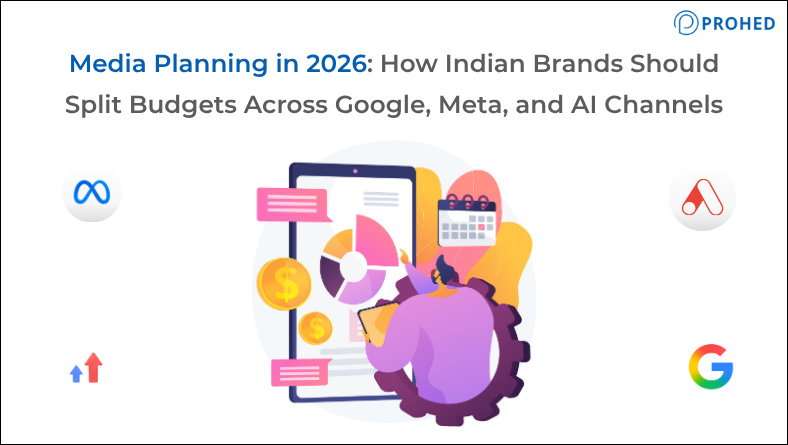
Let’s be honest: there is no “magic number.” Anyone promising a universal formula is oversimplifying a very complex problem. Your budget has to follow your specific data. However, if you need a baseline to start testing, here is how we’re seeing high-performance Indian brands structure their spend:
|
Channel |
Suggested Split |
The Strategic Role |
|
Google Search + AI Max |
30 – 40% |
Capturing intent when they’re ready to buy |
|
Meta (FB + Instagram) |
25 – 35% |
Building the “vibe” and staying top-of-mind |
|
YouTube / Demand Gen |
10 – 15% |
Creating that initial “I need this” spark |
|
Performance Max |
10 – 15% |
Letting the algorithms find scale across the web |
|
AI Discovery (GEO) |
5 – 10% |
Seeding your brand in AI conversations |
|
Testing Budget |
5% |
The “What If?” money for new formats |
These ranges shift significantly based on industry. An e-commerce brand with strong product feeds might weight Google and PMax higher. A B2B brand with a longer consideration cycle might invest more in LinkedIn and content. A D2C brand targeting younger urban audiences might weight Meta and YouTube more heavily.
The point isn’t to follow the table exactly. The point is to build a media plan with genuine intent behind each allocation, not just carry forward last year’s numbers out of habit.
Google in 2026: More Complexity, Still Essential
Google remains the foundation of most performance-driven media strategies in India. But how it’s being used has changed quite a bit.
Standard Search campaigns are still valuable for high-intent, bottom-of-funnel traffic. But AI Max and the continued evolution of Performance Max mean that media planning on Google now requires a more structured approach than setting up keyword campaigns and keeping an eye on spend.
AI Max deserves a dedicated allocation in any 2026 media plan. It captures search demand that traditional keyword targeting misses entirely. And with the DSA migration deadline arriving in September 2026, brands that haven’t tested it are running out of time to do so on their own terms.
The key principle on Google right now is data quality. The platform’s AI-driven campaigns perform in direct proportion to the quality of signals fed into them. Conversion tracking, audience lists, product feeds, negative keyword architecture, these aren’t one-time setup tasks. They’re ongoing inputs that determine how well the algorithm actually allocates budget on your behalf.
Meta in 2026: Still Powerful, But Needs a Smarter Approach
Let’s be clear: Meta is still a powerhouse for Indian brands, especially when you need to build a “vibe” or nurture a lead. But the days of easy wins are over.
Between skyrocketing CPMs and a much more cynical, sharper audience, you can’t just “boost a post” with some basic interest targeting and expect the sales to roll in. The platform has changed, the competition is fiercer, and the old-school ways of running Meta ads just don’t move the needle anymore.
The brands getting strong results from Meta right now are the ones investing seriously in creative quality. Short-form video performs significantly better than static across most categories. UGC-style content consistently outperforms polished production. Creative fatigue also sets in faster than before, which means the media planning process has to account for regular creative refreshes as a proper budget line item, not an afterthought that gets squeezed.
Advantage+ campaigns have also changed how media planning and buying works on Meta. The platform’s AI-driven targeting has improved to the point where broad targeting with strong creative often outperforms tightly defined audience segments. That’s a real shift from how Meta campaigns were built even two years ago.
Also Read: Top 5 Media Planning Agencies in Gurgaon for Real Estate Developers (2026)
The AI Channel Question: How Much Budget Goes Here?
This is the part of the media plan most Indian brands haven’t figured out yet. Which, honestly, is an opportunity.
AI-driven discovery through tools like ChatGPT, Gemini, and Perplexity is increasingly influencing how people research products and shortlist options, particularly in urban markets. A brand that shows up in an AI-generated recommendation has a very different kind of visibility than one appearing in a paid ad slot.
Allocating budget toward AI channel visibility isn’t as straightforward as buying a placement. It involves content strategy, digital PR, structured data, and LLM seeding, making sure the brand’s information is present in the sources these tools learn from and reference when generating answers.
Five to ten percent of a media budget dedicated to this area might feel small. But given how early the space is, the brands building presence now are creating an advantage that will be significantly harder to replicate in two or three years’ time.
Not sure how your current media budget is actually performing across channels? A lot of Indian brands are spending on habit rather than strategy right now. A proper media planning audit can show exactly where budget is working, where it’s leaking, and how to reallocate for better returns in 2026
Book a free media strategy session with PROHED Today
How Prohed Approaches Media Planning
The team at Prohed has been building and managing media plans for Indian brands across e-commerce, real estate, education, B2B, and D2C for years. And the honest observation from that experience is this: the brands that grow consistently aren’t always the ones with the biggest budgets. They’re the ones with the clearest media strategy and the discipline to follow data rather than assumptions.
Prohed’s media planning services are built around that principle. Every channel allocation is justified by audience behaviour and business objectives, not industry templates. Every campaign is tracked against outcomes that actually matter to the business, not just the numbers that look good in a report.
Beyond media planning and buying, Prohed handles Google Ads, Meta Ads, LinkedIn, SEO, content strategy, and conversion rate optimisation. Because a media plan that drives traffic to a weak landing page or a poorly converting funnel is still a plan that underdelivers. The whole system needs to work together, not just the ad spend part.
The Bottom Line
Planning media in 2026 is objectively harder than it was a few years back. There are more channels to manage, more AI variables to track, and a lot more noise to cut through. But “harder” doesn’t mean it’s impossible, it just means the quality of your thinking has to be better.
The brands that are actually winning right now aren’t always the ones with the biggest war chests. They’re the ones who truly understand their customer’s journey, build a strategy that respects that journey, and stay humble enough to let the data tell them when it’s time to pivot.
Prohed is a results-focused Performance Marketing Agency in India, helping brands build media strategies that perform across every channel, paid, organic, and AI-driven. Get in touch for a free consultation and let’s look at what your current media plan is actually delivering.
Frequently Asked Questions
1. What is media planning and why is it a big deal for Indian brands now?
Think of media planning as the roadmap for your money. It’s the “where, when, and how” of your ad spend. In 2026, the Indian digital space is so crowded and fragmented that guessing is no longer an option. One wrong turn with your budget is an expensive mistake; a right turn creates a growth engine that builds on itself.
2. How should I actually split my budget between Google and Meta?
A solid baseline for most is roughly 30-40% for Google (Search + AI Max) and 25-35% for Meta. Throw in 10-15% for YouTube/Demand Gen, and save the rest for PMax and emerging AI channels. But remember: this is a starting point. Your industry and your actual conversion data should always have the final say.
3. What does a real media planning process look like?
It isn’t a “set it and forget it” document. It starts with deep audience research and clear goals, moves into choosing the right channels, and then enters a constant loop of launch, track, and optimize. If your plan doesn’t change as the data comes in, it’s not a plan, it’s just a wish.
4. Is it too early for Indian brands to spend on AI channels?
Definitely not. Even a small 5% allocation can give you a massive head start. AI discovery is already changing how urban Indians shortlist products. If you start seeding your brand in these AI models now, you’ll have an advantage that will be incredibly expensive for your competitors to buy their way into later.
Schedule a Free Strategy Call with PROHED Today