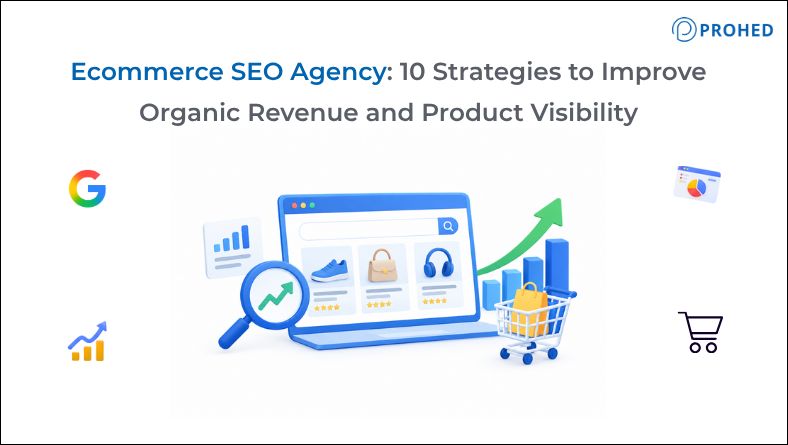
An ecommerce SEO agency specialises in improving the organic search visibility of online stores, helping product and category pages rank higher in Google to drive consistent, non-paid revenue. It differs from general SEO because it requires understanding catalogue structures, category architecture, product schema, and how to balance content with commercial intent. At PROHED, a performance marketing agency in Gurgaon with dedicated ecommerce SEO services, we’ve helped brands from D2C gifting to subscription commerce grow organic traffic significantly without depending entirely on paid acquisition.
Every founder eventually gets tired of the version of growth where every rupee of revenue needs a rupee of ad spend behind it. Paid media works, but it’s expensive and dependent on a budget that never stops running. The moment spending drops, so does traffic.
Organic search behaves differently. A category page that ranks well in September still ranks in March, and a product guide that earns backlinks keeps compounding in authority over time. Growth is slower but durable, and brands that understand this early build a structural advantage over the ones permanently tied to ad platforms they can’t control.
Here are the 10 strategies an experienced ecommerce SEO company uses to move the needle.
1. Fix the Foundation: Technical SEO
Before keywords or content, technical SEO decides whether Google can crawl, index, and rank your pages at all. Large catalogues create specific challenges: duplicate content from filter URLs, thin product pages, slow mobile load times, broken internal links, and missing sitemaps.
| Issue | Effect | Fix |
|---|---|---|
| Duplicate filter URLs | Competing pages for the same product | Canonical tags, parameter handling in GSC |
| Thin product pages | Weak ranking signals | Expand descriptions, add reviews and specs |
| Slow mobile speed | Higher bounce, lower rankings | Image compression, lazy loading, CDN |
| Broken internal links | Wasted crawl budget | Regular audits with Screaming Frog |
| Missing sitemap | Pages left unindexed | Submit a clean sitemap to GSC |
Google has confirmed Core Web Vitals as a ranking signal, and since most ecommerce traffic is mobile, a poor LCP or CLS score hurts both rankings and conversion rate. Both can be checked for free in Search Console.
2. Build Category Pages That Actually Rank
Category pages usually carry the highest SEO value on a site. They capture broad commercial intent and earn most of the backlinks, yet most brands populate them with products and move on.
A category page built to rank needs a unique H1 with the primary keyword, 150 to 300 words of original content above the fold, internal links to subcategories, FAQ schema for common buyer questions, and filter navigation that avoids duplicate content. That copy doesn’t need length; it needs to explain what the category covers and what makes the selection different.
3. Optimise Product Pages for Search and Conversion
Product pages sit at the bottom of the funnel, where buyers are close to deciding, so ranking here means satisfying Google’s relevance signals while giving the buyer enough confidence to act.
A strong product page includes a unique title with the primary keyword, a description of at least 150 words that isn’t lifted from the manufacturer, product schema for price and availability, descriptive image alt text, review schema, and internal links to related products. Brands selling across their own site, Amazon, and Flipkart often reuse the same product copy everywhere, and Google can’t tell which version is original, which dilutes rankings for all of them. Unique descriptions on the brand’s own site aren’t optional.
4. Target Keywords by Intent, Not Just Volume
Ecommerce keyword research has to account for intent, and getting the mapping wrong wastes time and budget.
| Intent | Example | Best Page |
|---|---|---|
| Informational | “how to choose a yoga mat” | Blog or guide |
| Navigational | “Nicobar linen trousers” | Brand/product page |
| Investigational | “best organic protein powder India” | Category/comparison page |
| Transactional | “buy whey protein online 1kg” | Product page |
Sending a transactional query to a blog post is one of the most common mistakes in ecommerce SEO. Most of the value sits in investigational and transactional queries, where buyers have already done their research and are close to purchasing.
5. Build Content Clusters Around Each Category
Brands that dominate competitive categories rarely win on product pages alone. They build supporting content that establishes topical authority, with each piece linking back to the commercial page it supports.
For a D2C skincare brand’s vitamin C serum category, that might mean a category page as the transactional target, supported by pieces on layering actives, choosing the right percentage for sensitive skin, and comparing vitamin C to niacinamide. Each piece earns its own traffic while signalling that the site genuinely knows the category, not just sells within it.
6. Earn Backlinks for Product and Category Pages
Link building for ecommerce is harder than for content sites, because publishers rarely link straight to a product page. A few approaches consistently work: digital PR built on original data, pitching for inclusion in existing “best X” roundups, placing founders as expert commentators, and building linkable assets like calculators or size guides that bloggers naturally reference. Links to category pages and the homepage do the most for domain authority; links to specific product pages or guides do the most for ranking those individual pages.
7. Implement Structured Data Across the Catalogue
Schema markup tells Google what’s on a page beyond the text, and it enables rich results: star ratings, pricing, availability, and FAQ dropdowns in search.
| Schema Type | What It Enables |
|---|---|
| Product | Price, rating, availability in results |
| Review/AggregateRating | Star ratings in organic listings |
| BreadcrumbList | Clear site structure |
| FAQPage | FAQ dropdowns for category pages |
| Organization | Brand info in the knowledge panel |
Rich results tend to lift click-through rate without moving the ranking position itself, so skipping schema markup means leaving measurable traffic unclaimed.
8. Treat Reviews as an SEO Asset
Customer reviews aren’t just a trust signal for buyers; they’re a content signal for Google. A product page with fifty reviews carries far more text than one with none, and that text is naturally keyword-rich because customers describe products the way they’d search for them. Reviews also refresh content regularly, which reads as a freshness signal.
Post-purchase email flows around 7 to 14 days after delivery, WhatsApp follow-ups with a direct link, and a simple mobile review process all help volume grow. Brands that already have reviews but haven’t added AggregateRating schema have a quick win sitting right there.
9. Build for AI Search Visibility Too
By 2026, ecommerce SEO can’t be planned around blue-link rankings alone. AI Overviews, Perplexity, and ChatGPT increasingly influence which brands surface during product research. Brands that get cited tend to have clear structured comparisons, specific claims backed by verifiable data, buying guides that answer real buyer questions, and a consistent presence across their site, review platforms, and third-party coverage. This doesn’t require abandoning traditional SEO; most of what earns AI citations also strengthens traditional rankings.
10. Track Metrics That Reflect Real Performance
The right framework separates agencies that drive business outcomes from ones producing traffic reports nobody acts on.
| Metric | Why It Matters |
|---|---|
| Organic revenue | Traffic without conversion doesn’t pay for inventory |
| Organic conversion rate by page | Shows which pages need CRO work |
| Category ranking positions | Tracks core page performance |
| Indexed vs total pages | Catches crawl issues early |
| Branded vs non-branded split | Shows real category authority growth |
Tracking traffic without revenue is the most common reporting failure in ecommerce SEO. A site can double organic traffic by ranking for informational queries while organic revenue stays flat, because that traffic never carried commercial intent.
What Good Ecommerce SEO Looks Like in Practice
Khoya Mithai, a D2C mithai and gifting brand, came to PROHED needing stronger organic presence. Technical fixes, category page optimisation, and content built around gifting-intent queries delivered 115% higher organic traffic and 60% better search rankings.
A Box Of Stories, a subscription commerce platform, worked with PROHED on organic growth that delivered 20% month-on-month traffic growth, 35% more subscriptions, and 40% lower acquisition costs, turning organic search into a consistent acquisition channel and cutting dependence on paid media.
Conclusion
Ecommerce SEO is one of the few marketing investments that genuinely compounds. The category page optimised this quarter keeps earning traffic six months from now, and a content cluster built around a product category keeps attracting buyers long after the work is done.
These 10 strategies aren’t theoretical; they’re the practical framework a results-driven ecommerce SEO company actually executes. Getting them right is how brands move from permanent dependence on ad spend to organic revenue that doesn’t disappear the moment campaigns pause.
If your ecommerce brand is underinvesting in organic search, the cost of that gap is already compounding.
Frequently Asked Questions
1. What does an ecommerce SEO agency do?
It improves organic search visibility by optimising product pages, category pages, technical infrastructure, and content, so revenue doesn’t rely entirely on paid media.
2. How much does ecommerce SEO cost in India?
Smaller D2C brands typically invest ₹30,000 to ₹80,000 per month. Mid-size brands with larger catalogues typically spend ₹80,000 to ₹2,00,000 per month, and the ROI math should account for the fact that rankings compound rather than reset each month.
3. How do I choose an ecommerce SEO company?
Look for verifiable case studies showing revenue growth, not just rankings. Ask how they handle technical SEO for large catalogues and category architecture; agencies that talk only about keywords and links tend to produce limited results.
4. How long does ecommerce SEO take to show results?
Technical fixes are usually visible in Search Console within 4 to 8 weeks. Meaningful ranking movement takes 3 to 6 months in most categories, and 6 to 12 months in competitive ones.
5. Can ecommerce SEO directly increase sales?
Yes. It targets buyers actively searching to purchase, so the traffic converts at meaningfully higher rates than social or display traffic.
6. What’s different about ecommerce SEO versus regular SEO?
It means managing large catalogues without duplicate content, optimising product schema, handling faceted navigation, and mapping keywords to commercial intent, constraints general SEO strategies often miss.
7. Which pages should an ecommerce brand prioritise?
Category pages first, since they capture broad intent and earn the most links. Product pages for best-selling SKUs come next, followed by blog content that links back into the category layer.
8. How do I measure whether ecommerce SEO is working?
Organic revenue, tracked in GA4 by attributing organic sessions to transactions, is the core metric, alongside conversion rate by page, keyword rankings, and the branded versus non-branded traffic split.
Schedule a Free Strategy Call with PROHED Today