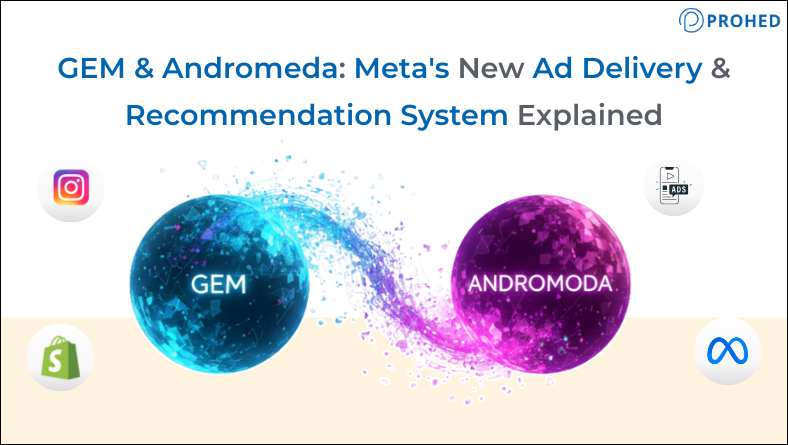
Have your Facebook and Instagram ads been acting weird lately? Maybe your trusty “lookalike” audiences stopped working, or your performance swings wildly from day to day. You aren’t imagining it. A massive, unified shift has happened under the hood of Meta’s ad platform. This new AI-powered ecosystem is driven by Meta Andromeda and the new foundational ad model, Meta GEM.
For years, marketing gurus have said, “Creative is the new targeting.” With these updates, this is no longer just a catchy slogan—it is a technical reality.
Here is exactly what is happening to your ads and how you need to change your strategy to survive.
What exactly is the GEM & Andromeda Ecosystem?
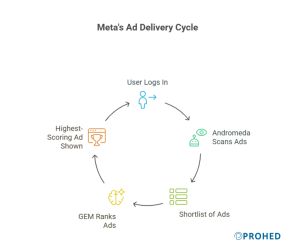
To understand this new reality, we first need to look at how Meta decides to show an ad to a user. The ad delivery system works in two giant, hyper-intelligent steps: Retrieval and Ranking.
- The Retrieval Phase (The Scan) – Powered by Meta Andromeda: Imagine a library with billions of ads. When a user logs in, the system must instantly scan those ads to find a small bundle, let’s say 500 ads—that might be relevant. Andromeda is the super-fast AI retrieval engine, powered by advanced hardware, that performs this scan. Crucially, it no longer relies on simple labels (like “Interest: Golf”). It can now “read” the actual content of your ad—the pixels, the video frames, the text on the image, and the caption—during this first scan.
- The Ranking Phase (The Score) – Powered by Meta GEM: Once Andromeda has that shortlist of 500 ads, Meta’s Generative Ads Model (GEM), the central AI brain, runs a complex calculation on them. This LLM-inspired foundation model is trained on vast amounts of data—both ads and organic content—to predict the likelihood of the user taking your desired action (e.g., clicking, buying). It gives each ad a score, and the winner gets shown.
The Core Relationship: Delivery vs. Recommendation
- Andromeda is primarily the ads delivery system to process more ads and find the most relevant short-list.
- GEM is the ads recommendation system that scores the ads based on user activity and long-term intent.
Together, they form a system that is far more sophisticated than your old manual targeting.
Why is Your Old Targeting Strategy Failing?
In the “Old Era” (pre-2024), the algorithm needed your help. You gave it strict instructions:
- “Find me men.”
- “Aged 25 to 45.”
- “Who live in Delhi.”
- “Who are interested in Crossfit and Keto Diets.
This helped the simple Retrieval engine narrow down the pool.
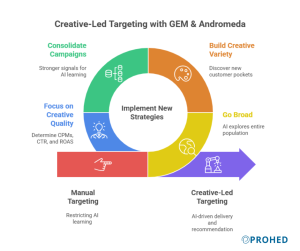
In the GEM & Andromeda Era, this strategy is dangerous. Because the new AI is so smart, it wants to look at everyone to find the best buyers.
- When you add strict targeting constraints (like “only show this to people who like Crossfit”), it’s like putting a “boot” on a Ferrari’s wheel. You are physically restricting the AI from finding customers who would have bought your product but didn’t fall into your specific settings.
- The AI is now smarter than your settings. When you try to outsmart it with manual targeting, you usually end up driving up your costs.
How “Creative” Actually Does the Targeting Now
This is the most important concept to understand: The ad content itself filters the audience.
With Andromeda, the AI analyzes your ad visually and semantically, looking for “signals” in your image or video to determine who should see it, providing a high-quality pool of candidates for GEM.
Let’s look at three examples of how this works in practice:
Example 1: The Visual Signal: If you run two ads for a protein shake—
- Ad A: Shows a bodybuilder lifting heavy weights in a gym.
- Ad B: Shows a busy mom mixing a shake in a kitchen while holding a baby.
In the old days, you would have to create two different Ad Sets to target these people (“Gym Rats” vs. “Parents”). Now, you don’t have to. Andromeda “sees” the heavy weights in Ad A and serves it to fitness enthusiasts. It “sees” the kitchen and baby in Ad B and serves it to parents. The creative told the algorithm where to go.
Example 2: The Text Signal: The AI reads the text overlay and the primary text. If your ad says “The best solution for lower back pain,” the system instantly matches that semantic meaning with users who have shown behavior related to health, chiropractic care, or pain relief.
Example 3: The Engagement Signal: This happens in real-time. If the first 50 people who stop to watch your video are women over 50 interested in gardening, the AI says: “Okay, this is a gardening ad for older women,” and it immediately starts finding more people like that.
If your creative is generic, the AI gets confused. If your creative is specific, the AI finds your perfect customer instantly.
The Winning Strategy: Broad Targeting & Creative Velocity
To leverage the GEM & Andromeda ecosystem, you must simplify your setup and scale your creative.
1. Broad Targeting Works Best
The winning strategy right now is Broad Targeting.
What does Broad mean?
You leave the “Interests” and “Lookalikes” sections completely empty. You simply select your country, your gender (if applicable), and perhaps age.
Why does this work better?
When you go Broad, you are giving the AI the biggest possible ocean to fish in. The AI finds the cheapest, most likely converters within the whole population, rather than fighting over expensive, small groups of people.
2. Diversify Your Creative Concepts
If you can’t target “Interests” anymore, you must test Creative Concepts to scale.
Andromeda needs different psychological hooks to find different pockets of users. You need to build a “Portfolio of Creative”:
Creative Concept | Psychological Hook | Who This Targets |
The Logic Hook | Appeals to the brain. Use charts, comparisons, and clear features. | The analytical buyers. The researchers. |
The Emotional Hook | Appeals to the heart. Use founder’s stories, user testimonials, or videos showing the feeling of using the product. | The impulse buyers. The people who buy based on vibes and brand connection. |
The Social Proof Hook | Relies on trust. Use UGC (User Generated Content), unboxings, or press quotes. | The skeptics. The people who need external validation before they buy. |
If you run these three different ads in a Broad campaign, the system will go out and find three completely different groups of people. You have effectively created three “targeting” segments, just by making three different videos.
3. Campaign Consolidation: Feed the Machine
The final piece of the puzzle is Consolidation. The AI needs data—or “signals”—to learn effectively.
- If your budget is spread across 10 campaigns and 50 ad sets, you are spreading your data too thin. Each ad set might only get 2 or 3 sales a week, which isn’t enough for the super-computer to learn.
- The Golden Rule: Consolidate your budget into as few campaigns as possible (e.g., one main Scaling campaign and one Testing campaign). You want to feed the machine 50+ conversions per week per ad set to allow GEM and Andromeda to stabilize and deliver consistent results.