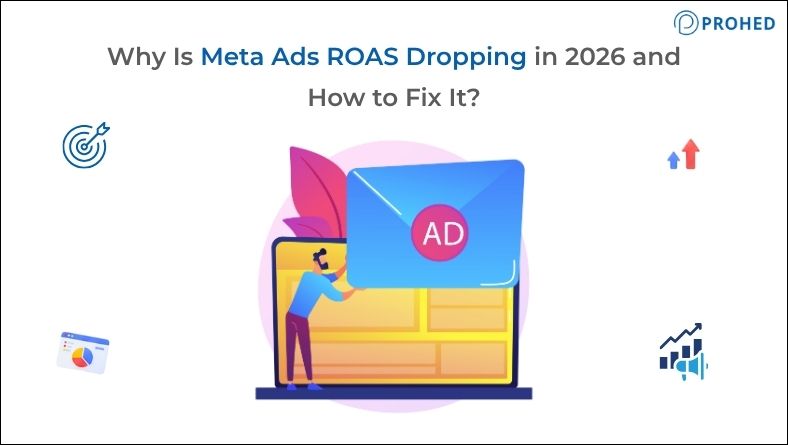
Last month, a brand spending ₹8 lakh a month on Meta Ads came to us with a simple question: “Why is nothing working anymore?” Their creative was solid. Their offer hadn’t changed. They’d even hired someone new to manage the account. But their ROAS had dropped from 4.2x to 1.8x over three months, and nobody could explain why.
Turns out, they had four separate problems stacked on top of each other. None of them were obvious. All of them were fixable.
That story isn’t unusual right now. 2026 has been a rough year for Meta Ads performance across the board, e-commerce brands, lead gen businesses, D2C start-ups, all of them dealing with some version of the same thing. Return on ad spend that used to be reliable is now unpredictable. And “the algorithm changed” has become the default explanation that explains nothing.
This article breaks down what’s actually going on, why your Meta Ads ROAS dropped, and what you can do about it, without the fluff.
Why Has Meta Ads ROAS Dropped in 2026?
Here’s where it gets interesting, and a little uncomfortable, because the answer isn’t one thing. Most of the time when we audit accounts at Prohed, we find several problems layered on top of each other. Pull one thread and another appears. So let’s go through what’s actually driving the Meta Ads ROAS drop this year.
1. Audience Saturation and Creative Fatigue
More brands are running Meta Ads than ever before. The auction is crowded, CPMs have gone up, and here’s the kicker, your audience has already seen your ad. Maybe multiple times. They just kept scrolling.
Creative fatigue is real and it compounds quietly. Your CTR dips a little. Your conversion rate slides. Your ROAS drops. You increase the budget thinking scale will fix it. It doesn’t. If the same creatives have been running for more than 3–4 weeks without a refresh, there’s a very good chance this is already happening to you.
2. iOS Privacy Changes – Still Hitting Hard
This one gets less attention now because it’s not “new news”, but the impact hasn’t gone away. A large chunk of iOS users have opted out of tracking, which means Meta simply cannot see a meaningful portion of the conversions your campaigns are driving. So what shows up in Ads Manager looks worse than what’s actually happening.
The dangerous part? Advertisers look at that reported ROAS on Facebook Ads, decide a campaign isn’t working, cut the budget, and unknowingly kill something that was profitable. It happens constantly.
3. Increased Competition and Rising CPMs
The barrier to entry for Meta Ads is essentially zero in 2026. Anyone can launch a campaign in an afternoon. That means more budgets flooding the same auction, and the people who get hurt most are the ones who haven’t adapted their strategy to account for higher acquisition costs.
In competitive verticals like e-commerce, fintech, and ed-tech, CPMs have risen considerably. And when it costs more to reach the same number of people, your cost per conversion goes up, and your ROAS comes down. There’s no workaround for that, only smarter strategy.
4. Landing Page and Post-Click Experience Issues
This one gets ignored more than it should. Your ROAS on Facebook Ads isn’t just a reflection of how good your ads are, it’s a reflection of everything that happens after someone clicks. And a lot of brands have a leaky funnel they don’t know about.
A landing page that takes 5 seconds to load on mobile. A headline that doesn’t match what the ad promised. A form that asks for too much information. Any one of these can tank your conversion rate while Ads Manager continues to show healthy CTRs, leaving you convinced the problem is Meta when it isn’t.
5. Over-Reliance on Broad Targeting Without Strategy
Meta’s Advantage+ and broad targeting tools have become increasingly powerful, but they’re not a plug-and-play solution. Many brands lean into broad targeting without feeding the algorithm enough quality data. Without sufficient conversion signals, purchase events, and pixel health, Meta’s system can’t optimise properly, leading to wasted spend and poor ROAS. Automation is powerful only when it has the right inputs.
Don’t Just Run Ads. Engineer Growth. If your product is ready for the big leagues, your ad strategy needs to be too. Outsource your Meta campaigns to Prohed and watch your conversion floor rise.
Schedule a Free Audit with PROHED Today
How to Fix a Dropping ROAS on Meta Ads
The good news: a Meta Ads ROAS drop is fixable. But it requires honest diagnosis before action. Here are the levers that actually move the needle.
Audit Your Creative Aggressively
Your ad creative is doing more heavy lifting than your targeting. In 2026, creative is the targeting. Build a structured testing framework, test hooks, formats (UGC vs. polished video vs. static), and CTAs. Rotate creative every 2–4 weeks minimum. Track thumb-stop ratio, 3-second video views, and outbound CTR alongside ROAS to catch fatigue early.
Move Beyond Last-Click Attribution
Here’s something nobody wants to hear: the ROAS number in Ads Manager is probably not accurate. Not because Meta is lying, but because the data it has access to is incomplete. iOS opt-outs, browser restrictions, cross-device journeys, all of it creates gaps between what actually converted and what gets reported.
Relying purely on last-click attribution in this environment leads to bad decisions. You pause a campaign that looked weak but was actually influencing purchases. You scale one that looked strong but was just catching people who would have bought anyway.
The fix is blended measurement. Pull data from Ads Manager, your CRM, GA4, and if possible run periodic incrementality tests, a holdout group that doesn’t see your ads, so you can measure the actual lift. It’s more work. But it gives you a far more honest read on your true return on ad spend, and it stops you from pulling budget out of things that are genuinely working.
Fix Your Funnel Before Scaling Spend
If your ROAS is dropping and your first instinct is to increase budget or test a new audience, stop. Spend 30 minutes on your landing page first.
Open it on your phone, on a slow connection, and just go through it like a first-time visitor would. Does it load fast? Is the headline the same promise the ad made? Is it obvious what you want them to do? Is there anything in the way of them doing it?
Most of the time, there is. A 4-second load time on mobile. A generic headline that doesn’t match the ad. Three different CTAs fighting for attention. These things don’t show up as errors in Ads Manager, they just quietly eat your conversion rate and make your ROAS look like a Meta problem when it’s actually a funnel problem. Fix the page before you touch the budget.
Strengthen Your Pixel and Conversions API Setup
In a post-ATT world, server-side tracking via Meta’s Conversions API (CAPI) is no longer optional, it’s essential for accurate ROAS measurement. If you’re relying solely on pixel-based tracking, you’re likely missing 20–40% of your conversions. Set up CAPI alongside your pixel, deduplicate events correctly, and aim for an event match quality score above 6 in Events Manager. Better data in means better optimisation out.
Revisit Your Bidding and Campaign Structure
This is one of those things that feels boring to fix but makes a huge difference. A lot of accounts we audit are running way too many ad sets, small budgets spread across fragmented audiences, none of them getting enough spend to actually learn.
Meta’s algorithm needs data to optimise. The general rule of thumb is around 50 conversion events per week per ad set to exit the learning phase properly. If your structure is working against that, CBO isn’t going to save you. Consolidate your ad sets, give the algorithm room to breathe, and you’ll often see ROAS stabilise without changing anything else.
Build Retargeting Audiences with First-Party Data
Audience pools are smaller, tracking is weaker, and pixel-based retargeting isn’t as reliable. But abandoning it means losing easy wins.
The shift is in the source. Instead of relying on pixels, focus on what you own, your CRM, email lists, past buyers, and unconverted leads. These audiences already know your brand, so they tend to deliver better ROAS than cold traffic. It takes more effort to set up, but the returns are usually stronger.
The Role of Strategy in ROAS Marketing – Not Just Tactics
Many brands see ROAS drop and start tweaking everything—bids, budgets, audiences—but nothing improves. That’s because they’re fixing symptoms, not the root problem.
A declining ROAS is rarely just a tactical issue. It often points to deeper problems like weak offers, audience saturation, poor funnels, or unclear positioning. The real challenge is knowing the difference. That’s why brands that recover faster often bring in a fresh perspective before losses grow further.
How Prohed Approaches Meta Ads ROAS Challenges
We’re not going to pretend there’s a magic fix. There isn’t. But there is a process that works, and it starts with being honest about what the data is actually saying rather than what you want it to say.
When brands come to us with a Meta Ads ROAS drop, we start by auditing the full picture, not just the ad account, but the landing pages, the attribution setup, the creative history, the funnel drop-off points. Nine times out of ten, the problem isn’t where the client thinks it is.
From there, we build a plan that’s specific to what we find. That might mean rebuilding campaign structure, implementing Conversions API properly, overhauling creative, or fixing a landing page that’s been quietly killing conversions for months. Our clients get a live dashboard, real numbers, updated daily, so there’s never a situation where something is going wrong and nobody notices for three weeks.
We work across Meta Ads, Google, SEO, B2B and B2C lead generation, e-commerce growth, and app marketing. So whether the issue is isolated to Meta or part of a bigger performance problem, we can look at the whole picture rather than just one channel.
Quick Diagnostic: Is Your ROAS Drop a Meta Problem or a Funnel Problem?
Ask yourself these questions honestly:
- Have CPMs increased significantly in the past 30 days? → Market competition issue.
- Has CTR stayed stable but conversion rate dropped? → Landing page or offer issue.
- Is reported ROAS declining but revenue roughly flat? → Attribution gap; check your CAPI setup.
- Are your best-performing creatives the same ones from 60+ days ago? → Creative fatigue.
- Are you running 10+ ad sets with small individual budgets? → Campaign structure issue.
Your answers will tell you exactly where to look, and save you from wasting time in the wrong place.
Final Word: ROAS Is a Symptom, Not the Problem
When your Meta Ads ROAS drops, it’s tempting to chase it with budget cuts and frantic A/B tests. But ROAS is a downstream metric. It reflects everything upstream, your creative, your audience, your landing page, your attribution setup, and your offer. Fix the inputs, and the output corrects itself.
In 2026, sustainable ROAS on Meta Ads is earned through strategic discipline, not shortcuts. The brands that are winning are treating performance marketing as a system, not just a channel.
If your brand is in the NCR region and you’re looking for a performance marketing agency in Delhi that understands Meta Ads inside-out, from Conversions API setup to full-funnel creative strategy, Prohed is built for exactly that. We combine the rigour of a data-led agency with the agility your campaigns demand.
Get in touch with Prohed for a free audit of your Meta Ads account. Let’s find out what’s actually driving your ROAS drop, and fix it.
Schedule a Free Strategy Call with PROHED Today