Most EdTech brands are caught in a cycle of throwing money at paid ads, Google, Meta, YouTube, you name it. The leads show up while the tap is open, but the second you pause the budget, everything goes quiet.
Hardly anyone talks about the alternative: actually fixing the one thing that should have been working the whole time, which is organic search.
This is a story about exactly that. We worked with an established EdTech company that had a great product and a real market, but their website was basically invisible to the very schools they were trying to reach. Fast forward twelve months, and their presence in AI-generated search summaries didn’t just grow; they saw a 1,420% jump in AI Overview visibility. This wasn’t because of a bigger ad spend or a lucky viral post; it was a total overhaul of how their SEO was built and executed.
Here is the breakdown of what actually went down, why it worked, and how other EdTech companies can do the same.
The Starting Point: A Good Product That Google Couldn’t Find
The company offers digital education tools for schools across India, things like LMS platforms, digital classrooms, and ERP software designed specifically for the Indian market. The product itself is solid, and the demand is definitely there. Schools are actively looking for these solutions; they just couldn’t find this specific brand.
The problem was straightforward. When school principals, administrators, and procurement decision-makers searched for these solutions on Google, this company wasn’t showing up. Competitors with weaker products were ranking higher. Organic traffic was negligible. The sales team was almost entirely dependent on outbound effort and paid channels to fill the pipeline.
For an edtech company selling a considered, high-value product to institutional buyers who research extensively before making a decision, not showing up in organic search isn’t just a missed opportunity. It’s a structural disadvantage that compounds over time.
Something needed to change, and it wasn’t the product.
Step 1: The Technical SEO Audit That Revealed the Real Problem
Before writing a single piece of content or building a single backlink, a full technical SEO audit was conducted. And what it found explained a lot.
The website had significant crawlability issues. Googlebot was struggling to index pages properly because of redirect chains, broken internal links, and inconsistent URL structures. Pages that should have been ranking for high-intent queries simply weren’t being crawled efficiently enough to compete.
Page speed was a serious problem. Core Web Vitals scores were well below acceptable thresholds, particularly on mobile, which matters enormously for a product targeting school administrators in tier 2 and tier 3 cities where mobile is often the primary device for research.
Duplicate content was diluting ranking potential. Multiple pages on the website were competing against each other for the same queries. Without clear canonical tags and a defined page hierarchy, Google’s algorithm had no clear signal about which page should rank for which search term.
Schema markup was either absent or incorrectly implemented. For an edtech company selling specific products to specific institutional buyers, structured data is one of the clearest signals Google uses to understand what a page is about and who it’s relevant to.
Fixing these technical issues was the foundation. Everything else that followed worked because the technical base was solid enough to support it.
Step 2: Keyword Strategy Built Around How Schools Actually Search
Generic SEO keyword research often misses the point for B2B edtech companies. Schools and educational institutions don’t search the way a consumer does. A principal evaluating school management software searches differently from a parent looking for a tutoring app.
The keyword strategy built for this edtech company was grounded in understanding the actual language of institutional buyers in Indian education. How do school decision-makers phrase their queries? What stage of the decision-making process are they at when they search? Which queries indicate genuine purchase intent versus general curiosity?
Consequently, the keyword architecture was built in three layers.
- High-intent commercial keywords for buyers actively evaluating solutions. These are for the decision-makers who are ready to pull the trigger. We targeted very specific terms like “LMS for CBSE schools” or “school ERP software in India.” If we wanted to catch buyers right as they were ready to choose a solution.
- Informational keywords Before a school picks a vendor, they have a lot of questions. We created content around topics like “how to choose a school management system” to get our brand in front of them while they were still weighing their options. It’s about building trust before they even start looking at price tags.
- Long-tail local and segment-specific keywords We realized that a principal at a state board school in Maharashtra doesn’t search the same way a CBSE administrator in Delhi does. Our strategy had to account for those regional differences and specific school categories to be truly effective.
Step 3: Content That Actually Answered What Buyers Were Asking
With the technical foundation fixed and the keyword architecture defined, the content strategy was built around one principle: answer the specific questions that school decision-makers are actually asking, in the language they actually use.
This sounds obvious. In practice, most edtech company websites don’t do it. They publish generic blog posts, product-focused pages with no depth, and content written for an imaginary audience rather than the actual buyers making purchasing decisions.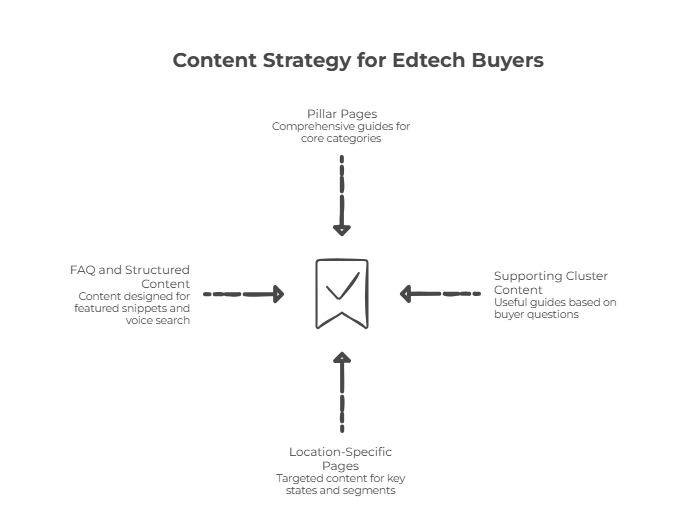
The content programme built for this company included several layers working together:
- Pillar pages: We didn’t just scratch the surface. We built massive, comprehensive guides for core categories like digital classrooms and ERP software. These pages answered everything, from implementation hurdles and pricing to how the product stacks up against competitors.
- Supporting cluster content: We moved away from fluff pieces written just to hit a word count. Instead, we wrote useful guides based on actual questions buyers ask. Every article was designed to be a resource for someone with a real intent to solve a problem.
- Location and segment-specific pages: Targeting buyers in key states and school categories. An edtech company selling to schools across India needs to be findable in Rajasthan as much as in Maharashtra, and a single generic page rarely achieves that.
- FAQ and structured content: Designed to appear in featured snippets and voice search results. This focus on structured data is exactly what allowed the brand to dominate AI Overviews, as the algorithm could easily parse and cite their answers.
Step 4: Link Building That Built Real Domain Authority
Content and technical SEO create the foundation. Links build the authority that allows pages to rank competitively for high-value queries.
The link acquisition strategy for this edtech company was built around three approaches that work specifically well in the education technology space.
- Digital PR and thought leadership in education publications. India has a strong network of education-focused media and publications. Contributed articles, expert commentary, and data-led content distributed through these channels built high-quality backlinks while simultaneously putting the brand in front of the exact audience it was trying to reach.
- Industry directory and listing placements on education technology directories, school resource platforms, and edtech review sites. These aren’t glamorous links, but they’re relevant, trustworthy, and consistently cited by institutional buyers doing research.
- Partnership and ecosystem links from the company’s own network of school partners, educational associations, and technology integrations. An edtech company with thousands of partner schools has a natural link building opportunity that most generic SEO approaches completely overlook.
The Results: 1,420% Jump in AI Overview Visibility in 12 Months
Twelve months after the SEO transformation began, the numbers told a clear story.
Visibility in AI Overviews and generative search results grew by 1,420%. This meant when school admins asked complex questions to AI search engines, our client’s insights were the ones being cited and recommended. This led to a massive, compounding increase in the volume of institutional buyers arriving through organic search and converting into genuine sales leads.
Organic traffic to the site increased significantly across all major product categories. Rankings for high-intent commercial keywords moved from page three and beyond to page one positions for the queries that matter most to the business.
Perhaps most importantly, the quality of traffic arriving from these AI citations and organic rankings was measurably better than the leads from paid ads. These buyers were further along in the decision-making process because they had already been “pre-sold” by the helpful content they found during their research.
Also Read: How to Scale B2B Lead Generation from 50 to 500 Qualified Leads Per Month for Enterprise Brands
What Other EdTech Companies Can Take From This
The specifics of this case are unique to one company in one category. But the underlying principles apply to almost every edtech company that’s currently over-investing in paid acquisition while underinvesting in organic search.
- Technical SEO is the unsexy work that makes everything else possible: An edtech company with brilliant content and a broken technical foundation will consistently underperform against a competitor with average content and a clean technical setup. Fix the base first.
- Keyword strategy for B2B edtech needs to reflect how institutional buyers actually search: Generic keyword research misses the nuance. Understanding the specific language of school administrators, education procurement teams, and institutional decision-makers is what separates a keyword strategy that drives leads from one that drives traffic with no commercial value.
- Content quality beats content quantity every time: One genuinely useful piece of content targeting a real buyer question consistently outperforms ten thin blog posts. High-quality content is also the primary fuel for AI Overviews, if you don’t provide the best answer, the AI won’t cite you.
Organic visibility compounds: Paid leads don’t. The 1,420% growth in AI visibility didn’t stop when the engagement ended. The authority and the citations continued to work long after the initial build. Paid campaigns stop the moment the budget does.
Is your edtech company winning the AI search battle, or is your website invisible to the buyers actively searching for what you sell?
An SEO audit can show exactly what’s holding your organic performance back and what a realistic growth path looks like for your specific category.