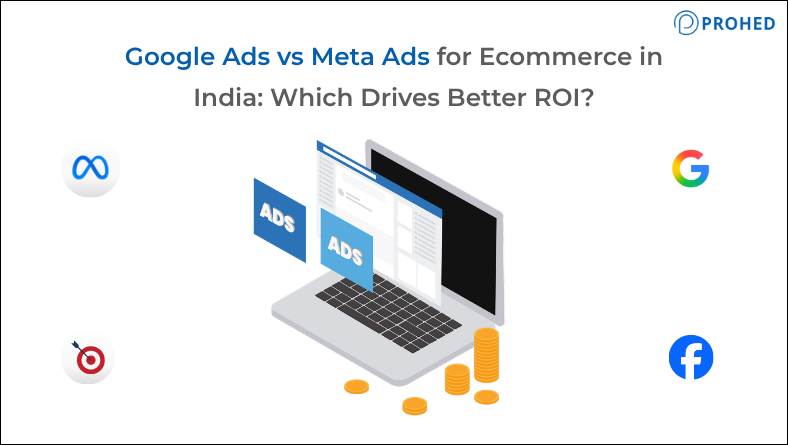
You’ve finally locked in your monthly ad budget. Now comes the question that keeps every ecommerce founder up at night: do you bet it on Google or go all-in on Meta?
No one-size-fits-all answer exists here, and anyone who says otherwise probably hasn’t run real campaigns for an Indian D2C brand. The google ads vs meta ads debate isn’t about picking a winner. It’s about matching the right platform to your product, your audience, and where they are in the buying journey.
India’s ecommerce landscape plays by its own rules. Price-sensitive buyers, a mobile-first population, deep regional diversity, and platforms like Meesho and Flipkart reshaping discovery, it’s a different game entirely. Layer in Google and Meta’s recent algorithm overhauls, and those old “search vs social” comparisons are officially dead.
In this guide, we break down how both platforms perform for Indian ecommerce brands, which one typically wins the ROI battle, and how to build a blended ecommerce paid ads strategy that actually works.
How Google Ads Works for Ecommerce in India
When we look at Google, we’re talking about “pull” marketing. You aren’t chasing people; you’re just showing up when they’ve already decided to buy.
- Shopping & PMAX: Think of these as your digital storefront. Your product image and price sit right there in the search results, cutting out the fluff.
- Search Ads: These are your surgical strikes. You bid on the exact words your customers are typing.
- YouTube & Remarketing: This is where you stay top-of-mind. Whether it’s a product demo or a gentle nudge to someone who abandoned their cart, it keeps the momentum alive.
In the Indian market, Google is a titan. Whether it’s a tech enthusiast in a metro or a first-time buyer in a Tier-2 city, everyone researches before they hit “buy.” That makes it the perfect engine for electronics, fashion staples, and home essentials. The beauty of Google is the intent: people are already in a shopping mindset. Yes, CPCs can get spicy, sometimes hitting ₹100 or more in competitive niches, but if your AOV is healthy, the predictability of the revenue is hard to beat.
How Meta Ads Works for Ecommerce in India
Meta is the ultimate “discovery” engine. Most people on Instagram aren’t looking to spend money, yet they end up buying because the algorithm knew what they wanted before they did.
- Catalogue & Collection Ads: These are dynamic, shifting based on what a user actually likes to see.
- Reels & Stories: This is where the magic happens. A 15-second “thumb-stopper” can turn a casual scroll into a sale.
- Lead & WhatsApp Ads: In India, nothing beats a direct line to a buyer’s WhatsApp, especially for pre-launches.
With over 400 million active users in India, Meta’s reach is staggering. For lifestyle, beauty, or any “aesthetic” brand, it’s a goldmine. The clicks are cheaper than Google, often as low as ₹5, but you have to work twice as hard on the creative. You aren’t just selling a product; you’re selling a vibe. If your creative hits the mark, the scale you can achieve here is unmatched by any other platform.
Google Ads vs Meta Ads: A Direct Comparison
Factor | Google Ads | Meta Ads |
User Intent | High (actively searching) | Discovery/Behavior-based |
Best For | Transactional, bottom-funnel buyers | Brand building and discovery |
Avg. CPC (India) | ₹10 to ₹80 (category dependent) | ₹3 to ₹30 (cheaper clicks) |
Ad Formats | Search, Shopping, YouTube | Reels, Stories, Carousels |
Confused about your Channel Mix? Every lakh spent on the wrong platform is a lost opportunity for your D2C brand. Whether it’s aggressive Google Shopping or creative-heavy Meta Reels, we build the roadmap that fits your unit economics.
Book Your Free Ecommerce Ad Audit With PROHED Today
When to Prioritize One Over the Other
Most brands don’t have the luxury of an unlimited budget on day one. Here is the practical way we advise our clients to think about it:
Start with Google if there is already high search demand for what you sell (use Keyword Planner to check). If your product is a “problem-solver” and your AOV is above ₹800, Google is the fastest way to get sales through the door and validate your unit economics.
Start with Meta if your product is a “head-turner” or solves a problem people haven’t even realized they have yet, Meta is usually where you’ll find your footing. If your Instagram posts are already getting decent organic love and you’ve got the bandwidth to pump out high-quality Reels, Meta is the fastest way to hit the gas on growth.
The real magic, however, happens when you run both. Once your conversion funnel is airtight and you’re looking at a budget of at least ₹1L a month, that’s your cue to integrate. It allows you to build a brand on one end while capturing the high-intent buyers on the other.
The Role of Ecommerce Marketing Agencies
Let’s be real for a second: you can’t just “set and forget” these campaigns. Both Google and Meta come with their own chaotic auction rules, bidding hurdles, and creative demands. Most brands that try to juggle this in-house without a specialized performance squad usually end up leaking money on one platform while completely ignoring the potential of the other. It’s an expensive way to learn a lesson that a dedicated team could have solved on day one.
This is where a specialized ecommerce marketing agency earns its keep. A solid partner doesn’t just “setup ads.” They design a full-funnel strategy, optimize daily based on real-time data, and make sure every rupee is going toward the platform that is actually delivering ROI.
At Prohed, we work across the fashion, D2C, and electronics sectors to build ecommerce paid ads strategies that move the needle. Whether it’s an aggressive Google Shopping push or a creative-heavy Meta catalogue strategy, our moves are backed by data, not gut feelings. As a Performance Marketing Agency in Gurgaon, we provide our clients with total transparency through real-time dashboards. You see what we see: every click, every conversion, and every rupee of profit.
Also Read: How to Scale D2C Brands Profitably in 2026: Proven Growth Frameworks
Final Thoughts
At the end of the day, Google owns the “intent,” but Meta owns the “discovery.” The brands currently dominating the Indian market have stopped treating this like a binary choice. They integrate.
If you’re ready to stop burning cash on “maybe” and start scaling with a team that actually understands the pulse of the Indian ecommerce shopper, Prohed is here. As a Performance Marketing Agency in Gurgaon, we don’t just give you reports; we give you a roadmap to ROI.
Ready to grow? Let’s talk.
Schedule a Free Strategy Call with PROHED Today