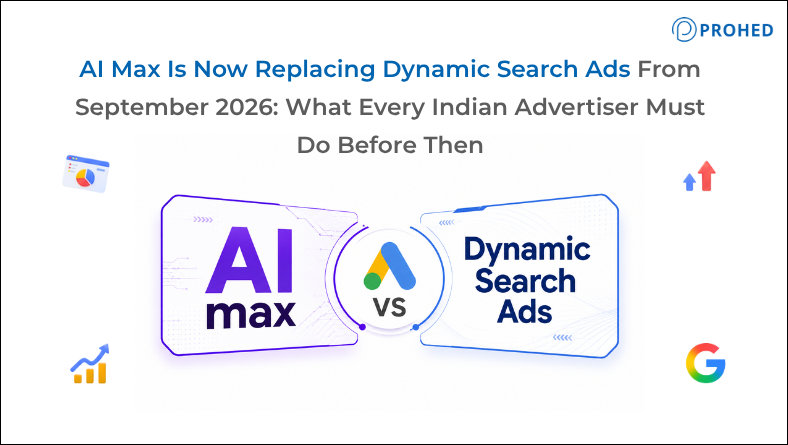
AI Max replaces dynamic search ads by combining advertiser assets, landing page content, and broader intent signals to match ads to queries no keyword list could predict. From September 2026, every eligible account gets migrated automatically. No opt-out, no exceptions. At Prohed, a performance marketing agency in Gurgaon, we’re already auditing client accounts ahead of this shift. The risk isn’t the migration itself. It’s what happens after, when the system starts winning conversions it was never supposed to get credit for.
Most coverage of this update stops at the obvious headline. DSA is going away. AI Max is taking over. There’s a deadline in September.
That’s true. But it’s not the part that should actually worry you.
The real story is what happens after the upgrade. Once AI Max is live, it starts making decisions across your account that used to require explicit keyword control. And early data shows something uncomfortable: massive variance in outcomes.
Some advertisers are seeing genuine efficiency gains. Others are watching reported ROAS climb while real revenue stays flat. Why? Because the system has quietly started capturing conversions it would’ve won anyway, just at a much higher cost than the old setup.
At Prohed, one of the best performance marketing agencies in India, this is the actual conversation we’re having with clients right now. Not “should we upgrade.” But “what guardrails need to exist before we do.”
What’s Changing, in Plain Terms
Dynamic search ads worked by scanning your website and generating headlines and landing pages for queries outside your keyword list. A useful catch-all, especially for large inventory sites and ecommerce catalogues.
AI Max does the same job, but bigger.
It pulls from advertiser assets, landing page content, and broader intent signals. It now also places ads inside Google’s AI Overviews and AI Mode results. And it comes with controls DSA never had: brand controls, location controls, text guidelines, search term matching, and final URL expansion.
The migration runs in two phases:
- Right now: voluntary upgrade tools are available, giving you control over the transition
- From September: anything still on legacy DSA, automatically created assets, or campaign-level broad match gets upgraded automatically, with Google’s defaults applied, not yours
That second phase is where most of the risk sits.
The Real Problem: Branded Query Cannibalization
Here’s something most Indian advertisers haven’t fully accounted for.
Without explicit brand exclusions, AI Max can start capturing branded searches. Queries where a customer is already typing your brand name. Searches your existing keyword campaign would’ve won at a fraction of the cost.
When that happens, the dashboard looks great. Conversions go up. ROAS improves.
But none of it is incremental. That customer was always going to convert. AI Max has simply rerouted the credit, often at a much higher cost per click than your branded keyword campaign was paying.
This pattern is already showing up across hundreds of Search accounts globally that adopted AI Max early. Google’s headline efficiency numbers are real on average. But the spread underneath is wide. A meaningful share of accounts are seeing CPA rise even as topline revenue appears to grow.
The difference almost always comes down to one thing: whether negative keyword lists and brand exclusions were configured before the system went live, not after.
For Indian D2C, EdTech, and BFSI brands running search AI campaigns at scale, this matters more than it might seem. Many accounts here are still managed without dedicated PPC oversight. A default migration in September could quietly inflate branded CPA for weeks before anyone notices.
Why Your Data Quality Now Decides Who Wins
There’s a second factor that’s easy to miss if you’re only reading the feature list.
AI Max depends far more heavily on first-party signal quality than DSA ever did. And third-party tracking has thinned considerably over the past few years.
So the algorithm’s ability to find genuinely relevant queries depends on what it can actually learn from:
- Server-side conversion tracking
- Enhanced conversions
- CRM revenue imports
- Customer lists tagged with real lifetime value, not just a single conversion event
Accounts with clean, well-configured tracking give AI Max a strong signal to optimise against.
Accounts running basic pixel tracking or incomplete event setups are essentially asking the algorithm to make decisions with half the picture. The output reflects that gap, every time.
This shifts the conversation. It’s no longer just a Google Ads settings question. It’s a performance marketing infrastructure question. And fixing your tracking before September is worth more than reading every new control in the AI Max panel.
Related Read: Top 7 Google Ads Services for High-Growth Start-ups in Delhi NCR
What Indian Advertisers Should Actually Do Before September
1. Build Brand and Navigational Exclusions First
Before touching anything else, build an account-level negative keyword list covering your brand name, common misspellings, and navigational queries like “[brand] login” or “[brand] login page.” This single step protects against the cannibalization risk described above and should be treated as non-negotiable, not optional.
2. Audit Conversion Tracking Before the Account Migrates
Review whether server-side tracking, enhanced conversions, and CRM data imports are properly configured. If they aren’t, fix this before the upgrade rather than after. An account migrating to AI Max with weak signal quality is starting the new system at a structural disadvantage that’s expensive to reverse later.
3. Separate High-Margin and Low-Margin Lines Into Distinct Tiers
AI Max optimises toward an average target across whatever it’s managing. Blending high-margin and low-margin products or services into a single campaign means the system optimises toward the blended average rather than protecting the margin that matters most. Where possible, structure campaigns so that high-value product lines or service categories carry their own dedicated ROAS targets.
4. Run a Controlled Comparison, Not a Blind Switch
Use Google’s experiment tools to compare AI Max performance against your existing structure on a portion of traffic before committing the full account. This is the only reliable way to know whether the platform-reported improvement is translating into genuinely incremental revenue for your specific business, rather than simply reshuffling credit for conversions you were already winning.
5. Move to Incrementality, Not Platform-Reported ROAS
Once AI Max is live, in-platform ROAS becomes a less trustworthy number than it used to be, because the system has more room to claim credit for conversions across a wider net of queries. Holdout testing, geo experiments, or basic marketing mix modelling give a far more honest read on what spend is actually driving versus what would have happened anyway. This is increasingly the standard that matters for budget decisions, not the dashboard number alone.
What This Means for How Accounts Get Managed Going Forward
The job has shifted from configuration to governance.
It used to mean adjusting bids, expanding keyword lists, managing match types. Now it means setting the boundaries automation operates inside, then auditing results against outcomes the platform has every incentive to overstate.
This matters more in India specifically. Many accounts here were built years ago around manual keyword strategy. They haven’t been rebuilt around server-side tracking, enhanced conversions, or tiered campaign architecture.
September isn’t just a deadline to migrate by. It’s a forcing function to fix infrastructure that should’ve been addressed already.
At Prohed, this is exactly where our performance marketing work has shifted over the past two quarters. Account audits now include a dedicated review of branded query exposure, conversion signal quality, and campaign tier structure, alongside the usual creative and targeting checks. This sits alongside our broader Performance Marketing, SEO, and E-commerce Marketing services. A search account leaking budget to cannibalized branded queries quietly undermines every other channel running alongside it.
Conclusion
The headline news here is simple: dynamic search ads are being retired, and AI Max is taking their place by September 2026. The part that actually determines whether your account comes out ahead or behind is less visible. It sits in whether brand exclusions are configured before launch, whether conversion tracking is clean enough for the algorithm to learn from, and whether campaign tiers protect margin instead of blending everything into a single average.
Advertisers who treat this purely as a feature update to accept will likely see the same wide variance showing up in early industry data, some gains, some quiet CPA inflation, and no clear way to tell the difference without proper measurement in place.
This shift is exactly why the best performance marketing agencies in India treat this transition as an infrastructure and governance project rather than a routine update. Advertisers who adopt this strategic approach now, rather than waiting until September, are the ones positioned to capture the genuine efficiency gains AI Max is capable of delivering.
Frequently Asked Questions
1. What is replacing Dynamic Search Ads in Google Ads?
Google is replacing Dynamic Search Ads with AI Max, a broader search automation system that combines advertiser assets, landing page content, and intent signals, including placements inside AI Overviews and AI Mode. The migration also covers automatically created assets and campaign-level broad match settings.
2. When does the automatic migration to AI Max happen?
Voluntary upgrade tools are already available. From September 2026, any eligible account still running legacy Dynamic Search Ads, automatically created assets, or campaign-level broad match will be upgraded automatically, with Google’s default settings applied rather than advertiser-chosen ones.
3. Why can AI Max increase cost per acquisition even when revenue looks higher?
Without explicit brand and navigational keyword exclusions, AI Max can start winning branded search conversions that an existing keyword campaign would have captured at a much lower cost. Reported revenue and ROAS rise, but the additional conversions are often not incremental, meaning real CPA quietly increases while the dashboard looks healthier.
4. What should Indian advertisers fix before migrating to AI Max?
Three things matter most: account-level negative keyword lists covering brand and navigational terms, clean first-party conversion tracking including server-side and enhanced conversions, and a campaign structure that separates high-margin and low-margin product lines into distinct tiers with their own ROAS targets.
5. Does AI Max respect negative keywords the way Dynamic Search Ads did?
Yes. AI Max respects negative keywords at both campaign and ad-group level, which makes brand and navigational exclusions a fully usable safeguard. This control needs to be configured before the campaign goes live, since the system will otherwise expand into branded queries by default.
6. How reliable is platform-reported ROAS once AI Max is active?
Platform-reported ROAS becomes less reliable as a standalone metric once AI Max is managing a wider net of queries, since the system has more opportunity to claim credit for conversions that would have happened anyway. Holdout incrementality testing or marketing mix modelling gives a more accurate picture of what spend is genuinely driving.
7. Should advertisers upgrade voluntarily or wait for the automatic migration?
Upgrading voluntarily is strongly recommended. It allows time to configure brand exclusions, audit tracking, and structure campaign tiers properly before the system goes live, rather than inheriting Google’s default settings through an automatic migration in September with no prior review.
Worried about branded query cannibalization or weak conversion data before the AI Max migration? Prohed can audit your account and build the right safeguards before September.
Schedule a Free Strategy Call with PROHED Today