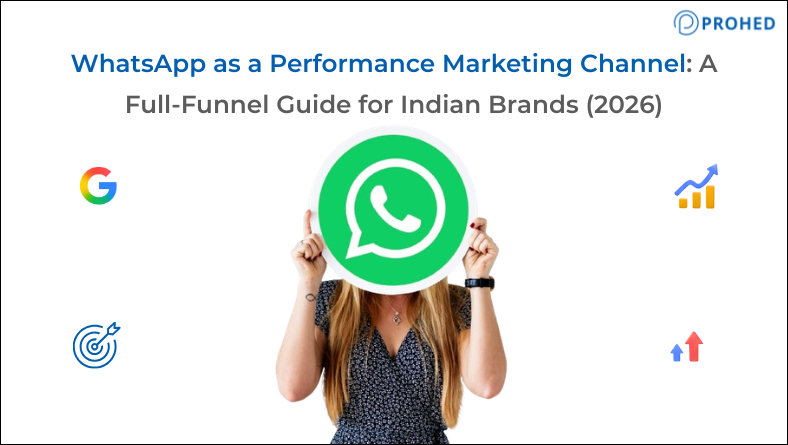
Most Indian brands are sitting on one of the highest-converting marketing channels available to them and using it only to send order confirmations.
WhatsApp has 535 million monthly active users in India as of 2024, making it the country’s single most used communication app by a considerable margin (Statista, 2024). Open rates on WhatsApp messages consistently sit between 85-98%, compared to 20-25% for email. And yet, the majority of Indian brands treat it as an afterthought. A support tool, a notification pipe, or at best, a broadcast channel for festival sale announcements.
That is a significant missed opportunity. Because when WhatsApp marketing is set up properly, with the right strategy, the right campaign types, and the right measurement in place, it functions as a genuine full-funnel performance marketing channel. One that generates leads, nurtures consideration, converts buyers, and brings them back, often at a fraction of the cost of running the same journey on paid social.
This guide covers how to build that system for your brand in 2026.
Why WhatsApp Is a Performance Marketing Channel, Not Just a Messaging App
The instinct to think of WhatsApp as “messaging” rather than “marketing” is understandable. It started as a personal communication tool. But honestly, that framing is exactly what keeps brands from realising its potential.
What actually makes something a performance marketing channel? Each message reaches a specific, opted-in contact. Interactions are fully trackable. Campaigns can be segmented, sequenced by behaviour, and optimized using real conversion data. This is not casual messaging; rather, it is a measurable, outcome-driven system, which is precisely the definition of performance marketing.
There is something about WhatsApp that no paid channel has really managed to replicate. When your brand message shows up in someone’s WhatsApp, it is sitting right next to a text from their mother or a voice note from a college friend. That kind of proximity simply does not exist on Instagram or Google. Those are advertising environments, and people scroll through them with their guard up.
WhatsApp is different. Furthermore, if your message genuinely earns its place in that inbox, the attention you get is of a completely different quality. Passive scrolling is replaced by active reading. And that difference shows up very clearly in the numbers.
WhatsApp Business App vs WhatsApp Business API: What Indian Brands Actually Need
Before putting any strategy together, it is worth getting clear on which version of WhatsApp your brand is actually going to use. A lot of brands skip this step and end up building on the wrong foundation entirely, which costs time down the line.
WhatsApp Business App
This is the free version for small operations. While you get basic auto-replies and broadcast lists, you’ll quickly hit a ceiling: broadcasts are capped at 256 contacts, only reach people who’ve saved your number, and offer no real segmentation. For a brand with actual marketing ambitions, it’s very limiting.
WhatsApp Business API
This is the infrastructure built for scaling. Accessed through providers like Wati or Interakt, the API lets you send mass segmented broadcasts, build automated drip flows, and integrate directly with your CRM. If you want chatbots, rich media templates, and actual campaign analytics, this is the setup you need.
Getting the Foundation Right: Opt-Ins and Compliance in India
This part matters more than most brands want to sit with, because the temptation to import contacts from an existing database and start broadcasting is real. It is also the fastest way to get your WhatsApp account flagged or permanently banned.
WhatsApp’s policy in India, enforced by Meta, requires explicit opt-in from every contact before they receive any marketing messages. That opt-in needs to clearly state that the person is agreeing to receive WhatsApp messages from your brand specifically. A generic “I agree to terms and conditions” checkbox buried at the bottom of a form does not count.
How Opt-Ins Are Collected
Practically speaking, brands collect opt-ins through several different touchpoints:
- A checkout page checkbox, something like “Get order updates and offers on WhatsApp”
- Lead gen forms on Meta or Google with a dedicated WhatsApp opt-in field
- Click-to-WhatsApp ads where the user initiates the conversation themselves
- In-store QR codes that open a pre-filled WhatsApp message
- Website chat widgets that invite visitors to connect on WhatsApp directly
Why List Quality Matters More Than List Size
Here is something worth internalising early. A list of 5,000 people who genuinely want to hear from you will outperform a list of 50,000 people who have no idea who you are, on every single metric that matters. Open rates, click rates, conversion rates, and critically, your account health with Meta. Brands that shortcut the opt-in process almost always pay for it later, either through mass opt-outs or through getting their account flagged.
One more practical thing worth knowing before building: every marketing message sent through the API goes through a Meta template approval process. This is not optional and it is not instant. Templates need to be written, submitted, and approved before your campaign can go live. Factoring this into your campaign timeline from the beginning saves a lot of last-minute scrambling.
The Full-Funnel WhatsApp Marketing Strategy
Here is where most WhatsApp strategies stay stuck. Brands use it for cart recovery, order updates, and the occasional re-engagement message, and then call it a day. Those use cases work. But they are only one slice of what WhatsApp can actually do when it is set up properly across the full funnel.
When campaigns are designed for each stage of the buyer journey, rather than just for the moment someone abandons a cart, WhatsApp starts functioning like a proper performance marketing channel from first contact all the way through to repeat purchase.
Top of Funnel: Driving Opt-Ins and First Contact
The awareness stage is really just about one thing: building a contact list of people who actually want to hear from you. The most effective way to do this in 2026 is through Click-to-WhatsApp ads, or CTWA ads as they are commonly called. These are standard Meta ads running on Facebook and Instagram, except instead of sending someone to a landing page, tapping the ad opens a WhatsApp conversation directly.
For Indian audiences specifically, this format works really well. It removes the landing page entirely, which means one less thing to load, one less form to fill, and one less reason to drop off. Someone sees the ad, taps it, and they are already talking to your brand. The whole journey from scroll to conversation happens in a single step.
Making That First Message Count
That first message your brand sends in that conversation matters a lot. If it is generic or immediately pushy, the person will just exit. But if it delivers something genuinely useful right away, a helpful guide, a relevant offer, a quick quiz that leads somewhere interesting, it establishes a reason for them to stick around. That first impression sets the tone for everything that follows.
For lead generation specifically, CTWA ads combined with a structured WhatsApp intake flow, where a chatbot asks a few qualifying questions, can replace traditional lead forms entirely for many brands. Often at a lower CPL and with noticeably higher lead quality.
Middle of Funnel: Nurturing and Consideration
This is where WhatsApp’s sequencing capability becomes genuinely powerful. Once someone is in your contact list, drip campaigns can deliver a structured nurture sequence across several days or weeks, triggered by the buyer’s behaviour rather than a fixed schedule.
The key difference between WhatsApp nurturing and email nurturing comes down to attention. When a nurture message arrives on WhatsApp, it gets read. When the same message arrives in an email inbox, it may or may not be opened at all. For high-consideration categories like EdTech courses, financial products, healthcare services, or high-ticket D2C products, this difference in attention translates directly into faster conversion cycles.
What a WhatsApp Nurture Sequence Looks Like
A well-designed WhatsApp nurture sequence for a considered purchase might look something like this:
Day 1 – A welcome message with a useful resource or product guide relevant to what the person initially enquired about.
Day 3 – A social proof message, a customer story or case study specific to the person’s concern or category.
Day 5 – A direct offer or incentive with a clear next step to either purchase or book a call.
Day 8 – A soft re-engagement if there has been no response. Something conversational like “Did you get a chance to look through this?” rather than another hard sell.
The exact sequence varies by category and product type. But the underlying principle, relevant messaging spaced out and triggered by behaviour, applies consistently. For brands already investing in data-driven marketing, layering WhatsApp sequences with CRM data creates personalization that actually feels personal, rather than clearly automated.
Bottom of Funnel: Conversion, Recovery, and Closing
The bottom of the funnel is where most brands already have some WhatsApp activity, and also where they are leaving the most money on the table by not being more systematic about it.
- Cart abandonment recovery: This is the most effective use case. Sending a WhatsApp 30–60 minutes after someone drops off, ideally with a direct checkout link and a small discount—consistently beats email open rates. A final 24-hour nudge often closes the deal for buyers who just needed a little extra time to decide.
- Payment failure recovery: Less talked about but equally worth setting up. A gentle WhatsApp message to a buyer whose payment failed, offering an alternative payment method or a direct payment link, recovers a portion of transactions that would otherwise just disappear.
- COD-to-prepaid conversion: A uniquely Indian use case that WhatsApp handles extremely well. For D2C brands dealing with high return-to-origin rates, a WhatsApp message after a COD order is placed, offering a small incentive to switch to prepaid, reduces RTOs and improves cash flow simultaneously. Very few brands run this systematically, which makes it a genuine competitive edge for those that do.
- Cross-sell and upsell sequences: These automated flows trigger based on what a customer just bought. For example, suggesting a serum to a skincare buyer three days later or an advanced module to a student two weeks in. Because these are tied to actual behavior, they feel like helpful recommendations rather than intrusive marketing.
Ready to turn WhatsApp into your #1 revenue driver?
Stop guessing and start scaling. Whether you’re struggling with high RTOs or looking to slash your CPL with Click-to-WhatsApp ads, we’ll build the roadmap for you.
Book a Free WhatsApp Strategy Audit with PROHED Today
WhatsApp Campaign Types Indian Brands Should Know
Not all WhatsApp campaigns work the same way. Knowing which type fits which objective saves significant time and budget from being spent in the wrong direction.
1. Broadcast Campaigns are one-to-many messages sent to a segmented list. They work best for product launches, sale announcements, and event-based communications. Segmentation matters a lot here. A broadcast sent to your entire list with no relevance filter is the fastest way to drive mass opt-outs and damage your sender reputation.
2. Drip Campaigns are automated message flows triggered by specific actions, like a new sign-up or a purchase. They work best when they’re tied to a buyer’s behavior, sending a message because someone just viewed a product feels like a helpful nudge, whereas a random “Tuesday update” just feels like spam.
3. Transactional Messages cover order confirmations, shipping updates, appointment reminders, and payment receipts. These messages get opened at remarkably high rates, usually because the person is actively waiting for the information. That attention is genuinely valuable. A well-placed cross-sell suggestion or a polite review request tucked into a shipping update can perform surprisingly well, precisely because the person is already engaged and in a positive headspace about their purchase.
4. Conversational Campaigns use chatbots to handle a back-and-forth dialogue right inside the app. By answering product questions and qualifying leads in real-time, you guide the decision without forcing the user onto a website. It’s perfect for high-consideration sectors like EdTech or FinTech where buyers usually need a little hand-holding.
5. Re-engagement Campaigns target contacts who opted in and then went silent. No opens, no clicks, nothing in the last two or three months. These people are not gone, they just need a reason to come back. A well-timed message with a small incentive, or even a casual “we haven’t heard from you” approach, brings a meaningful portion of dormant contacts back at a fraction of what it would cost to acquire new ones. For customer retention specifically, it is one of the most cost-efficient levers available on WhatsApp.
Metrics That Actually Matter in WhatsApp Marketing
One of the things that makes WhatsApp a genuine performance marketing channel is that it is measurable. The metrics worth tracking, though, are different from what most brands default to.
Metric | What It Tells You | Healthy Benchmark (India) |
Delivery Rate | Whether messages are actually reaching contacts | 95%+ |
Open Rate | How many recipients opened the message | 75-90% for opted-in lists |
Click-Through Rate | How many clicked a CTA button or link | 15-35% depending on offer |
Response Rate | How many replied (for conversational campaigns) | 10-25% for relevant campaigns |
Opt-Out Rate | How many unsubscribed after a message | Below 2% is healthy; above 5% signals a relevance problem |
Conversion Rate | How many completed the desired action | Varies by category; compare against your Meta and Google benchmarks |
Revenue per Broadcast | Total revenue attributed to a specific campaign send | Track over time to identify which message types consistently perform |
The metric most brands miss entirely is opt-out rate broken down by campaign type. If a particular kind of broadcast, sale announcements for example, consistently drives higher opt-outs than others, that is a signal to fix the message relevance or frequency, not just send fewer messages overall.
Common WhatsApp Marketing Mistakes Indian Brands Make
Every brand that starts taking WhatsApp seriously goes through a learning curve. Some lessons are cheap. Some are not. After seeing what goes wrong across D2C, EdTech, and fintech brands, these are the mistakes that come up most often and hurt the most.
- Broadcasting to non-opted-in contacts: This happens way more than it should. Buying from a brand isn’t an automatic invite into someone’s WhatsApp inbox. Therefore, if you send messages without a documented opt-in, you’re violating Meta’s policies. As a result, your quality score will tank, and you risk a permanent account ban. There is no workaround: the opt-in has to be real.
- Sending too frequently with no segmentation: A daily broadcast to your entire list, regardless of what each person has shown interest in, is a reliable way to drive mass opt-outs fast. Frequency and relevance need to be calibrated together, not treated as separate decisions made in different meetings.
- Using WhatsApp only for bottom-of-funnel recovery: Cart recovery is valuable. But brands that use WhatsApp only for abandoned cart messages are leaving the awareness, nurture, and re-engagement applications completely untapped. The same logic that applies to fixing a broken paid ads funnel applies here too. WhatsApp needs presence across all three funnel stages to deliver its full potential.
- No clear CTA in messages: Many WhatsApp messages explain what the brand is offering but do not tell the reader what to do next. A single, clear call-to-action, one button, one link, one specific next step, dramatically improves click and conversion rates. When people have to figure out what to do, most of them simply do not.
- Treating WhatsApp as a broadcast tool rather than a conversation channel: The brands getting the best results from WhatsApp in 2026 are the ones creating two-way dialogue, asking questions, inviting replies, and making the conversation feel genuinely two-sided. Conversational campaigns consistently outperform one-way broadcasts on every metric that matters.
- Ignoring message timing: WhatsApp messages land in a personal inbox that people check throughout the day. Messages sent between 9 to 11 AM and 7 to 9 PM consistently outperform those sent at off-peak hours. Testing timing as systematically as you test creative content is genuinely worth doing.
WhatsApp as Part of a Broader Performance Marketing Strategy
WhatsApp does not replace other performance marketing channels. It works best when it sits inside a broader channel mix, making paid ads, SEO, and email work harder rather than running separately from all of them.
Someone sees a Meta or Google ad and clicks. Instead of a landing page, a WhatsApp conversation opens. A chatbot qualifies the lead, shares a relevant offer, and captures consent for follow-up. A drip sequence then runs in the background, nudging toward a decision. After purchase, automated messages handle transactional communication and trigger cross-sell flows. If the contact goes quiet later, a re-engagement campaign brings them back, without spending on paid acquisition again.
That entire loop, from the first paid click all the way through to the third or fourth purchase, costs significantly less than repeatedly paying to find the same person through paid channels every time. That is where the real customer acquisition cost reduction comes from. Not from getting cheaper clicks on Meta, but from building a contact list that you own and can reach again and again at a fraction of the original acquisition cost.
For brands that are already integrating AI into their marketing workflows, WhatsApp fits naturally into that stack. AI-driven systems can determine which segment gets which message, figure out the best time to send it for each individual contact, and adjust the sequence based on how the person is responding. The experience on the receiving end feels genuinely personalised, not like a mass broadcast that went out to 10,000 people at the same time on the same morning.
The Bottom Line
WhatsApp is not a support tool. It is not a notification pipe. And it is definitely not just for sending “Happy Diwali” messages to your customer list once a year.
When it is built properly, with genuine opt-ins, smart segmentation, behavioural drip sequences, and measurement tied to real business outcomes, WhatsApp functions as one of the most effective performance marketing channels available to Indian brands today. The open rates are unmatched. The trust factor is real. And the cost of reaching an opted-in contact on WhatsApp is a fraction of what it costs to find the same person through paid ads repeatedly.
The brands that figure this out early are building a retention and conversion asset that compounds over time. The ones that wait are paying rising acquisition costs to reach the same people, over and over, on channels that keep getting more expensive.
Prohed is a Performance Marketing Agency in India that works with brands across D2C, EdTech, fintech, and B2B to build full-funnel performance marketing systems, including WhatsApp as an integrated channel within a broader performance marketing strategy. If you are looking to build this properly, we are worth a conversation.
Frequently Asked Questions
1. Is WhatsApp marketing legal in India?
Completely legal, yes. The condition is that every person receiving your messages has explicitly agreed to receive them from your brand on WhatsApp. Bringing in contacts from a purchased list or an old database without that specific consent puts your account at serious risk of suspension.
2. Do I need the WhatsApp Business API to run campaigns at scale?
If you want to run actual marketing campaigns with segmentation, automation, and analytics, then yes, the API is non-negotiable. The free Business App has a 256-contact broadcast cap and no real automation capability. For anything beyond basic customer service, a BSP like Wati, Interakt, or Gupshup is what you need.
3. How is WhatsApp marketing different from email marketing?
The most obvious difference is that people actually read WhatsApp messages. Open rates in India run between 85 and 95% on WhatsApp versus 20 to 25% on email. The flip side is that tolerance for irrelevant messages is lower. Someone will unsubscribe from a WhatsApp list faster than they will from an email list, so the bar for relevance is higher.
4. What kind of Indian brands benefit most from WhatsApp marketing?
D2C brands, EdTech companies, financial services, healthcare providers, and real estate businesses tend to get the strongest results. But honestly, any brand with a genuine opted-in contact base can build effective WhatsApp campaigns. The category matters less than the quality of the list and the relevance of the messaging.
5. How do I measure ROI from WhatsApp campaigns?
Use UTM parameters on every link in your messages and track conversions through your BSP’s dashboard alongside GA4. For retention campaigns, compare repeat purchase rates and LTV between contacts who are in your WhatsApp sequences and those who are not. That comparison usually tells the clearest story about what WhatsApp is actually contributing.
Schedule a Free Strategy Call with PROHED Today