Here is a question worth sitting with for a moment. If Google went down tomorrow and Meta was blocked, would your brand still be discoverable?
For most Indian brands, the honest answer is no. And that is precisely the problem.
Over the last decade, digital marketing in India effectively became synonymous with two platforms. Google for intent-based search. Meta for social reach and retargeting. Both are powerful. Both remain important. But in 2026, the Indian buyer’s journey spans far more touchpoints than either platform can cover on its own, and brands still treating Google and Meta as their entire marketing universe are leaving significant visibility, and revenue, on the table.
Omnichannel marketing is the approach that closes that gap. Not by abandoning what works, but by building a connected, consistent presence across every channel where your buyers actually spend time, and ensuring those channels work together rather than in silos.
This guide covers what an omnichannel marketing strategy actually looks like for Indian brands in 2026, which channels matter, how the customer journey gets mapped, and what it takes to measure success across a multi-channel ecosystem.
Omnichannel vs Multichannel: A Distinction That Actually Matters
Let’s be honest: most marketers throw these two terms around like they’re the same thing. They aren’t. Not even close. In fact, this exact misunderstanding is usually where a brand’s growth strategy starts to fall apart.
Think of multichannel as just “being there.” You’ve got your Google Ads live, someone is posting on the company Instagram, the newsletter goes out every Tuesday, and you’re blasting updates on WhatsApp. On paper, you’re everywhere. But in reality? These channels are running on parallel tracks that never actually meet. Each has its own vibe, its own reporting, and its own content, meaning there is zero “connective tissue” tying the experience together for the person actually seeing the ads.
Omnichannel: One Story, No Matter the Device
Omnichannel, however, is a completely different beast. It’s about making sure the buyer’s journey feels like one continuous story, no matter where they stumble across your brand.
Look at it this way: Imagine a customer catches your YouTube ad on a Tuesday afternoon. That evening, they browse your site on their phone, toss something into the cart, but then get a call and completely forget about it. By Thursday, they get a quick, friendly WhatsApp nudge about that exact item. Fast forward to Saturday, they’re walking past your physical storefront and decide to finally pop in and buy it. If that whole process felt like one seamless, helpful conversation with your brand, rather than five random, disjointed interruptions, that is omnichannel marketing doing its job.
Pulling this off is genuinely difficult. It takes more than just tools; it requires your teams to actually talk to each other and your data to be unified. But the brands that do it? They build a moat. A Harvard Business Review study even pointed out that customers engaging across four or more channels end up spending about 9% more. Especially in India, where we love to research online for days before buying offline, that difference in customer value is massive.
Why Google and Meta Are No Longer Enough on Their Own
This is not an argument against Google or Meta. Both platforms remain essential components of an effective digital marketing stack. The argument is against treating them as the entire stack.
Several shifts in the Indian market have made single-channel or dual-channel dependence increasingly risky.
1. The Fragmentation of Indian Buyer Attention
Indian consumers are spending meaningful time across a wider range of platforms than at any previous point. YouTube consumption in India exceeded 476 million monthly active users in 2024, according to Statista. WhatsApp has 535 million monthly active users in the same period. Platforms like Meesho, Flipkart, and Amazon are themselves becoming discovery and advertising environments. Koo, ShareChat, Josh, and Moj serve regional language audiences that neither Google nor Meta reaches effectively in their own languages.
A buyer who discovers your brand on Instagram, researches you on YouTube, asks ChatGPT for a recommendation, and then searches Google for a discount code before purchasing, that is an increasingly normal buying journey in India. If you are only present on two of those five touchpoints, you are absent for significant portions of the decision-making process.
2. Platform Algorithm Dependency Is a Business Risk
When your entire marketing spend is concentrated on two platforms, your business is structurally exposed to their algorithm changes, policy updates, and ad cost inflation. Media planning across Google, Meta, and AI is no longer just a tactical question, it is a risk management question.
Meta CPMs in India rose by an estimated 18-22% between 2022 and 2024 (Statista, 2024). Google CPC inflation in competitive Indian categories has followed a similar trajectory. Brands with omnichannel strategies absorb these increases better because they are not entirely dependent on either platform’s pricing to reach their audience.
3. AI Search Is Creating New Discovery Pathways
ChatGPT, Perplexity, and Google’s AI Overviews are not just changing how people search, they are creating entirely new discovery channels that exist outside traditional Google and Meta placements. A buyer asking ChatGPT “which D2C skincare brand in India is worth trying” is getting a recommendation from an AI system that draws from a completely different set of signals than a Google Ads auction. Brands absent from AI-powered brand visibility are invisible to this growing segment of discovery.
The Indian Omnichannel Landscape in 2026: Which Channels Actually Matter
Being omnichannel does not mean signing up for every platform that exists. That is a fast way to spread your team thin and do nothing particularly well on any channel. The real goal is being present where your specific buyers actually are, and then making sure those channels feed into each other.
1. Google and Meta: Still the Core of the Performance Stack
Neither of these platforms is going anywhere. Google Search is still where high-intent buyers go when they have already decided they want something and are looking for where to get it. Meta is still where you reach people earlier in the journey, before they know they want what you sell. Together, they form the performance base that most Indian brand marketing stacks are built around.
What has shifted in 2026 is how these two channels function within a broader strategy rather than as the entire strategy. Performance marketing on Google and Meta consistently delivers better results when it has organic content running alongside it, brand awareness being built on other channels, and retargeting setups that account for the full buyer journey rather than just the last action taken.
2. WhatsApp: The Retention and Nurture Layer
With 535 million monthly active users in India and open rates between 85-98%, WhatsApp is arguably the most underutilised channel in most Indian brands’ omnichannel strategies. While Google and Meta are primarily acquisition channels, WhatsApp marketing is where consideration nurturing, cart recovery, post-purchase communication, and re-engagement happen most effectively.
Click-to-WhatsApp ads running on Meta, feeding into automated WhatsApp drip sequences, feeding into Google retargeting for non-converters, that integration is what an omnichannel stack actually looks like at the mid-funnel level.
3. YouTube: The Trust and Consideration Channel
Video is how a significant proportion of Indian buyers research products before purchasing. YouTube’s position as both a search engine and a social platform makes it uniquely valuable in an omnichannel strategy. Content that builds trust and demonstrates product value on YouTube warms audiences that paid search then converts more efficiently.
Additionally, YouTube SEO as a discipline means that YouTube presence compounds over time, much like Google organic rankings, providing long-term visibility that paid ads cannot replicate.
4. AI Platforms: The Emerging Discovery Layer
ChatGPT, Perplexity, and Google’s AI Overviews are increasingly the starting point for product and brand research, particularly among urban Indian buyers aged 25-40. LLM seeding, the practice of ensuring your brand is mentioned and recommended inside AI language models, is becoming a legitimate and important component of an omnichannel visibility strategy.
This is not paid placement. Rather, it is the result of being cited across authoritative sources, having high-quality content indexed by AI training systems, and building the kind of brand credibility that AI systems draw on when generating recommendations.
5. Organic Search: The Long-Term Compounding Channel
SEO-driven content continues to be one of the most cost-efficient components of an omnichannel marketing strategy over a 12-24 month horizon. Organic search traffic does not reset when the budget is paused. Moreover, well-optimised content supports search everywhere optimisation across platforms simultaneously, a blog post that ranks on Google can also surface in AI Overviews, get shared on social, and be referenced in WhatsApp conversations.
6. Email and CRM: The Channel Your Brand Actually Owns
Indian brands that grew up on social media tend to underestimate email. That is understandable, because social feels faster and more visible. But here is the thing, every follower you have on Instagram belongs to Instagram. Every subscriber on your email list belongs to you.
Email is the only major marketing channel where a platform algorithm cannot decide tomorrow that fewer people will see your messages. When it is paired with a properly segmented CRM, it becomes the connective layer that ties everything else together. Behaviour on paid channels triggers the right email. Purchase cycles determine the timing. Customer history shapes the content. Done well, it feels less like marketing and more like a brand that actually pays attention.
7. Offline and Phygital: The Reality Most Digital Brands Ignore
Here is a number that surprises a lot of digital-first marketers. According to the Bain & Company report “How India Shops Online 2024,” over 80% of retail in India still happens offline, even as digital influence on purchase decisions grows rapidly. The full report is publicly available at their website.
For brands with physical distribution, retail tie-ups, or direct sales operations, an omnichannel strategy that only lives online is missing most of where the actual buying happens. The integration points are not complicated once you know what to look for. A QR code in a store that opens a WhatsApp conversation. A phone number on packaging that feeds into a CRM. An in-store experience that people naturally want to photograph and share. These small connections between the physical and digital world are what make an omnichannel strategy genuinely reflect how Indian buyers shop, rather than how marketers wish they shopped.
Mapping the Omnichannel Customer Journey for Indian Buyers
The idea that a buyer moves neatly from “awareness” to “purchase” in a straight line is mostly a fiction that looks good in presentations. Real buying journeys, especially here in India, are incredibly messy. Instead of following a path, customers tend to loop back or stall for weeks at a time. People often jump between online research and offline showroom visits at unpredictable points. Navigating this chaos requires a strategy that is as flexible as the buyers themselves. 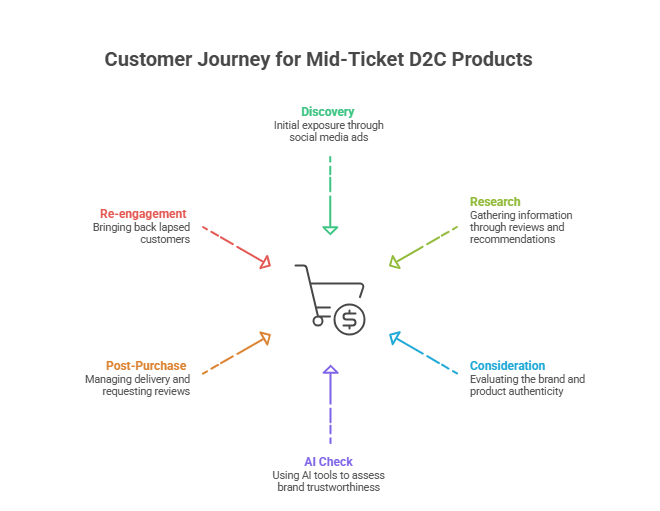 A more realistic picture for a mid-ticket D2C product looks something like this:
- Discovery: A YouTube pre-roll or an Instagram Reel catches their attention for the first time. They watch it, maybe save it, and keep scrolling.
- Research: A few days later they search Google for reviews. They ask a friend about it on WhatsApp. They find a long YouTube review from a creator whose opinion they trust and watch most of it.
- Consideration: A Meta retargeting ad surfaces the product again while they are scrolling. They visit the brand’s Instagram to see if the comments seem genuine and whether real customers are posting about it.
- AI Check: They ask ChatGPT or Perplexity if the brand is trustworthy. The AI pulls from review aggregators, press mentions, and indexed content.
- Conversion: A Google Search ad with a discount offer captures the final purchase intent. Alternatively, a WhatsApp broadcast with a limited-time offer closes the deal.
- Post-Purchase: Automated WhatsApp messages handle delivery updates and a review request. An email sequence offers a complementary product two weeks later.
- Re-engagement: A Meta retargeting campaign or WhatsApp re-engagement message brings lapsed buyers back into the funnel three months later.
Mapping this journey for your specific product and audience is the foundation of an effective omnichannel strategy. Without understanding where buyers actually go and what they actually do between discovering you and purchasing, channel selection becomes guesswork.
Omnichannel Marketing Mistakes Indian Brands Make
After spending years navigating the nuances of D2C, EdTech, Fintech, and B2B sectors, I’ve noticed the same omnichannel errors popping up time and again. The good news? Most of them are actually quite easy to fix once you spot them.
1. Treating Every Channel Like a Siloed Department: This is perhaps the most frequent structural blunder we see. It happens when the paid media team is chasing one KPI, the content team is focused on another, and the CRM guys are living in their own bubble. When this happens, the customer experience feels broken. The person getting your WhatsApp message should feel like they are talking to the same brand they just saw on a Google search, not a different company that just happens to use the same logo.
2. Falling for the “Last-Click” Attribution Trap: If you only ever look at the very last touchpoint, Google and Meta are always going to look like the heroes of your story. Why? Because they’re usually the ones catching that final click right before the sale happens. But that’s a dangerously narrow view. It completely ignores the YouTube video that first put you on their radar, the WhatsApp message that pulled them back to the site, or the week-long email sequence that actually built the trust needed to buy.
To make budget decisions that reflect how real people actually shop in 2026, you need an omnichannel strategy backed by models that give credit to the whole journey, not just the person who crossed the finish line. If you keep ignoring the “assist” and only rewarding the “goal,” you’ll eventually starve the very channels that are feeding your funnel.
3. Ignoring the Power of Owned Media: It’s easy to forget that social media followers and ad placements are essentially “rented” space. If an algorithm changes or ad prices spike, your visibility can vanish in an instant. On the other hand, your email lists, WhatsApp opt-in databases, and organic search rankings belong to you. Brands that fail to grow these owned assets are always one update away from a crisis. Investing in your own platforms is how you eventually drive down customer acquisition costs instead of watching them climb every single year.
4. Being on multiple channels without connecting them at all: Eight separate channels running eight separate campaigns is not omnichannel. It is just expensive multichannel. If a customer mentions to your WhatsApp bot that they are interested in a specific product, they should not be shown a Meta ad for something completely different an hour later. Real integration requires a CRM or customer data platform that shares behavioural signals across channels so each one knows what the others are doing.
5. Underestimating the offline-to-online gap: Many Indian brands have excellent digital marketing but no mechanism for capturing customers who discover them offline and want to engage digitally. A phone number on packaging with no WhatsApp opt-in, a store visit with no loyalty capture, a sales call with no CRM entry, each of these is a missed connection in the omnichannel journey.
Measuring Omnichannel Performance: Beyond Last-Click
Measurement is honestly where most omnichannel strategies quietly fall apart. The tools and frameworks most brands use were built for one or two channels. Apply them to a genuine omnichannel stack and you get a distorted picture that consistently rewards the easiest-to-measure channels and ignores the ones doing the hardest work.
Metrics Worth Tracking at Each Layer
| Channel Layer | Primary Metrics | What They Tell You |
| Awareness (YouTube, Display, Social) | Reach, frequency, brand search lift | Whether awareness campaigns are creating recognisable recall |
| Consideration (Content, Email, WhatsApp) | Engagement rate, email open rate, WhatsApp CTR | Whether nurture content is building purchase intent |
| Conversion (Google Search, Meta, WhatsApp BOFU) | ROAS, CPA, conversion rate | Whether bottom-of-funnel campaigns are closing efficiently |
| Retention (Email, WhatsApp, CRM) | Repeat purchase rate, LTV, churn rate | Whether post-purchase experience is building long-term value |
| Overall Stack | LTV:CAC ratio, blended ROAS, revenue by channel | Whether the full omnichannel setup is actually profitable |
Why Last-Click Attribution Specifically Fails Here
Last-click logic works fine if you’re only using one channel, but it starts lying to you the moment you scale. What happens is the final click before a purchase steals 100% of the glory. Meanwhile, the YouTube ad that sparked interest or the WhatsApp nudge that built trust get credited with precisely nothing. If you follow that math, you’ll end up starving the very channels that made the sale possible in the first place. It is a guaranteed way to break your funnel by over-funding the “closer” and ignoring the “assist.”
Data-driven attribution is the fix. It spreads the credit across every single touchpoint that played a part, weighting them by their actual influence instead of just their spot in line. When you pair this with incrementality testing, basically seeing what happens to your sales if you actually turn a specific channel off for a bit, you get a much more honest picture of what’s actually working in your omnichannel stack.
For brands already leaning into AI-driven automation, this measurement isn’t just a monthly report anymore. It’s handled by systems that track individual journeys across different platforms in real time. Honestly, it’s a massive step up from those old-school aggregated reports that tend to flatten out and hide the cross-channel connections that actually drive your revenue.
Budget Allocation Across an Omnichannel Stack
One of the most practical questions in omnichannel marketing is how to allocate budget across a multi-channel mix without over-indexing on what is easily measurable and under-investing in what is genuinely valuable but harder to attribute.
A useful starting framework for Indian brands, adjusted based on business model and stage:
Performance-first brands (D2C, e-commerce, lead gen):
-
- 50-60% on paid acquisition: Google, Meta, and click-to-WhatsApp as primary channels
- 15-20% on content, SEO, and organic
- 10-15% on WhatsApp and email as retention and nurture
- 10% on brand, YouTube, and awareness
Brand-led businesses (B2B, enterprise, high-ticket services):
-
- 35-45% on content, SEO, and thought leadership
- 10-15% on events, PR, and offline touchpoints
- 15-20% on email, CRM, and WhatsApp nurture
- 25-35% on paid media: Google Search and LinkedIn primarily
The principle worth holding onto in both models is ring-fencing budget for owned channel development. Email list building, WhatsApp opt-in growth, and SEO-driven content creation are the assets that reduce acquisition costs over time, rather than rising alongside platform inflation.
Omnichannel Marketing for Different Indian Business Types
The omnichannel strategy that works for a D2C beauty brand is quite different from the one that works for a B2B SaaS company. Here is a quick breakdown:
| Business Type | Primary Omnichannel Channels | Key Integration Points |
| D2C / E-commerce | Meta, Google, WhatsApp, YouTube, Email | Cart recovery, post-purchase WhatsApp, loyalty CRM |
| EdTech | Meta, Google, YouTube, WhatsApp, Organic | Lead nurture via WhatsApp, course completion CRM, referral loops |
| Fintech / BFSI | Google Search, Content, Email, WhatsApp | Trust content, compliance-aware WhatsApp, advisor handoff CRM |
| Healthcare | Google Local, Content, WhatsApp, Offline | Appointment reminders, post-visit follow-up, local SEO integration |
| B2B / SaaS | LinkedIn, Google Search, Email, Content | Long-cycle nurture, sales-marketing CRM alignment, account-based content |
| Retail / Phygital | Meta, Google, WhatsApp, In-store QR, Offline | Digital-to-offline loyalty capture, WhatsApp post-visit follow-up |
Bottom Line
By 2026, the average Indian consumer isn’t just sitting on one or two apps waiting for an ad. They are bouncing between YouTube, WhatsApp, Instagram, and even physical stores, sometimes all in the same afternoon. They expect your brand to keep up with them. If your messaging feels disjointed or you lose track of them the moment they switch apps, you’re going to lose the sale.
True omnichannel marketing isn’t about shouting from every rooftop; it’s about being present at the exact moments that matter with a message that actually makes sense. It’s about looking at the whole race, not just the person who crossed the finish line
As a leading Digital Marketing Agency in Gurgaon, Prohed specializes in building these exact types of connected systems. Whether you are in D2C, EdTech, or Fintech, we help you move past a “two-platform” dependency and into a strategy that drives real, scalable growth. If you’re ready to unify your marketing and actually see the full picture, let’s have a conversation.
Frequently Asked Questions
1. What is the real difference between omnichannel and multichannel marketing?
Multichannel is just “being everywhere,” but often in silos. Omnichannel is much smarter, it’s about making those platforms actually talk to each other. Think of it as moving from just having a presence to creating one seamless, connected experience for your customer.
2. Which channels should an Indian brand focus on in 2026?
It varies, but a solid 2026 mix uses Google and Meta for discovery, WhatsApp for nurturing, and YouTube to build real trust. While SEO creates your long-term organic base, a CRM or email layer acts as the glue that ties every single touchpoint into one cohesive funnel.
3. How do I measure ROI when so many channels overlap?
Last-click attribution is too narrow for 2026. Instead, use data-driven models that spread credit across the whole journey. For the real truth, try incrementality testing, pause one channel for a bit to see how its absence actually impacts your total bottom-line conversions.
4. Is this strategy only for big brands with massive budgets?
Not at all. A startup linking Meta ads to a simple WhatsApp flow is already doing omnichannel. While the tech gets fancier as you scale, the core goal, keeping a consistent, helpful brand voice across every platform, is something any brand can do, regardless of their budget.
5. How does AI actually help with omnichannel marketing?
AI acts as the “brain” of your stack, moving budgets between channels in real-time. It also handles massive scale by personalizing WhatsApp content for individual users and ensuring your brand is cited as an authority in AI search engines like ChatGPT and Perplexity.
6. How important is offline integration in an Indian omnichannel strategy?
It’s actually much more vital than most digital-first teams want to admit. Since a massive chunk of Indian retail still happens offline, a digital-only strategy ignores the moment where most customers actually open their wallets. You don’t need a massive tech overhaul to fix this; simple things like QR codes in-store or WhatsApp opt-ins at the billing counter go a long way. Closing that gap ensures your brand stays in the conversation from the moment they see an ad to the second they walk out of a physical store.
7. What is the biggest omnichannel mistake Indian brands make?
The biggest pitfall is treating every platform like a siloed business rather than a single journey. When you only look at individual channel metrics, you end up “starving” the channels that do the hard work of nurturing the customer. Usually, this leads to brands over-rewarding the final click while ignoring the YouTube ad or email sequence that actually convinced the person to buy. It’s a recipe for a broken funnel that looks good on paper but fails in reality.
8. What tools do Indian brands use to manage omnichannel campaigns?
While everyone has their favorite stack, like Wati for WhatsApp, HubSpot for CRM, or Klaviyo for email, the specific logo on the software matters less than you think. What actually matters is whether your tools are talking to each other. If your GA4 data isn’t shaking hands with your CRM, you’re just flying blind. The goal isn’t just to have the “best” tools, but to have a connected ecosystem where data flows freely between Google, Meta, and your internal systems.
9. How is omnichannel different for Tier 2 versus Tier 1 Indian cities?
In practice, you’re dealing with two totally different worlds. While a shopper in Delhi might be fine with a slick, English-only site, that approach usually flops in Tier 2 cities. Out there, trust is everything. People lean heavily on WhatsApp for reassurance and expect regional language content before they ever hit “buy.” Since these buyers often research online for weeks before visiting a shop, your strategy has to respect that slower pace. Get the language or platform wrong, and your brand basically becomes invisible.
10. How do I get my offline and online teams to actually work together?
Let’s be real: this is a management headache, not a technical one. Teams often fail because they live on “islands,” chasing their own isolated targets. To fix this, you have to force everyone to work from a single, shared map of the customer journey. Instead of celebrating small channel wins, use your weekly meetings to find where customers are actually getting stuck. When everyone is rewarded for the final sale, no matter where it happened, those internal walls tend to crumble fast.