Your customer isn’t Googling you anymore. Well, not only Googling you.
They’re searching for you on Instagram. They’re asking ChatGPT whether your product is worth buying. They’re watching YouTube reviews before they even think about visiting your website. And if you happen to sell on Amazon, your product listing is being judged by an algorithm that has nothing to do with Google at all.
This is the reality of search in 2026. And most brands are still playing by 2019 rules.
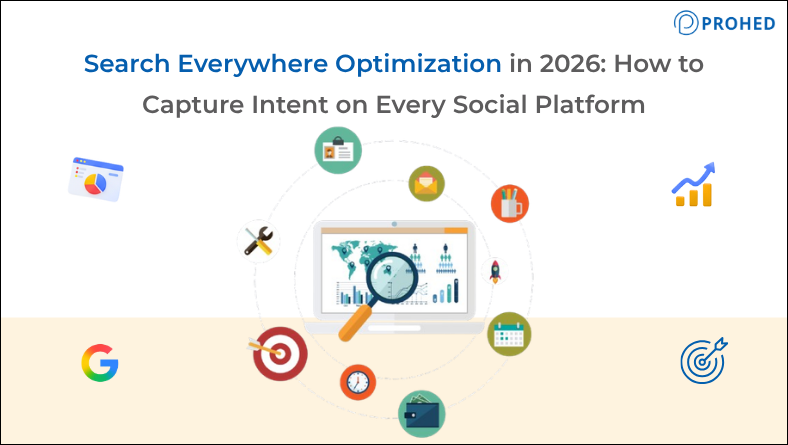
Search everywhere optimization is the practice of making your brand discoverable across every platform where your audience is actively looking, not just search engines, but social platforms, marketplaces, AI tools, and video platforms too. If your current search strategy only accounts for Google rankings, you’re invisible in places where a huge chunk of your potential customers are making decisions right now.
Here’s how to fix that.
The 2026 Search Landscape at a Glance
Platform | User Intent Type | Optimization Priority |
Google/AI | Information & Facts | Structured data & Direct Q&A |
Instagram/TikTok | Discovery & Lifestyle | On-screen text & Searchable captions |
YouTube | Deep Understanding | Keyword-rich titles & Timestamps |
Amazon | Immediate Purchase | High-conversion images & A+ content |
Is your brand invisible where it matters most? We don’t just “do SEO.” We build a presence that captures intent across every platform your customers actually use.
Get a Free Multi-Platform Search Audit with PROHED Today
Why Google Alone Isn’t Enough Anymore
Think about the last time you wanted to find a good restaurant, a skincare product, or a course to learn a new skill. Did you open Google immediately? Or did you check Instagram first? Maybe TikTok? Maybe you just asked an AI chatbot?
The way people search has fundamentally changed. According to multiple studies, a significant portion of Gen Z now uses Instagram and TikTok as their primary search engines. YouTube has been the world’s second-largest search engine for years. And since the rise of ChatGPT and Gemini, AI-generated answers are now intercepting queries that would have previously sent users to a website.
The intent is still there. People still want to find things, compare options, and make decisions. But the platforms where that intent is being expressed have multiplied dramatically. A smart search everywhere optimization strategy follows the intent, wherever it goes.
Platform by Platform: Where Intent Lives in 2026
1. Google – Still the Foundation, But Evolving Fast
Google isn’t dying, but it’s definitely evolving. Those AI Overviews at the top? They’re answering questions before anyone even thinks about clicking a link.
AI search optimization in 2026 isn’t about gaming a rank; it’s about being cite-worthy. You need clear headers and no-nonsense answers that AI can easily parse. Think of it this way: keywords still matter, but being the authoritative source that an AI chatbot quotes is the new “Position Zero.”
2. Instagram – The New Discovery Engines
People are searching Instagram like they used to search Google, looking for specific product names, brand vs. brand face-offs, and “how-to” guides. But instead of a wall of text, they want a Reel.
If you aren’t optimizing your social content for search, you’re hand-delivering leads to your competitors. Use searchable keywords in your captions and on-screen text. Treat your bio like a high-converting landing page, not a place for a witty one-liner.
3. YouTube – The Search Engine People Forget Is a Search Engine
YouTube SEO optimization is one of the highest-ROI activities a brand can invest in right now, and most brands are doing it half-heartedly at best.
YouTube isn’t just for entertainment; it’s where people go to see if a product actually works. A smart YouTube strategy keeps your brand relevant for years.
To win here, stop guessing. Use titles that match what people actually type into the search bar. Use timestamps to help users (and Google) find the exact answer they need. Treat your video description like a mini-blog post. Most importantly, make sure your content answers a real question your audience is asking, rather than just shouting about your features.
4. Amazon – Where Product Search Actually Converts
If you sell physical products, Amazon SEO is arguably more commercially important than Google SEO. People who search on Amazon aren’t browsing. They’re buying, or very close to it. The intent is transactional and the competition is fierce.
Amazon’s A9 algorithm rewards relevance and conversion history. That means product titles need to be built around how people actually search (not how brands like to describe themselves), bullet points need to answer the questions that would otherwise stop a buyer from converting, and A+ Content needs to build enough trust that someone who’s never heard of your brand feels comfortable hitting “Add to Cart.”
Prohed works with e-commerce brands on exactly this, building listing strategies that improve organic Amazon rankings while running Sponsored Ads that compound the visibility. When both sides are managed together, the results compound faster than either does in isolation.
5. AI Search – The New Frontier Nobody’s Fully Cracked Yet
ChatGPT, Gemini, Perplexity, Claude, these tools are now being used for product research, brand comparisons, and purchase decisions. And they pull their answers from what’s available on the web, structured in ways they can parse and trust.
Think of AI search as a massive game of telephone where the AI only repeats what it can clearly understand and trust. To win here, you have to be present in the places where these models go to learn. This means getting your brand mentioned on reputable third-party sites, not just your own.
You also need content that’s actually structured for a machine to read, think ultra-clear descriptions of who you are and who you help. Use FAQ-style blocks that answer the exact questions people are firing into ChatGPT or Gemini about your industry. The brands getting cited right now aren’t always the ones with the biggest budgets; they’re the ones with the most structured, trustworthy, and widely referenced content on the web.
Also Read: Top 7 SEO Agency in Gurgaon (2026) | Reviewed & Ranked
What Omnichannel Search Actually Looks Like in Practice
Here’s a real-world scenario. A working professional is thinking about buying a premium yoga mat. Here’s the journey that might actually happen:
She searches “best yoga mat for bad knees” on Google. Reads a couple of articles. Then opens Instagram and searches the same thing, watches a few Reels from fitness creators who review mats. One brand keeps showing up, so she searches them on YouTube. Watches a 4-minute video showing how the mat performs. Then heads to Amazon, searches the brand name, reads the reviews, and buys.
Five touchpoints. Four different platforms. One purchase decision.
This is what omnichannel marketing looks like when it works, and this is exactly why search everywhere optimization matters. If your brand had dropped out at any point in that journey, a competitor stepped in.
The brands winning in 2026 aren’t just showing up on Google. They’re present at every point where intent surfaces.
Building Your Search Everywhere Strategy: Where to Start
This can feel overwhelming, and trying to do everything at once is a guaranteed way to do nothing well. So here’s a more practical way to think about it:
Start with your audience’s actual search behavior
Where do they discover products like yours? What platforms do they use to research before buying? The answer varies significantly by category, age group, and product type. A B2B software brand and a D2C skincare brand need very different platform priorities.
Then audit where you currently have presence versus where you’re invisible
Most brands are surprised by how many high-intent searches are happening in channels they’ve completely ignored. That gap is both a problem and an opportunity.
Build platform-specific content, not repurposed content
What works as an Instagram caption doesn’t work as a YouTube description. What ranks on Google doesn’t automatically rank on Amazon. Each platform has its own algorithm, its own content format, and its own version of what “optimized” means.
This is where Prohed’s approach to search strategy becomes genuinely useful. Rather than treating SEO, paid media, and social as separate functions, the work is built around a unified picture of where your customer is searching and how to be present at every stage. That kind of connected thinking, across Google, YouTube, Amazon, and social, is what omnichannel marketing actually requires in 2026.
The Brands Getting Left Behind Are the Ones Still Thinking in Channels
Here’s the honest reality. A lot of marketing teams are still organized in silos, one person handles SEO, another runs paid ads, a third manages social. Each channel is optimized independently. Nobody is looking at the full picture of how a customer actually moves through their decision process.
That structure made sense five years ago. It doesn’t anymore.
Search everywhere optimization isn’t a tactic you add to the list. It’s a mindset shift in how you think about discovery, intent, and presence. The brands that internalize this in 2026 will build compounding visibility across every platform their customers use. The ones that don’t will keep pouring budget into one channel while leaking opportunity everywhere else.
If your brand is ready to build a search presence that actually maps to how people make decisions today, not how they did in 2019, working with an experienced SEO Agency in India that understands the full landscape is the most efficient place to start. Because doing this well across every platform simultaneously isn’t something most in-house teams can build from scratch.
Prohed’s SEO and performance marketing work is built for exactly this, helping brands show up where it matters, across every channel that moves the needle.
FAQs:
1. What actually matters most for AI search optimization?
It really comes down to two things: structure and authority. You need to use clean Schema markup so the code is readable, and you have to provide direct, “no-fluff” answers. If an AI can easily scrape a factual answer from your site and verify it elsewhere, it’s much more likely to cite you as the expert source.
2. How do I make sure people find my TikTok and Instagram videos?
The algorithms are listening and reading everything now. You need to say your keywords out loud in the video, put them in the on-screen text overlays, and front-load them in the first two lines of your caption. If the app can “hear” and “see” what the video is about, it’ll know exactly who to show it to.
3. Is it true that YouTube videos help Google rankings?
Definitely. Google loves showing video snippets for “how-to” or product review searches. By optimizing a YouTube video, you’re basically getting a second shot at ranking on page one of Google without having to fight for a traditional blue link.
4. Is Amazon SEO really that different from Google?
Honestly, they’re two different worlds. While Google looks for information and authority, Amazon cares almost entirely about one thing: will this person buy? Your listings need to be optimized for immediate conversion and high-velocity sales. If you don’t convert, you don’t rank, it’s as simple as that.
Schedule a Free Strategy Call with PROHED Today