App marketing involves acquiring, activating, and retaining mobile users through paid campaigns, creatives, and targeting. Profitable scaling relies heavily on tracking cost-per-install and cost-per-action. At Prohed, a performance marketing agency in Gurgaon, our experience across logistics, gaming, and edtech proves that strategic execution can reduce app marketing costs by 40%.
There’s a version of app marketing that every founder eventually experiences. The campaigns are live. The installs are coming in. And yet the unit economics look worse every week, cost per install creeping up, cost per action nowhere near the target, and a growing sense that spending more isn’t solving the problem. It’s creating a larger version of it.
That’s a familiar story. However, the more interesting one is what happens when the strategy gets rebuilt properly.
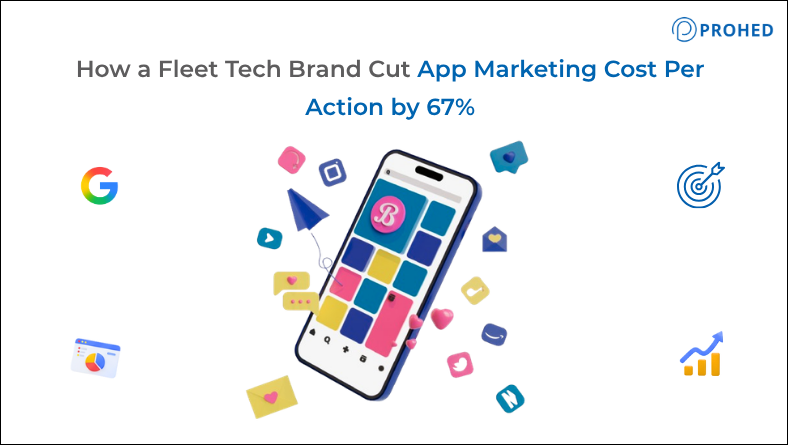
At Prohed, one of the best performance marketing agencies in India, we worked with a fleet technology company that was facing exactly this situation. Their app had genuine product-market fit. Their target audience, fleet owners and logistics operators across India, was real and reachable. What wasn’t working was the approach to mobile app marketing. And once that changed, the numbers shifted in a way that’s worth understanding in detail.
Why Most App Install Campaigns Underperform
Before getting into strategy, it’s worth naming the pattern that keeps app advertising costs high for most brands.
Most app install campaigns are built around a single objective: drive installs as cheaply as possible. The bid is set, the creative goes live, and the campaign runs until the budget runs out. Consequently, what tends to happen is that early, low-cost installs exhaust the most receptive audiences quickly. After that, the algorithm has to reach progressively less relevant users to maintain volume, and cost per install climbs.
Additionally, most campaigns treat the install as the finish line. However, for any app where in-app activity, a trip, a booking, a transaction, is the real business outcome, optimising for installs alone is optimising for the wrong thing entirely. Cost per action is what actually matters, and in-app advertising strategy has to be structured around it from day one.
The Prohed App Growth Framework: How It Works
Before the case study, it’s useful to understand the structured approach Prohed applies to app marketing strategy. We call it the Prohed App Growth Framework, a four-stage system built around data collection, audience precision, creative relevance, and platform utilisation.
The framework addresses the four decisions that most commonly determine whether an app marketing strategy works or fails.
Stage 1: Fill the Data Gaps Before Spending Heavily
The single most costly mistake in mobile app marketing is scaling spend before the measurement foundation is solid. If the mobile measurement partner isn’t configured correctly, if event tracking is incomplete, or if the campaign is optimising toward an event that doesn’t have enough conversion volume, the algorithm is essentially flying blind.
Therefore, the first stage of the Prohed App Growth Framework is always a data audit. This covers MMP configuration, in-app event taxonomy, conversion window settings, and attribution logic. Gaps that go unaddressed at this stage cost significantly more to fix later, both in budget wasted and in time lost rebuilding audience signals.
For most apps, this audit surfaces three to five issues that are silently degrading campaign performance. Fixing them before scaling is the single highest-ROI activity available in the early weeks of an app install campaign.
Stage 2: Build Audience Targeting Around Geography and Behaviour – Not Just Demographics
Standard app advertising targeting starts with age, gender, and interest categories. For most apps, however, those signals are too broad to drive efficient cost per install. The brands that achieve the lowest cost per action are building audience strategy around behavioural signals and geographic precision.
For a B2B app like a fleet management platform, this means:
- Identifying the regions where the target user, in this case, fleet operators, is most active and most likely to have a genuine use case for the product
- Building custom audience lists based on local market data rather than national broad targeting
- Using lookalike audiences seeded from the highest-value in-app action events, not just installs
This geographic and behavioural precision is consistently one of the best app marketing strategies for reducing wastage at the top of the funnel. Furthermore, it tends to improve retention metrics downstream, because users acquired through precise targeting are genuinely more likely to use the app repeatedly.
Stage 3: Use Every Platform Placement – Don’t Default to One
A common pattern in mobile app marketing is defaulting to one primary channel, usually Meta or Google UAC, and running most of the budget through it. This approach is easy to manage. However, it leaves significant performance on the table.
Accordingly, the Prohed App Growth Framework uses all available placements across each platform simultaneously:
- Google Universal App Campaigns covering Search, Play Store, YouTube, and Display Network simultaneously
- Vernacular ad creative to reach users in regional languages, particularly important for logistics and fleet apps where the end user is often more comfortable in Hindi, Tamil, Telugu, or Kannada than in English
- YouTube pre-roll for awareness among cold audiences before conversion-focused campaigns reach them
- Meta and Instagram for retargeting users who’ve shown app-adjacent interest signals
The platform mix isn’t fixed. Instead, it’s adjusted weekly based on where cost per install and cost per action are most efficient. Budget follows performance signal rather than a predetermined allocation.
Stage 4: Optimise for In-App Actions From Day One
Finally, the last stage of the framework, and the one that most directly determines cost per action, is campaign objective alignment.
Most app marketing agencies set install campaigns to optimise for installs. Prohed structures campaigns to optimise for the specific in-app action that represents genuine user value, a completed trip, a registered vehicle, a first transaction, from the very beginning of the engagement.
This means the algorithm is trained on the right signal from the start. Consequently, as conversion data accumulates, the targeting improves toward users who are more likely to take that valuable action rather than simply download and abandon the app.
This single structural change, optimising for the right event rather than the easy event, is where a significant portion of the cost per action reduction comes from.
Related Read: Top 7 App Marketing Agencies in India for App Installs and Engagement Growth
The Real Story: What Happened With the Fleet Tech Brand
The numbers cited in this article’s title aren’t hypothetical. They came from a real campaign, and the full story is worth reading.
A leading fleet technology company in India came to Prohed with a clear brief: grow app installs for their fleet management platform and drive in-app trips by fleet owners. The audience was specific, logistics operators and fleet owners across India’s highway corridors. The challenge was that existing app advertising was generating installs at a high cost per install, with in-app activity significantly lower than targets.
Prohed applied the App Growth Framework in full. Specifically, we ran Google Universal App Campaigns with vernacular ad creative, identified the highest-load regions across India’s logistics network for sharp geographic targeting, built custom audience lists based on local market data, and restructured campaign objectives around in-app trip completion rather than install volume.
The results, achieved within three months, moved the needle further than the client expected. However, rather than listing every number here, the full picture, including the go-to-market strategy, the platform breakdown, and what the week-by-week progression looked like, is documented in the complete case study.
If you’re running an app install campaign for a B2B or mobility app, it’s worth fifteen minutes of your time.
Read the Full Rivigo Case Study Here
5 Best App Marketing Strategies to Reduce Cost Per Install in 2025–26
Beyond the framework, here are the five best app marketing strategies that consistently reduce cost per install and improve in-app engagement across categories.
1. Invest in Vernacular Creative Early
India’s app users are not a monolith. A fleet owner in Rajasthan and a logistics manager in Tamil Nadu interact with content differently. Mobile app marketing that runs only English creative is leaving a significant portion of the target audience underserved, and consequently paying more to reach users who aren’t converting.
Vernacular ad creative in Hindi, Marathi, Tamil, Telugu, Kannada, and Bengali, consistently outperforms English-only creative in Tier 2 and Tier 3 markets. Therefore, building language variants into the app marketing strategy from the start lowers cost per install in markets where the product has genuine demand but creative hasn’t matched the audience.
2. Separate Awareness and Conversion Campaigns
Running a single app install campaign aimed at both cold and warm audiences simultaneously is one of the most common efficiency killers in mobile app marketing. Cold audiences need to understand what the app does before they’re ready to install it. Warm audiences, those who’ve already seen the app or interacted with related content, need a direct, clear conversion prompt.
Mixing both audiences in one campaign means the creative has to serve two incompatible purposes. Consequently, it serves neither particularly well. Separating awareness and conversion campaigns by audience temperature is a structural fix that improves both cost per install and post-install retention.
3. Use Play Store and App Store Optimisation Alongside Paid Campaigns
App advertising drives traffic to the store listing. However, if the listing itself – screenshots, description, first impression, isn’t optimised, a meaningful percentage of that paid traffic abandons before installing.
App Store Optimisation isn’t a substitute for paid app marketing. It’s a multiplier on it. Brands that improve their store listing in parallel with paid campaigns consistently see lower cost per install from the same spend, simply because the conversion rate of store page visits to installs improves.
4. Build a Retargeting Layer for Lapsed Users
In-app advertising retargeting, reaching users who installed but haven’t completed a key in-app action, is one of the most under-utilised levers in mobile app marketing strategy. The audience already trusted the app enough to install it. Reactivating them costs a fraction of what acquiring a new user does.
For apps where the key business event is a repeat action, a trip, a transaction, a booking, retargeting lapsed users with specific, action-oriented creative regularly produces the lowest cost per action in the entire campaign mix. Furthermore, it improves overall retention metrics, which tends to improve algorithmic performance on the acquisition side as well.
5. Review Creative Weekly, Not Monthly
App advertising creative fatigues faster than most marketing formats. A creative that performs strongly in week one is often showing significant efficiency decline by week three, as the same audiences see it repeatedly.
Therefore, the best app marketing agencies build creative review into a weekly cadence rather than a monthly one. This means tracking frequency alongside cost per install and cost per action at the creative level, refreshing underperforming assets proactively, and testing new formats, video, static, playable ads, before existing creative fatigues completely.
Where Prohed Fits Into Your App Marketing Strategy
App marketing done well is not a single campaign. It’s a connected system, data infrastructure, audience architecture, creative strategy, platform utilisation, and post-install engagement all working together. When any one of those elements is missing, the others underperform.
At Prohed, our app marketing agency work is built around exactly this kind of full-system thinking. We don’t run app install campaigns in isolation. Our broader digital marketing services and marketing services, including Search Engine Marketing, Social Media Marketing, SEO, B2B Lead Generation, and E-commerce Marketing, are built to work alongside app marketing strategy so that every growth lever is pulling in the same direction.
For app-first brands, that means the paid acquisition strategy, the content that supports organic discovery, and the retention campaigns that protect LTV are all designed as one system rather than three separate workstreams managed by separate teams.
This is, fundamentally, why the fleet tech results described above came together the way they did, and why they held at scale rather than collapsing once spend increased.
Frequently Asked Questions
1. What is app marketing and why does it matter for mobile-first businesses?
App marketing is the end-to-end strategy for acquiring, activating, and retaining app users, covering paid app advertising, creative strategy, audience targeting, store optimisation, and post-install engagement. For mobile-first businesses, it directly determines cost per install, cost per action, and ultimately whether the user base grows profitably or at a loss.
2. What is a good cost per install benchmark for Indian apps in 2025–26?
Cost per install benchmarks vary significantly by category. For B2C consumer apps in India, a healthy CPI typically sits between ₹20 and ₹60 depending on the vertical. B2B and logistics apps tend to have higher CPIs, often ₹80 to ₹200, because the target audience is smaller and more specific. However, cost per action is ultimately the more meaningful metric, since a low CPI with poor post-install engagement creates negative unit economics.
3. How does a mobile app marketing agency reduce cost per action?
A powerful mobile app marketing firm cuts CPA by starting your campaign with the right in-app event, honing audience precision through behavioural and geographic precision, executing vernacular creative to reach regional audiences efficiently and structuring awareness and conversion campaigns separately. All four collaborate to improve your install quality and post-install engagement rates.
4. What platforms work best for app install campaigns in India?
Google Universal App Campaigns, covering Search, Play Store, YouTube, and Display simultaneously, are typically the highest-volume channel for app install campaigns in India. Meta and Instagram add strong retargeting and warm audience coverage. For B2B and logistics apps specifically, geographic precision within UAC campaigns and vernacular creative are the two highest-impact levers for reducing cost per install.
5. How important is vernacular creative in mobile app marketing?
An absolute must, especially if your app is a Tier 2/Tier 3 town or made by a fleet owner, as a farmer or as field service app. Ad creative in those regional languages – Hindi, Tamil, Telugu, Kannada, etc, works way better than English only creative with those users and often lowers your cost per install by 30% to 50% in regional markets where your English creative just doesn’t resonate.
6. Should B2B app campaigns be structured differently from B2C?
Yes, significantly. B2B mobile app marketing strategy needs sharper geographic targeting, longer consideration windows, and campaign objectives aligned to high-value in-app actions rather than raw install volume. Creative should address specific professional pain points rather than broad consumer messaging. Additionally, B2B apps often benefit from LinkedIn and YouTube as supplementary channels alongside Google UAC.
7. How does Prohed approach app marketing for growth-stage brands?
At Prohed, we don’t just throw money at ads. First, we fix your data tracking gaps. Then, we target users by behavior and location, launch local-language ads, and focus entirely on actions that drive real business value. This Prohed App Growth Framework is exactly how we cut costs per action by 67% and grew installs by 2.5x for the featured fleet tech brand.
8. What is in-app advertising and how does it fit into an app marketing strategy?
In-app advertising refers to ads shown within other apps to reach users who are likely to install or re-engage with your app. It sits within the broader app marketing strategy as a precision retargeting and awareness channel. For brands managing active app install campaigns, in-app placements on relevant apps, particularly those with overlapping audiences, add efficient reach that supplements platform-native UAC and Meta campaigns.
Ready to replicate these results for your own mobile app?
Schedule a Free Strategy Call with PROHED Today