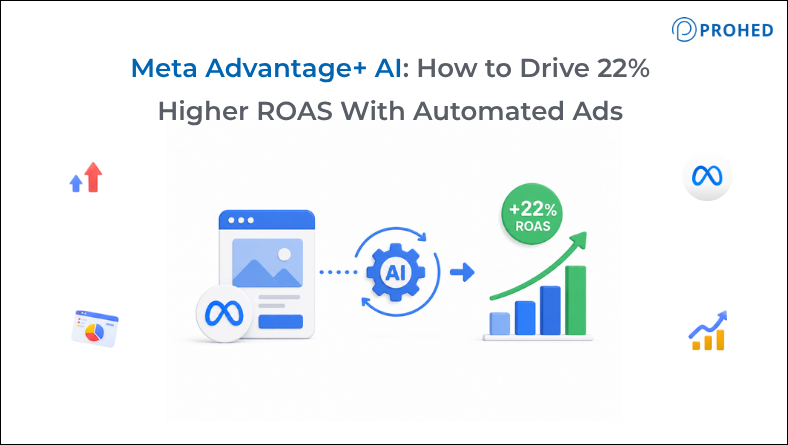
Meta Advantage+ AI is Meta’s suite of AI-powered campaign automation tools that handles audience targeting, placement selection, creative rotation, and bid optimisation automatically. Instead of manually building audiences and selecting placements, the algorithm uses millions of real-time signals to find the right person at the right moment. According to Meta’s internal data, Meta Advantage+ Shopping Campaigns deliver up to 22% higher ROAS compared to traditional manual campaign setups. At PROHED, a performance marketing agency in Gurgaon, we run automated ads across D2C, EdTech, and healthcare accounts, and the results consistently validate that number, when the campaign is structured correctly.
Most advertisers approach Meta Advantage+ AI one of two ways.
They either hand everything to the algorithm and wonder why results are unpredictable. Or they over-control every setting, strip the AI of the data it needs, and then conclude that automation doesn’t work.
Neither approach is right. The 22% ROAS improvement Meta cites isn’t automatic. It’s conditional. It happens when advertisers stop trying to manage the algorithm and start building the right environment for it to learn.
Here’s exactly what that looks like.
Manual Campaigns vs Meta Advantage+: What Actually Differs
Before getting into structure, it helps to be specific about what Advantage+ actually changes.
Factor | Manual Campaigns | Meta Advantage+ AI |
Audience targeting | Interest groups, lookalikes | Algorithmic, broad signal-based |
Placement selection | Manual per placement | Dynamic across all placements |
Creative rotation | Manually controlled | Auto-optimised toward best performer |
ROAS benchmark | $3.70 per $1 spent | $4.52 per $1 spent (Meta internal data) |
Learning speed | Slower, fragmented data | Faster with consolidated budget |
Scaling approach | Manual bid and budget adjustments | Algorithm scales toward efficiency |
The core difference isn’t features. It’s data consolidation. Automated ads in Advantage+ pool conversion signals across a unified campaign, which lets the algorithm learn faster and find higher-value customers that manual targeting would have excluded.
The PROHED Advantage+ Setup Framework
At PROHED, we use a four-part setup structure for every Meta Advantage+ Shopping Campaign. Each part directly influences how well the AI learns and how quickly ROAS improves.
Part 1: Consolidate Budget Into One Campaign
The AI needs volume. Splitting budget across multiple ad sets fragments the conversion data the algorithm depends on. Consequently, the learning phase takes longer or never fully completes.
The right structure is one meta campaign with a consolidated budget rather than multiple campaigns targeting different audience segments. This single change alone accelerates the learning phase and reduces the frequency of “Learning Limited” status, which is one of the most common reasons Advantage+ campaigns underperform.
The 50-conversion rule applies here. For the algorithm to stabilise, the campaign needs at least 50 conversions per week. If the target CPA is ₹2,000, the minimum weekly budget should be approximately ₹1,00,000. Below that threshold, the AI is permanently data-starved.
Part 2: Optimise for Value, Not Just Conversions
Most advertisers set their facebook ads objective to “Purchase.” This tells the algorithm to find anyone who will buy. Setting the objective to Value Optimisation instead tells the algorithm to find buyers who spend more.
For Indian D2C brands with varying product price points, this distinction matters significantly. A skincare brand selling both ₹299 cleanser packs and ₹2,499 serum bundles wants the algorithm chasing the second customer, not the first. Value Optimisation directs the AI accordingly.
Part 3: Set the Existing Customer Budget Cap
Meta Advantage+ Shopping Campaigns allow a specific budget cap for existing customers. This is one of the most important settings most advertisers ignore.
Without a cap, the algorithm defaults to retargeting existing customers heavily because they convert at higher rates and lower costs. This inflates reported ROAS while contributing very little to actual revenue growth.
Setting the existing customer cap between 10 and 20% of total budget forces the AI to allocate most spend toward new customer acquisition, which is where the growth actually comes from.
Part 4: Implement Meta Conversions API (CAPI)
The Meta campaign algorithm is only as good as the data it receives. In 2026, relying on the browser pixel alone means losing 15 to 40% of conversion signals to ad blockers, Safari ITP, and cookie consent rejections.
Meta’s Conversions API sends conversion data server-to-server, bypassing browser-level signal loss. For accounts running Meta Advantage+ AI on Smart Bidding strategies, CAPI is the infrastructure decision that determines whether the algorithm has accurate data or a distorted picture of who is actually converting.
Without CAPI, even a perfectly structured Advantage+ campaign is optimising toward an incomplete dataset.
The 3 to 6 Creative Rule: Why Creative Is Now the Targeting
In manual campaigns, audience targeting was the primary lever. In Meta Advantage+ AI campaigns, creative has taken that role.
Since the algorithm selects the audience, the creative is what signals to the AI which users are most likely to respond. Consequently, a weak creative pool doesn’t just produce weak ads. It actively limits which audiences the AI can find.
The 3 to 6 rule: provide the algorithm with three to six fundamentally different creative concepts per campaign, not six versions of the same visual with different headlines.
What counts as genuinely different:
Creative Type | What It Does |
UGC testimonial video | Builds trust through authentic social proof |
Product-focused static | Highlights features and price clearly |
Before and after format | Shows transformation, outcome, or problem solved |
Educational carousel | Teaches something relevant to the target audience |
Comparison creative | Positions the product against the alternative |
Each format attracts a different behavioural signal. Together, they give the algorithm multiple angles to test and optimise toward.
Creative fatigue is the most common reason Advantage+ ROAS declines after initial success. When the same creative runs for three to four weeks in a small, defined audience, engagement rates drop and the algorithm pulls back distribution. Monthly creative refresh is the minimum cadence for campaigns spending above ₹3 lakh per month.
When Meta Advantage+ AI Works Best, and When It Doesn’t
Advantage+ is not a universal solution. Understanding when to use it prevents the budget waste that gives automation a bad name.
Works well when:
- Monthly spend is above ₹1.5 lakh per campaign
- The account has clean conversion tracking with CAPI in place
- The product has proven demand and a clear purchase cycle
- Creative variety of three to six distinct concepts is available
- The campaign objective is purchase, value, or lead generation
Works less well when:
- Budget is too low to reach 50 conversions per week
- Conversion tracking relies on pixel-only without CAPI
- The product is new with no purchase history for the algorithm to learn from
- Creative pool has only one or two variations
- The campaign objective is brand awareness or reach
Among marketing agencies in India managing performance accounts, the teams seeing the strongest Advantage+ results are the ones treating the data infrastructure and creative strategy as equally important as the campaign settings themselves.
What the Algorithm Can’t Fix
This is the part most coverage of Meta Advantage+ AI leaves out.
How to increase ROAS through Advantage+ depends entirely on what the AI is working with. The algorithm amplifies what already exists. If the product-market fit is weak, the offer is uncompelling, or the landing page conversion rate is low, automation will surface those problems faster, not solve them.
Specifically, Advantage+ cannot fix:
- A weak offer that doesn’t convert regardless of who sees it
- A slow landing page with poor mobile experience
- Misleading ad creative that generates clicks but not purchases
- A CPA target that doesn’t reflect actual business economics
Brands that expect Meta Advantage+ AI to solve fundamental business problems consistently report poor results and conclude that automation doesn’t work. In reality, the automation worked correctly. It just amplified an underlying problem that needed to be solved first.
Let PROHED Run Your Meta Advantage+ Campaigns
Running Meta Advantage+ Shopping Campaigns profitably requires the campaign structure, creative strategy, data infrastructure, and conversion economics all to be correct simultaneously.
At PROHED, facebook ads management is built around ROAS outcomes, not ad spend volume. We implement CAPI, structure campaigns for algorithm learning speed, manage creative refresh cycles, and connect ad campaign social media performance to downstream revenue data.
As one of the top digital marketing companies in India for performance-focused brands, PROHED brings the same rigor to Meta Advantage+ AI as to Google Ads, LinkedIn, and SEO. This work connects to our broader Performance Marketing, E-commerce Marketing, B2C Lead Generation, and Social Media Marketing services, because Meta campaigns don’t operate independently of the broader media mix.
As a performance marketing agency in India working with D2C, EdTech, and healthcare brands, PROHED treats AI in digital marketing as infrastructure, not novelty.
Related Read: How One Meta Ads Shift Took This D2C Brand from 1.8x to 4.2x ROAS in Just 60 Days
Conclusion
Meta Advantage+ AI delivers 22% higher ROAS when the campaign structure, creative variety, conversion tracking, and budget consolidation are all correctly in place. Without those inputs, the algorithm has nothing useful to learn from, and performance reflects that gap.
The shift from manual campaign management to automated ads isn’t about doing less work. It’s about doing the right work: building the environment the AI needs rather than trying to override the decisions it’s built to make.
Frequently Asked Questions
1. What is Meta Advantage+ AI and how does it work?
Meta Advantage+ AI is Meta’s suite of automated campaign tools that handles audience targeting, placement selection, bid optimisation, and creative rotation algorithmically. Instead of manually building audiences, the AI uses real-time behavioural signals to find the right users. Meta’s internal data shows Advantage+ Shopping Campaigns deliver up to 22% higher ROAS than traditional manual setups.
2. What is the 22% higher ROAS claim based on?
The 22% figure comes from Meta’s internal benchmark comparing Advantage+ Shopping Campaigns against manual campaign setups across their advertiser base. The Advantage+ benchmark averages $4.52 revenue per $1 spent, compared to $3.70 for manual campaigns. Results vary by account based on budget, creative quality, and conversion tracking setup.
3. How much budget do I need for Meta Advantage+ to work?
Enough to generate at least 50 conversions per week. If the target CPA is ₹2,000, the minimum weekly budget is approximately ₹1,00,000. Below this threshold, the campaign enters “Learning Limited” status and the algorithm cannot optimise effectively.
4. What is the 3 to 6 creative rule in Advantage+ campaigns?
The 3 to 6 rule means providing three to six fundamentally different creative concepts per campaign, not variations of the same image. Different creative types attract different behavioural signals, giving the algorithm multiple angles to test and optimise toward. Without creative variety, the AI has limited data to find the right audiences.
5. Is Meta Conversions API necessary for Advantage+ campaigns?
Yes, in 2026. Browser-level pixel tracking loses 15 to 40% of conversion signals to ad blockers, Safari ITP, and consent rejections. CAPI sends conversion data server-to-server, bypassing these losses. Without CAPI, Advantage+ is optimising toward incomplete data, which limits targeting accuracy and ROAS improvement.
6. Should I use Advantage+ or manual campaigns?
Use Advantage+ when monthly spend is above ₹1.5 lakh per campaign, conversion tracking is clean with CAPI in place, and three to six distinct creative concepts are available. Use manual campaigns when budget is too low to generate 50 weekly conversions, or when the product is new with no purchase history for the algorithm to learn from.
How does Advantage+ handle existing customers vs new customers?
Advantage+ Shopping Campaigns include a budget cap setting for existing customers. Without a cap, the algorithm defaults to retargeting existing customers heavily because they convert at lower cost, which inflates ROAS without driving real growth. Setting the cap at 10 to 20% of total budget directs the AI toward new customer acquisition.
Are your Meta campaigns structured to get the most from Advantage+ AI? PROHED can audit your current setup and rebuild your campaign architecture for stronger, more consistent ROAS.
Schedule a Free Strategy Call with PROHED Today