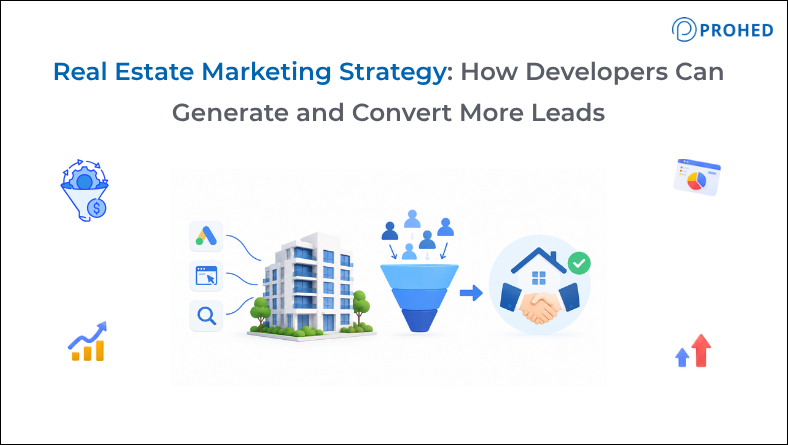
Most developers aren’t short on leads. They’re short on leads that actually show up for a site visit and don’t ghost after the third follow-up call. A solid real estate marketing strategy covers both halves of that problem: getting the right buyer into your funnel, and then actually converting them once they’re in it. At PROHED, we’ve seen developer marketing budgets get eaten up chasing volume instead of quality, which is usually the real reason sales teams complain about “bad leads” even when spend keeps climbing. This piece breaks down what actually moves the needle, from generation through to closing.
We’ve covered agency selection and media planning for real estate elsewhere on this blog if that’s more what you’re after right now. This one’s about the strategy itself.
Why Real Estate Lead Generation Is Different From Most Other Categories
A homebuyer isn’t deciding in an afternoon. Between first search and signed booking, most buyers touch a brand across multiple platforms over weeks, sometimes months, before they’re ready to commit real money.
That changes what “good marketing” actually looks like here:
- Ticket sizes are high, so a wrong lead costs a lot more in wasted sales team time than in most other industries
- Trust matters more than urgency, since nobody’s buying an apartment on impulse the way they might buy a pair of shoes
- The buying journey is genuinely fragmented, spanning property portals, Instagram, Google search, and word of mouth, often in that order
- Site visits are the real conversion event, not the form fill, which means digital marketing’s job is to get someone to show up, not just click
Developers who apply a D2C-style “more traffic equals more sales” mindset to real estate usually end up with a CRM full of unqualified leads and a sales team that’s stopped trusting marketing altogether.
Building the Lead Generation Layer
1. Get Found Where Buyers Actually Search
Real estate digital marketing starts with visibility across the specific channels buyers use at each stage:
Channel | What It’s Best For |
Capturing high-intent buyers actively searching for a project or locality | |
Meta Ads | Awareness and early-stage interest, especially for new launches |
Property portals | Buyers already in comparison mode across multiple projects |
SEO and organic content | Long-term, low-cost visibility for locality and project-specific searches |
WhatsApp and CRM-driven remarketing | Re-engaging leads who’ve gone quiet after initial contact |
Google Ads tends to deliver the highest-intent traffic since it captures people already searching for a project name, locality, or configuration type. Meta Ads does different work, building awareness during the research phase before someone even knows which project they want.
2. Qualify Before You Chase
Not every form fill deserves a sales call. A basic qualification layer, even something as simple as budget range and timeline questions built into the lead form, filters out a meaningful chunk of low-intent traffic before it hits your sales team’s calendar.
This is where a lot of property marketing budgets get wasted. Chasing raw lead volume without a qualification filter looks good on a monthly report and terrible on a conversion dashboard three months later.
3. Use Hyperlocal Targeting, Not Broad City Targeting
“Gurgaon” as a targeting radius is too wide to be useful. Buyers search by micro-market, and your campaigns should reflect that. A project near Golf Course Extension Road and one in Sohna Road are competing for genuinely different buyer profiles, even within the same city.
Related Read: Top 5 Lead Generation Agency in Gurgaon for Real Estate Growth
Building the Conversion Layer
Generation gets someone into the funnel. Conversion is where most of the actual leaks happen, and it’s the part developers underinvest in relative to media spend.
1. Speed to First Response Matters More Than Most Developers Realize
A lead that doesn’t get a callback within the first hour cools fast. Buyers researching multiple projects simultaneously will simply move to whichever developer responds first with useful information. This isn’t a marketing fix on its own, it’s a sales-ops problem that marketing needs to flag and push on.
2. Nurture the Ones Who Aren’t Ready Yet
Most leads aren’t ready to book a site visit on day one. A structured nurture sequence, project updates, price movement alerts, construction progress, testimonials, keeps a developer top of mind until intent catches up with interest. This is where real estate advertising should hand off cleanly to CRM and retargeting, rather than treating the initial ad click as the end of the job.
3. Make the Site Visit Worth the Trip
Digital marketing’s job doesn’t end at the booking. The site visit experience itself, how prepared the sales team is, how well digital data (budget, preferences, past interactions) gets passed along, directly affects whether that visit converts. A CRM that talks to your ad platforms means a buyer never has to repeat themselves to a sales executive who clearly hasn’t looked at their history.
4. Track Conversion, Not Just Cost Per Lead
Cost per lead is a vanity number if it’s not connected to cost per site visit and cost per booking. A campaign with a higher CPL but a much better site-visit conversion rate is usually the better spend, even though it looks worse on a surface-level report.
How PROHED Approaches Real Estate Marketing
Our approach for developer clients ties generation and conversion together rather than treating them as separate workstreams. In practice, that means running Google Ads and Meta Ads with hyperlocal, micro-market targeting instead of broad city-level campaigns, building lead qualification into the funnel before leads hit a sales team’s calendar, and pairing SEO with paid so organic search picks up long-term, lower-cost visibility for project and locality searches.
We also work CRO into landing pages specifically for real estate, since a project landing page that doesn’t load fast or doesn’t make the site-visit booking obvious is quietly costing conversions regardless of how good the ad targeting is. As a digital marketing agency in Gurgaon, we’ve built this specifically around how developers actually sell, not around a generic lead-gen playbook borrowed from ecommerce.
Conclusion
Real estate marketing lives or dies on the handoff between generation and conversion, and most developers only invest heavily in one half of that equation. Getting hyperlocal targeting and qualification right fixes the top of the funnel. Getting response speed, nurture, and site-visit readiness right fixes the bottom. Neither works well without the other, and that’s usually where the actual budget is being wasted, not in the ad spend itself, but in the gap between a click and a closed booking.
FAQs
1. What’s the most effective digital channel for real estate lead generation?
Google Ads tends to deliver the highest-intent leads since it captures people already searching for a specific project or locality. Meta Ads works better earlier in the funnel, building awareness before someone’s actively comparing projects.
2. How much should a developer budget for digital marketing?
It varies by project scale and city, but most mid-to-large developers allocate somewhere between 3% and 6% of overall sales revenue targets to marketing, with a meaningful share going toward performance channels.
3. Why do real estate leads often fail to convert into site visits?
Usually a combination of slow response times, no qualification filter at the lead capture stage, and weak nurture between first contact and the actual visit. Fixing response speed alone often improves conversion noticeably.
4. Is SEO worth investing in for real estate, given how competitive paid ads already are?
Yes, particularly for locality and project-specific searches, where organic visibility compounds over time and reduces dependency on rising ad costs.
5. How important is CRM integration for real estate marketing?
Quite important. Without it, sales teams lose visibility into a lead’s digital journey, budget signals, and past interactions, which weakens the site-visit conversation and slows follow-up.
6. What’s a good cost per lead for real estate?
This varies too widely by city and project type to give one number responsibly, but cost per lead alone is a weak metric anyway. Cost per qualified site visit is usually a better benchmark to track.
7. Should developers run their own ads or work with an agency?
Developers with in-house teams can run basic campaigns, but hyperlocal targeting, CRM integration, and cross-channel nurture usually need dedicated expertise most in-house teams don’t have bandwidth to build.
8. How long does it typically take to see results from real estate digital marketing?
Paid campaigns can generate leads within days, but you will usually see meaningful, stable conversion patterns emerge after 6 to 8 weeks as you refine targeting and messaging based on actual site visits and booking data
Looking to fix the gap between your ad spend and your booking numbers? Talk to PROHED, a lead generation marketing agency that builds real estate campaigns around what actually gets buyers to show up and sign.
Schedule a Free Strategy Call with PROHED Today