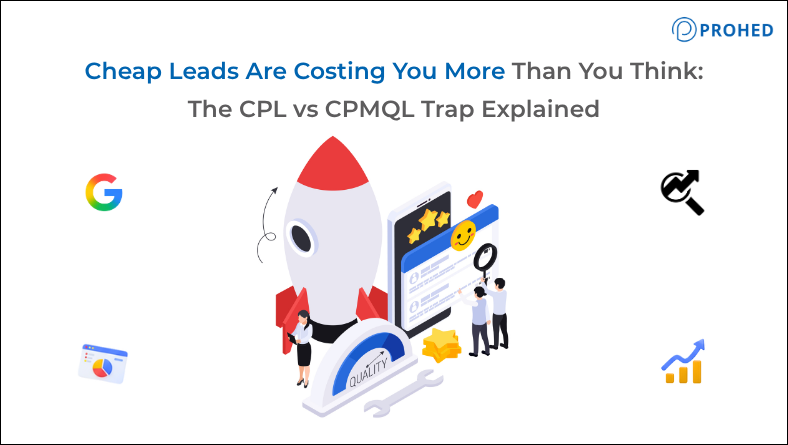
What is the CPL vs CPMQL trap? It’s what happens when a brand optimises its campaigns for the lowest possible cost per lead, and ends up with a pipeline full of people who were never going to buy. CPL measures how cheaply you can generate leads. CPMQL, or cost per marketing qualified lead, measures how much you’re actually paying for leads that have a real chance of converting. At Prohed, a performance marketing agency in Gurgaon, the gap between these two numbers is consistently where revenue is being lost – quietly, and at scale.
Your campaigns are hitting target. Cost per lead is down. The dashboard looks healthy. And yet, the sales team is frustrated, the pipeline isn’t closing, and the revenue numbers don’t match the optimism in the weekly report.
Lead generation accounts across India face this common problem today. The issue persists because marketers optimize for the entirely wrong metric: cheap leads and low CPL.
At Prohed in Gurgaon, we saw a repeating pattern across B2C, EdTech, real estate, and D2C brands in 2025-26. Campaigns optimized for CPL had actual sales costs 3–5x higher than necessary. Switching the focus to tracking cost per marketing qualified lead (MQL) significantly improved conversions without increasing total spend.
The problem isn’t that you’re generating leads. The problem is that cheap leads are costing you far more than expensive ones ever would.
What CPL Actually Measures, and What It Misses
Cost per lead is a straightforward metric. It tells you how much money was spent to get one person to fill in a form, click a button, or raise their hand in some trackable way. Lower CPL means more leads for the same budget. That sounds like efficiency. In many cases, it’s actually the opposite.
Here’s what CPL doesn’t tell you. It fails to show whether that person actually has the budget to buy. You also have no idea if they even understood what they were inquiring about. Ultimately, there is no way to know if they are in active decision-making mode or just browsing out of mild curiosity. And it doesn’t tell you whether they’ll pick up the phone when the sales team calls.
Consequently, a campaign optimized purely for cheap leads will almost always generate volume at the expense of quality. The algorithm finds the easiest, cheapest people to convert, and the easiest, cheapest people to convert are rarely the buyers your sales team can actually close.
This is the CPL trap. The number looks good. The pipeline doesn’t work.
What CPMQL Measures and Why It Changes Everything
Cost per marketing qualified lead takes the standard CPL calculation one step further. Instead of counting every form fill as a lead, it counts only the leads that meet a defined qualification threshold, budget, intent level, category fit, or whatever criteria your sales team has agreed signals genuine purchase readiness.
The calculation is simple. If you spend ₹1,00,000 and generate 500 leads at ₹200 CPL, but only 50 of those leads are actually qualified, your CPMQL is ₹2,000, ten times higher than your CPL suggests.
That gap is where most marketing and sales disagreements live. Marketing reports great CPL. Sales reports terrible lead quality. Both are technically correct. The problem is that they’re looking at different numbers and drawing opposite conclusions from the same campaign.
Furthermore, CPMQL connects marketing spend to sales outcomes in a way that CPL simply cannot. When campaigns are optimized toward qualified leads rather than all leads, the algorithm learns what a real buyer looks like, and starts finding more of them over time. This is precisely why conversion rate optimization services built around lead quality consistently outperform those built around lead volume.
The Real Cost of Cheap Leads – A Number Most Brands Don’t Calculate
Most brands calculate marketing ROI by looking at revenue relative to ad spend. However, this calculation misses a significant cost that cheap leads generate: the cost of sales team time spent on leads that will never convert.
Consider this pattern, which appears repeatedly across accounts Prohed has audited. A brand generates 400 leads per month at ₹250 CPL, spending ₹1,00,000. Of those 400 leads, 320 are unqualified, wrong budget, wrong intent, or wrong timing. Each of those 320 leads still gets called by the sales team. If a salesperson spends an average of eight minutes per lead, 320 unqualified leads consume over 42 hours of sales time monthly. At a conservative fully-loaded cost of ₹300 per hour for a salesperson’s time, that’s ₹12,600 per month in direct labour cost spent on leads that were never going to convert.
Additionally, there’s a softer cost that is harder to quantify but equally real: sales team morale. When salespeople spend the majority of their time on dead-end calls, motivation drops, follow-up quality suffers, and the leads that actually were qualified get the same low-energy treatment as the ones that weren’t. Cheap leads, therefore, don’t just waste marketing budget. They compromise the entire revenue function.
Why PPC Ads Are Particularly Vulnerable to This Trap
PPC ads, particularly on Meta, are especially prone to the CPL trap because of how the platform’s algorithm optimizes for conversion events. When a campaign is set up with “lead” as the conversion event and no qualification signals built into the funnel, the algorithm does exactly what it’s told. It finds the people most likely to fill in a form. Not the people most likely to buy.
This is why PPC ads that generate excellent CPL metrics so often produce disappointing sales outcomes. The algorithm is technically performing well, it’s delivering cheap leads at scale. But cheap and qualified are two different things, and the algorithm can only optimize for what it’s been given as a signal.
The fix is to give the algorithm better signals. Use specific conversion events like bookings or WhatsApp chats, and pre-filter leads through funnel qualification logic before they convert.
Switching from generic form fills to intent-qualified actions improved Prohed’s clients’ lead quality within four to six weeks. The volume of leads fell. The quality rose. And the revenue followed the quality, not the volume.
The Prohed MQLR Framework – How to Fix the CPL Trap Systematically
Our MQL Rate Framework increases the percentage of genuinely qualified leads instead of just lowering unqualified lead costs.
The framework operates across four connected stages.
Stage 1: Define MQLR before campaigns launch.
Marketing Qualified Lead Rate is the percentage of total leads that meet your agreed qualification criteria. The first step is agreeing on what those criteria are, between marketing and sales, not within marketing alone. Budget threshold, intent signals, category fit, timing indicators, all of these need to be defined before a single rupee of campaign spend is committed. Without this definition, there’s no way to optimize toward it.
Stage 2: Build qualification into the funnel, not onto it.
Most brands mistakenly treat qualification as a sales-side activity after capturing the lead. Instead, build qualification directly into the conversion path. A detailed landing page naturally filters out bad-fit prospects. A form that asks one or two meaningful questions before submission gives the algorithm better signals and the sales team better context. These aren’t obstacles to conversion. They’re filters that protect conversion quality.
Stage 3: Create separate campaign tracks for different intent levels.
Not every leads marketing campaign needs to serve the same goal. Top-of-funnel campaigns build awareness and capture early interest, naturally generating less qualified leads than bottom-of-funnel campaigns targeting active buyers. Treating both types of leads identically in the CRM is a major driver of poor MQLR. Instead, each campaign track should have its own lead scoring, nurture path, and follow-up sequence calibrated to its specific intent level.
Stage 4: Feed MQLR data back to campaign optimization.
This is the step that most brands skip entirely, and it’s the most important one. Conversion rate optimization services only compound their impact when the data on which leads actually converted gets fed back to the media team. When the algorithm learns not just “this person filled a form” but “this person filled a form and became a customer,” it gets significantly better at finding similar people. Closed-loop optimization, where CRM data informs campaign targeting, is what separates brands that improve MQLR over time from those that stay stuck in the CPL trap indefinitely.
What This Looks Like in Practice
A B2C EdTech client managed by Prohed was generating leads at ₹190 CPL through a combination of Google PPC ads and Meta campaigns. Volume looked strong at 600 leads per month. However, the sales-to-enrolment rate sat at 4%, producing approximately 24 enrolments monthly from a ₹1,14,000 monthly ad spend. Effective cost per enrolment was ₹4,750.
First, we restructured the campaigns around an MQLR-focused approach. Next, the rebuilt landing pages described the programme in specific terms to filter out casual enquirers. Finally, we modified the form to include a qualifying question about learning goals and changed the conversion event from a generic form fill to a calendar booking. Additionally, we created separate campaign tracks for cold and warm retargeting audiences, with distinct nurture sequences for each.
Within six weeks, lead volume dropped to 280 per month, less than half the previous number. However, the sales-to-enrolment rate climbed to 14%. Total enrolments rose to 39 per month. Effective cost per enrolment fell from ₹4,750 to ₹2,923, a 38% improvement, on a lower total spend. Fewer leads. Better outcomes. That’s the MQLR principle in practice.
Where to Start If You Suspect You’re in the CPL Trap
If volume is high but pipeline isn’t converting, ask: what percentage of last month’s leads actually met sales criteria?
If you don’t have that number readily available, that’s the first problem. Without MQLR tracking, there’s no way to know whether the issue is campaign targeting, funnel design, qualification criteria, or sales follow-up. Each of those requires a different fix, and treating them as the same problem produces no fix at all.
Once MQLR is being tracked, the next step is identifying where in the funnel unqualified leads are entering. Is it at the ad level, broad targeting that captures people far outside your ideal buyer profile? Is it at the landing page level, vague messaging that attracts curiosity rather than intent? Or is it at the form level, zero-friction capture that removes any qualifying signal from the process?
The answer tells you exactly where to intervene. And in most cases, the intervention costs nothing in additional spend.
Related read: 8 Real Reasons Your Leads Are Not Converting Into Sales and How to Fix Each One
How Prohed Approaches Lead Quality for B2C and D2C Brands
At Prohed, we treat lead quality as a campaign metric from day one, rather than reviewing it after sales start complaining. We structure every lead generation campaign with built-in MQLR tracking, embed qualification logic in the funnel, and use closed-loop reporting to connect CRM conversion data to campaign optimization.
Beyond lead generation, Prohed’s full service range covers Search Engine Marketing structured around intent-qualified conversion events, SEO that builds organic lead pipelines with naturally higher qualification rates, Social Media Marketing that warms audiences before asking them to convert, and e-commerce marketing built around revenue metrics rather than traffic volume. Prohed’s ad account audit and consultation process is specifically designed to identify whether a CPL trap exists in an account and produce a prioritized plan to fix it.
If your lead generation campaigns are producing volume but not revenue, and you’re looking for a digital marketing agency that understands the difference between cheap leads and qualified ones, Prohed is worth a conversation.
Frequently Asked Questions
1. What is the difference between CPL and CPMQL?
CPL, or cost per lead, measures how much you spend to capture any lead regardless of their quality or intent. CPMQL, or cost per marketing qualified lead, measures how much you spend to capture a lead that meets your agreed qualification criteria, budget fit, intent level, and category relevance. The gap between the two numbers is where most pipeline conversion problems actually live.
2. Why do cheap leads produce poor sales outcomes?
Cheap leads are typically generated by campaigns optimized for low-friction conversion, broad audiences, simple forms, and minimal qualification signals. The people who convert most easily in that environment are often early-stage researchers, price-sensitive browsers, or people who filled in a form out of casual curiosity. None of those profiles typically convert in a sales conversation, regardless of how well the sales team performs.
3. How do PPC ads contribute to the CPL trap?
PPC ads on Meta and Google optimize for whatever conversion event they’re given. When that event is a generic form fill, the algorithm finds the people most likely to fill forms, not the people most likely to buy. Consequently, CPL falls and lead quality falls with it. The fix is assigning higher-intent conversion events, such as booking confirmations or WhatsApp initiations, so the algorithm learns to find buyers rather than form-fillers.
4. What is Marketing Qualified Lead Rate and how is it calculated?
Marketing Qualified Lead Rate is the percentage of total leads that meet your agreed qualification criteria. It’s calculated by dividing the number of qualified leads by total leads and multiplying by 100. For example, if 80 out of 400 leads meet your qualification threshold, your MQLR is 20%. Tracking this number over time is what allows campaigns to be optimized toward quality rather than volume.
5. How do you improve MQLR without increasing ad spend?
The most effective interventions don’t require more budget. They require better funnel design, more specific landing pages that filter by intent, forms with one or two qualifying questions, and conversion events that signal genuine purchase readiness rather than passive curiosity. Additionally, separate campaign tracks for different intent levels, with different nurture paths for each, consistently improve MQLR without changing total spend.
6. What does closed-loop reporting mean in lead generation?
Closed-loop reporting means that data on which leads actually converted into customers is fed back to the campaign management system, so that future campaigns can be optimized toward the profile of a real buyer rather than the profile of anyone who fills in a form. Without it, campaigns keep optimizing for volume. With it, lead quality compounds over time as the algorithm learns what a genuine buyer looks like.
7. How does conversion rate optimization apply to lead quality?
While conversion rate optimization typically involves improving the percentage of visitors who take an action, when applied to lead quality it involves optimizing not just for the rate of conversion but what converts. This means testing landing page specificity, form question design, and conversion event selection alongside the content that sells, all with a focus on the ultimate goal of boosting MQLR instead of raw volume.
8. How long does it take to see improvement in lead quality after fixing the funnel?
In most cases, meaningful improvement in MQLR is visible within four to six weeks of implementing qualification logic at the funnel and conversion event level. The algorithm needs two to three weeks to recalibrate toward the new conversion signal, and qualification improvements on the landing page and form typically show results in the first round of data after launch.
Schedule a Free Strategy Call with PROHED Today