Most people got comfortable with generative AI pretty quickly. You type something, it writes something back. You ask, it answers. Fair enough.
But then something quietly shifted.
AI stopped just responding and started doing. Booking appointments. Comparing products. Completing purchases. Making decisions on someone’s behalf after a single instruction. The same technology that was helping people write emails is now capable of completing an entire buying journey without the user doing much at all after the first nudge.
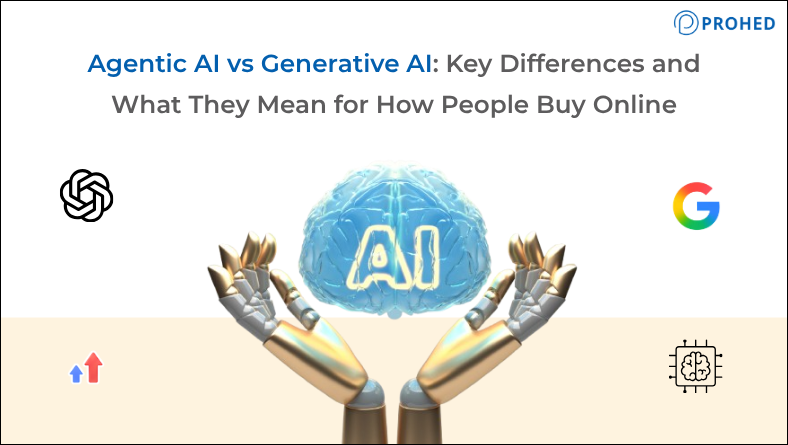
That’s not generative AI anymore. That’s agentic AI. And the gap between the two? It’s not just a technical footnote. It has real, right-now consequences for how brands get found, how purchases get made, and what digital marketing actually needs to look like going forward.
At a Glance: Generative AI vs. Agentic AI
Feature | Generative AI | Agentic AI |
Core Function | Creates content from a specific prompt | Executes actions to achieve a broad goal |
User Involvement | High as the user must guide every step | Low because the AI operates independently |
Memory | Limited to the current conversation | Maintains deep context across multiple tasks |
Decision Making | Provides a response without “deciding” | Plans, makes choices, and executes them |
Example Tools | ChatGPT, Gemini, or Claude | AutoGPT, AI shopping agents, or browser agents |
Marketing Impact | Refines content creation and discovery | Orchestrates the entire customer journey |
Frameworks | Not applicable | LangChain, AutoGen, or CrewAI |
Is your brand built to be found, and trusted, by AI agents making purchase decisions on behalf of buyers? Most brands aren’t. The ones that start fixing that now will have a real edge going into the second half of 2026.
Book An Audit For Your Digital Presence With PROHED Today
Generative AI: The One You Already Know
Generative AI is what most people have been using for the past couple of years. ChatGPT, Gemini, image generators, AI writing tools. You give it a prompt, it creates something. A paragraph, a summary, a piece of code, an image.
It’s reactive by nature. Nothing happens until you ask. Once it responds, the job is done.
For brands, gen AI has already changed a lot, content gets produced faster, ad copy gets drafted quicker, SEO content scales more easily. But the model itself is passive. It waits. It responds. It doesn’t go off and actually do things on its own.
That’s the ceiling of generative AI. And it’s exactly where agentic AI picks up.
Also Read: Generative Engine Optimization (GEO): Boost Your Visibility in AI-Powered Search
What Is Agentic AI, Then?
Agentic AI is what happens when you give an AI a goal instead of just a prompt.
Not “write me a product comparison.” More like: “Find the best laptop under ₹80,000 and book the one with the fastest delivery.” The AI breaks that down into steps, makes decisions along the way, uses tools like browsers and APIs, and works toward completing the task without being walked through every move.
That’s a fundamentally different kind of AI. It plans. It adapts when something doesn’t work. It completes multi-step tasks on its own.
Agentic AI frameworks like LangChain, AutoGen, and CrewAI are the technical infrastructure making this possible. They allow developers to build agents that chain tasks together, access external tools, and maintain context across longer workflows. And the use cases are growing every few months.
The Simplest Way to Understand the Difference
Think of it like this.
Generative AI is a brilliant assistant who gives excellent answers but sits at their desk waiting for you to come to them. You ask, they answer. You leave, they stop.
Agentic AI is that same assistant, except now you’ve handed them a task, a set of tools, and the authority to go figure it out. They research, compare, decide, and come back with something done, not just something written.
The shift from responding to executing is the whole story. And for anyone running campaigns or managing a brand’s digital presence, that shift carries serious weight.
What This Means for How People Buy Online
This is where it gets genuinely important for marketers.
When people used gen AI to research a product, they still came back to a browser, searched, clicked an ad, visited a site, and made a purchase. The human was present at every conversion point.
With agentic AI, that loop compresses fast. A shopping agent gets a simple instruction, searches across platforms, evaluates options on price, reviews, and delivery speed, and completes the purchase, without the buyer revisiting a search engine or clicking a single ad.
So what happens to the traditional funnel?
The awareness stage, consideration stage, comparison stage, all of these can be skipped or handled entirely by an AI working on the buyer’s behalf. Your product page might never even be seen in the conventional sense.
For brands, this raises questions that genuinely need answering now:
- Is your product data structured clearly enough for AI agents to evaluate?
- Are your reviews, pricing, and delivery info consistent across platforms?
- Is your brand visible and trusted enough to be recommended by an AI comparing options?
What Agentic AI Changes About Digital Marketing Strategy
Traditional performance marketing assumes a human is making each decision in the funnel. You write ad copy to appeal to a person. You build landing pages to convert a person. You retarget a person who bounced.
When an AI agent is making decisions on that person’s behalf, the variables shift.
The agent isn’t moved by clever copy. It’s reading structured data, checking trust signals, comparing pricing accuracy, and assessing availability. It wants clarity, not persuasion.
Paid advertising doesn’t become irrelevant, not even close. But the signals that make your brand trustworthy to an AI agent need as much attention as the creative that converts a human buyer.
In practical terms, this means:
- Cleaner product feeds and data hygiene for e-commerce
- Consistent brand citations and accurate reviews across authoritative platforms
- Content built to be readable by both humans and AI systems
- Tighter campaign structures with sharper conversion signals
How Prohed Is Thinking About This
The team at Prohed has been tracking this shift and the client conversations have started changing as a result.
Performance marketing in 2026 isn’t just about CTRs and CPLs, though those still matter. It’s about building a brand that holds up whether a human or an AI agent is doing the evaluating.
Prohed works with brands across e-commerce, real estate, education, and B2B on Google Ads, Meta Ads, LinkedIn, SEO, and conversion rate optimization. The approach has always been data-first. In the age of agentic AI, that foundation matters more than ever, because the systems making purchase decisions on behalf of buyers are running entirely on data signals.
If the current strategy was built for a world where humans click every ad and read every page, it’s probably worth a second look.
The Bottom Line
Generative AI changed how content gets made. Agentic AI is changing how decisions get made.
The difference between agentic AI vs generative AI isn’t just a tech conversation. It’s a signal about where buyer behaviour is going and what brands need to do to stay visible and relevant in that environment.
The purchase journey is being automated in ways most marketing strategies haven’t caught up with yet. The brands building for this now, cleaner data, stronger trust signals, consistent cross-platform presence, will be in a much stronger spot than the ones still optimising a funnel that’s quietly changing shape underneath them.
Frequently Asked Questions
1. What is agentic AI in simple terms?
Agentic AI is an AI system that completes tasks on its own, you give it a goal, and it figures out the steps, makes decisions, and gets it done without being walked through every move.
2. What are the main agentic AI frameworks being used today?
LangChain, AutoGen, and CrewAI are among the most widely used. They give developers the structure to build agents that can chain tasks, access tools, and hold context across longer workflows.
3. How does agentic AI affect online shopping and e-commerce?
A shopping agent can search, compare, and complete a purchase on a user’s behalf, meaning your product data, reviews, and pricing accuracy matter more than your ad creative.
4. Should businesses change their digital marketing strategy because of agentic AI?
Gradually, yes. The fundamentals still apply, but brands that invest in clean data, consistent cross-platform presence, and structured content will be far better positioned as agentic AI becomes a bigger part of how buying decisions get made.
Prohed is a performance-focused Digital Marketing Agency in Delhi NCR, helping brands build strategies that actually work in today’s AI-driven environment. From paid media to SEO to full-funnel growth, it’s always built around what moves the needle.
Schedule a Free Strategy Call with PROHED Today