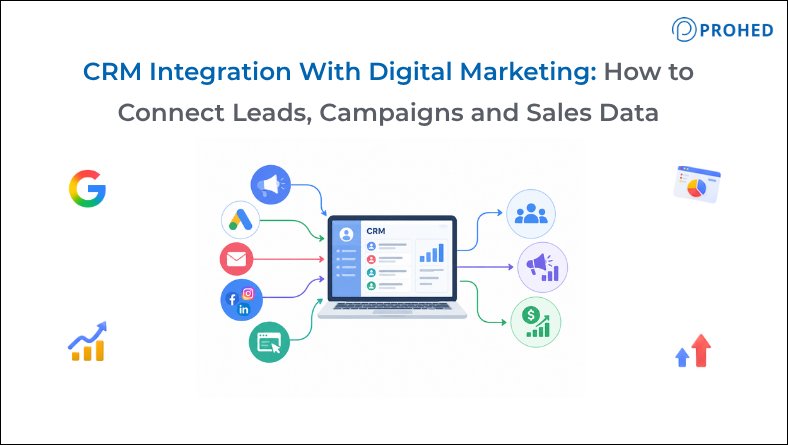
CRM integration is the process of connecting a CRM system with ad platforms like Google Ads and Meta Ads, so lead and sales data flows between them automatically, instead of being tracked and uploaded by hand. PROHED works on this piece for clients regularly, and it’s often the first gap found in a marketing setup that’s otherwise running fine.
Most marketing teams know how many leads came in last month. Almost none of them know which leads actually became customers. Or which campaign brought them in. That gap exists for one simple reason: the CRM and the ad platforms don’t talk to each other. CRM integration fixes that.
Why This Actually Matters
Ad platforms are great at getting clicks. They’re not great at knowing what happens next. One lead fills a form and ghosts you. Another closes a deal worth lakhs. To the ad platform, both leads look exactly the same. That’s the problem with skipping crm digital marketing setups.
Once CRM data flows back into your campaigns, the algorithm learns. It stops chasing clicks. It starts chasing leads that actually close. That one change matters more than most bid tweaks people obsess over.
There’s a longer-term angle too. As ad platforms lean harder into automated bidding, they’re only as smart as the data feeding them. Feed them form fills and clicks, and they’ll keep optimising for exactly that: cheap, shallow conversions. Feed them real revenue signals, and the whole account starts behaving differently within a few weeks.
CRM Integration With Google Ads and Meta Ads
Both major platforms accept offline conversion data. This is where CRM integration with Google Ads and CRM integration with Meta Ads comes in.
Platform | What Syncs | Why It Helps |
Google Ads | Lead status, deal value, close date | Smart Bidding chases real sales, not form fills |
Meta Ads | Lead quality, purchase events | Lookalikes get built from real buyers |
Both | Offline conversions via webhook | Attribution goes beyond last click |
Marketing automation tools usually sit in the middle of this setup. A lead fills a form, the tool pushes it to the CRM, and once sales updates the status, that data flows back to the ad account. This loop is what most crm digital marketing setups are missing, and it’s rarely a one-time fix. As sales cycles get longer, or a business adds a second product line, the mapping between CRM stages and ad platform signals needs revisiting too.
What a Real CRM Integration Looks Like
A proper setup covers a few basics:
- Fast lead sync – forms hit the CRM in seconds, not hours
- Status mapping – CRM stages (New, Contacted, Closed) become conversion signals
- Deal value tracking – revenue flows back so campaigns chase value, not volume
- No duplicates – one lead, one record, no matter the channel
- Source tagging – every lead keeps its campaign source through the whole funnel
- Sales team buy-in – reps actually update lead status, since the whole loop depends on that data being current
That last point gets skipped more often than it should. The best integration in the world won’t help if a sales rep leaves fifty leads sitting untouched in “New” status for three weeks. The data flowing back to the ad platform is only as reliable as the CRM hygiene behind it.
Miss any of these pieces, and reporting gets messy fast. Cost-per-lead looks great. Revenue doesn’t add up. Nobody can quite explain why.
Choosing the Right CRM Tools for Marketing
Not every CRM works well with every ad platform. Some crm tools for marketing connect natively to Google Ads and Meta. Others need Zapier or a custom build in between. Before picking one, check three things: does it support offline conversion uploads, can you map custom fields, and is the API stable enough that it won’t break every time the CRM pushes an update.
Getting this wrong is a common reason integrations fail within the first few months. Not because the concept doesn’t work, but because the tools were never really compatible to begin with. It’s worth testing the connection with a small batch of leads before rolling it out account-wide, since fixing a mapping error after a month of live data is a lot harder than catching it on day one.
How PROHED Approaches CRM Integration
Setting up CRM integration usually needs both a marketing lens and a technical one, and that combination is where most in-house teams get stuck. As a performance marketing agency, PROHED builds this integration alongside the campaign structure itself, so conversion data starts feeding back from week one instead of months later. This is one reason brands working with digital marketing agencies Gurgaon teams often see faster optimisation cycles, since the ad account is learning from real sales outcomes, not guesswork.
Real Results: What This Looks Like in Practice
Theory only goes so far, so it helps to look at how this plays out with an actual account. PROHED’s work with Pearson, an EdTech and higher-education brand, is a close example of what CRM integration is meant to solve. Pearson needed to manage enrollments from 10 new countries at once, which meant lead quality mattered a lot more than raw lead volume. By tightening how lead data connected back into campaign optimisation, the account saw 45% higher qualified leads and 2.5X registrations.
That kind of result doesn’t come from a bigger budget. It comes from the ad platform knowing which leads were actually worth chasing, which is exactly what CRM integration is built to do.
A Short Note Before You Start
Keep it simple at first. Pick one platform. Map the basic lead stages. Get offline conversions flowing before adding anything else. Once that’s working, expanding to a second platform, or a more advanced automation workflow, gets a lot easier.
CRM integration isn’t a one-time project either. Campaigns shift. Sales processes shift. The integration needs an occasional check-in to keep up with both. Brands that treat it as ongoing, not a box to tick once, tend to get the most out of it over time.
FAQs
1. What is CRM integration in digital marketing?
Your CRM and your ad accounts start talking. That’s really it. A lead comes in through Google Ads, gets marked Closed Won weeks later in the CRM, and that update makes its way back to the ad platform without anyone touching a spreadsheet. Sounds small. Changes a lot once it’s running.
2. Which CRM works best with Google Ads?
Depends who you ask, and half the “best CRM” debates online miss the actual point. HubSpot, Zoho, Salesforce- most of them plug in fine; sometimes natively, sometimes you’re routing through Zapier. Field mapping is where things usually go wrong, not the CRM choice itself.
3. Does CRM integration work with Meta Ads?
Yes, and most teams still aren’t doing it, which is a bit strange given how well it works. Meta pulls offline conversions and lead scores from the CRM, then builds lookalikes off that. Ad targeting shifts from “people who clicked” to something closer to “people who actually bought something.”
4. How long does setup take, realistically?
A few days if your lead data’s already clean. Weeks, sometimes closer to a month, if there are duplicate entries, half-filled fields, three different naming conventions for the same lead source. Nobody budgets for the data cleanup part. That’s usually the part that takes the longest.
5. Small brands or only big companies, who actually benefits?
Small brands, more than people assume. A large company shrugs off some wasted spend. A D2C brand running on a tight budget can’t really afford leads the algorithm is optimizing blindly. Fewer leads, sure, but each one that’s tagged correctly moves the whole account faster.
6. CRM integration vs marketing automation, what’s the actual difference?
One’s plumbing, one’s what flows through the plumbing. Integration moves the data between systems. Automation does something with it once it arrives: a follow-up email fires, a lead gets scored, someone on the sales team gets a nudge to call back. People use the terms interchangeably. They shouldn’t.
7. Do I need a developer for this?
Not for the basics, no. Plenty of platforms ship no-code connectors now; a marketer can wire up the standard fields alone in an afternoon. Custom fields, weird data formats, legacy CRMs from 2014 that nobody wants to touch, that’s where you bring in a developer, even just for an hour.
8. Does this actually move ROI, or is it just cleaner reporting?
Both, but mostly the first one. Without integration, the algorithm’s optimizing for clicks and cheap form fills, which isn’t the same as revenue. Feed it real conversion data, and budget drifts toward whatever’s actually closing. Same spend. Fewer leads that were never going anywhere to begin with.
Want your CRM and ad campaigns actually talking to each other?
Schedule a Free Strategy Call with PROHED Today