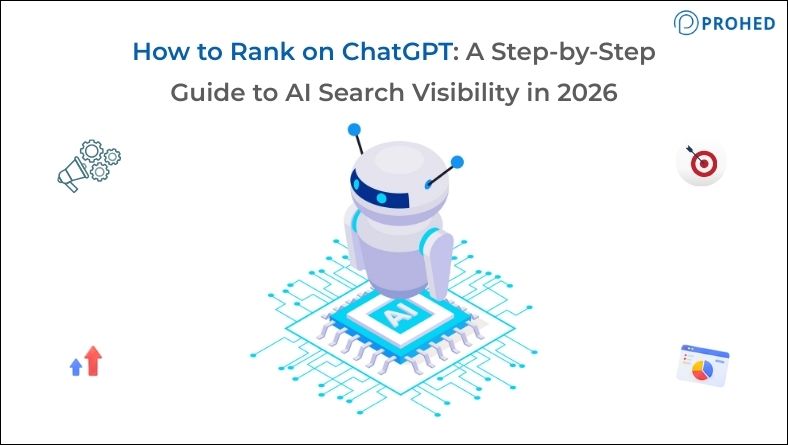
If your entire growth strategy is still pinned on being “Blue Link #1” on a Google search page, you aren’t just behind the curve, you’re invisible to a massive chunk of your market. In 2026, the game has fundamentally shifted. Your customers have stopped scrolling through endless pages of sponsored ads; they’re now asking AI chatbots for definitive, one-sentence recommendations.
When a high-intent buyer asks, “Who is the top performance marketing expert in India?”, you can’t afford to be buried in a list of links. You need to be the answer the AI provides. Learning how to rank on ChatGPT is no longer a “future project”, it’s the only way to ensure your brand visibility survives the AI revolution.
This guide breaks down the high-stakes world of AI Search Optimization (AISO) and shows you exactly how to secure your brand visibility in an AI-first world.
Quick Overview: The AI Search Hierarchy
Optimization Pillar | Focus Area | Goal |
Data Citation | High-authority PR & Backlinks | Getting mentioned in training data |
Conversational Content | FAQ & Natural Language | Matching user intent patterns |
Structured Data | Schema Markup & JSON-LD | Making your data “readable” for bots |
Brand Sentiment | Reviews & Community Mentions | Ensuring AI views you as “Trusted” |
Is Your Brand Ghosted by AI?
Traditional SEO is no longer enough to survive. At Prohed, we specialize in AISO strategies that ensure your website doesn’t just rank, but gets cited as the primary source.
Schedule a Free Audit of Your AI Visibility with Prohed Today
The 2026 Shift: Why Traditional SEO is Only Half the Battle
For the longest time, learning how to rank a website was a simple game of keywords, meta tags, and chasing backlinks. While that foundation still matters, the goalposts have moved. ChatGPT and other AI engines don’t care about keyword density as much as they care about “Consensus” and “Trust.”
If you want to know how to rank your website on ChatGPT, you have to understand the machine’s logic. These models aren’t “crawling” the web in the same way Google’s old bots did. Instead, they’re synthesizing mountains of data, news, reviews, and authority blogs, to build an answer. To get recommended by AI chatbots, your brand can’t just exist on your own site, furthermore, it needs to be a core part of the “knowledge graph” these models use as their source of truth.
Step-by-Step: How to Rank on ChatGPT
1. Own the “Entity” in the Knowledge Graph
We don’t just cross our fingers and hope bots find you. By contrast, we proactively land your brand mentions on heavy-hitting platforms, think major industry journals, high-authority news sites, and LinkedIn. When an AI sees your name dropped in the same breath as established market leaders, it stops seeing you as a random site and starts categorizing you as a trusted authority.
2. Optimize for Conversational Intent
Let’s be real: nobody talks to ChatGPT in awkward fragments like “marketing agency Gurgaon.” They ask real, complex questions like: “Which marketing agency in Gurgaon actually delivers the best ROI for D2C brands?” To show up in that answer, your content needs to stop acting like a static billboard and start behaving like a consultant. Consequently, you have to address these specific, long-tail queries head-on with clear, expert-led answers.
3. Secure Third-Party Validation
AI chatbots are programmed to be “safe,” which basically means they’re skeptical of anyone calling themselves an expert. Therefore, to get recommended by AI chatbots, you need a chorus of other voices backing you up.
- The Data Goldmine: High-quality reviews on G2, Trustpilot, and Google Maps are massive training signals for AI.
- The “Vote of Confidence”: Being featured in “Best of” roundups or reputable tech blogs acts as a digital seal of approval that the AI picks up on instantly.
4. Technical Precision: Schema and Structure
While AI is smart, it still appreciates a map. Using advanced Schema Markup helps LLMs understand exactly what your business does, what services you offer, and where you are located. When you’re figuring out how to rank a website for AI, technical health isn’t just about speed, it’s about data clarity.
ChatGPT vs. Perplexity vs. Google AI Overviews: How Optimisation Differs by Platform
Here’s something most guides completely skip: not all AI search platforms work the same way. In fact, optimizing for ChatGPT and optimizing for Perplexity require genuinely different strategies, because each platform pulls from different source types and weights different signals.
Research shows that ChatGPT leans heavily on Wikipedia, which accounts for roughly 47.9% of its top citations. Perplexity, on the other hand, prioritises Reddit, which makes up approximately 46.7% of its top citation sources. Google AI Overviews behave differently again, drawing primarily from pages that already rank well in traditional Google Search.
This matters enormously for your content strategy. If you’re only optimising for one platform, you’re likely invisible on the other two. Here’s a clear breakdown:
| Platform | Primary Citation Source | Key Optimisation Signal | Content Format That Works Best |
|---|---|---|---|
| ChatGPT | Wikipedia (47.9% of top citations) | Entity authority, knowledge graph presence | Long-form authoritative guides, PR placements on high-DA sites |
| Perplexity | Reddit (46.7% of top citations) | Community discussion, real user language | Forum-style content, genuine community engagement, Reddit threads |
| Google AI Overviews | Existing top-ranked Google results | Traditional SEO signals plus E-E-A-T | Structured how-to content, FAQ schema, featured snippet optimisation |
What this means practically: if you want ChatGPT to recommend your brand, focus on building Wikipedia-adjacent authority, think high-DA press coverage, knowledge panels, and entity mentions across authoritative publications. If Perplexity visibility is your goal, invest in genuine Reddit presence and community-led conversations in your niche. For Google AI Overviews, your existing SEO foundation matters most, provided you layer in proper schema and clear, structured answers.
The brands winning across all three platforms in 2026 aren’t running three separate strategies. Instead, they’re building a single high-authority content ecosystem that naturally gets picked up by each platform for its own reasons.
Brand Visibility in AI Search: The Power of Consensus
In the world of how to rank on ChatGPT, consensus is everything. If one obscure blog says you’re great, but ten other authority sites don’t even know you exist, the AI is going to skip right over you. This is exactly where your retention marketing and community plays become your secret SEO weapons.
When your brand is constantly being discussed on Reddit, niche forums, and social media, you’re creating a “digital footprint” that’s impossible for an LLM to ignore. This isn’t just about old-school SEO; it’s about total brand visibility across the entire digital ecosystem. You want to be so well-cited that the AI would be “wrong” not to mention you.
How to Check If You’re Ranking on ChatGPT
This is one of the most commonly asked follow-up questions from brands getting started with GEO, and yet most articles treat it as an afterthought. So here’s a proper answer.
The simplest place to start is manual prompt testing. Open ChatGPT and ask it the kinds of questions your target customers would actually type, for example, “What are the best performance marketing agencies in India?” or “Which agency should I use for D2C ecommerce growth?” Then check whether your brand appears in the response, how it’s described, and whether it’s framed positively or neutrally. Do this across a range of question formats and note down the patterns.
Beyond manual testing, several tools now exist specifically to track AI visibility at scale:
- Otterly.AI tracks brand mentions across ChatGPT, Perplexity, and Google AI Overviews, and shows you which prompts are triggering your brand versus competitors
- SE Ranking AI Visibility Tracker monitors how your brand appears in AI-generated answers over time, making it easier to spot improvements after you make content changes
- Writesonic Brand Radar scans AI responses for brand mentions and sentiment, giving you a clearer picture of how AI models currently perceive your brand
Additionally, it’s worth running the same prompts across ChatGPT, Perplexity, and Google AI Overviews simultaneously. Because each platform cites different sources, your visibility can vary significantly between them, and knowing where the gap is tells you exactly where to focus next.
As a general rule, if your brand isn’t appearing in ChatGPT responses for your core category queries, that’s your baseline. Track it monthly, because changes to AI citation behaviour don’t happen overnight, but they do happen, and measuring consistently is how you know what’s working.
Also Read: 5 Best D2C Marketing Agencies in India for Ecommerce & Performance Growth
Common Traps: Why Your Website is Invisible to AI
If you’re trying to figure out how to rank your website on ChatGPT and seeing no results, you might be falling for these 2026 pitfalls:
- Gating Your Best Content: If your most authoritative insights are hidden behind a PDF or a login, the AI can’t read them.
- Generic “SEO Writing”: AI models are getting better at spotting fluff. If your content is 1,000 words of nothingness, it won’t be cited.
- Ignoring Niche Authority: Many brands try to be “everything to everyone.” AI prefers specialized sources. If you want to rank, own a specific niche first.
The Prohed Strategy: Beyond the Search Bar
At Prohed, we don’t just look at the current trends; we build for the future of search. We understand that brand visibility in AI search is the new frontier of performance marketing.
We aren’t a “set it and forget it” agency. Specifically, we are performance architects who bridge the gap between technical data and human persuasion. Whether you are looking for Performance Marketing that converts or a long-term E-commerce strategy, we ensure your brand is optimized for the platforms where your customers are actually spending their time.
Our AI-Focused Growth Services Include:
- AISO (AI Search Optimization): Ensuring your brand is the top recommendation in ChatGPT, Claude, and Gemini.
- Content Authority Building: Crafting high-value, “cite-able” content that AI models love to reference.
- Entity Management: Building a robust digital footprint that establishes your brand as a market leader.
- Creative Strategy: Developing visuals and narratives that stick in the minds of both humans and algorithms.
The Bottom Line: Ranking is No Longer Optional
The window to “claim your space” in the AI knowledge base is closing. As these models become more refined, they will rely on a smaller, more elite group of trusted sources. Partnering with a specialized AEO Agency in India and learning how to rank on ChatGPT today ensures that you are part of that “inner circle” of recommended brands tomorrow.
In the 2026 market, the winners aren’t those who shout the loudest, but those who are the most “discoverable.” Stop fighting for clicks and start fighting for citations. It’s time to move your brand out of the shadows and into the conversation.
FAQs:
1. What’s the real difference between SEO and ranking on ChatGPT?
Google SEO is about winning the “link game” to show up in a list of results. Ranking on ChatGPT (often called GEO) is more about winning a recommendation. The AI doesn’t care how many times you’ve stuffed a keyword onto a page; it’s looking for authority and clear, direct answers it can actually use to talk to a user.
2. Does ChatGPT actually use Bing for its search results?
For live web browsing, yes, it leans on Bing’s index. So, if Bing likes your site, you’ve got a much better shot at being cited in a live response. But for its “baked-in” knowledge, it’s looking at the bigger picture of how often your brand is mentioned as an expert across the entire internet.
3. How long does it take to start showing up in ChatGPT?
Anyone giving you an exact date is making it up. Generally, if you’re consistently building authority and answering conversational questions, you’ll start seeing your name pop up in 3 to 6 months. It’s a slow build, the AI has to “learn” that you’re a reliable source.
4. How do I even know if ChatGPT is mentioning my brand?
The “old school” way is to just go in and prompt it, ask it for recommendations in your niche and see if you’re in the mix. If you want to get serious about tracking it, there are now tools like Otterly.AI or SE Ranking that act like a PR monitor specifically for AI mentions.
Ready to dominate the AI search landscape?
From deep-tech AISO to high-velocity performance marketing, Prohed is the partner that delivers results you can actually bank on.
Schedule a Free Strategy Call with PROHED Today