There’s a moment most B2B marketing teams know too well. The monthly report lands, the lead numbers look roughly the same as last month, and someone in the leadership meeting asks why growth has stalled. Sound familiar?
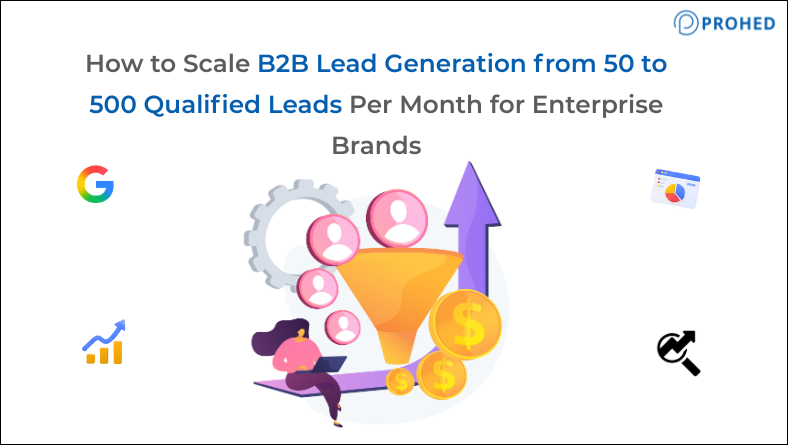
Getting stuck at 50 leads a month isn’t always a budget problem. More often, it’s a strategy problem. And the good news is, scaling to 500 qualified leads per month is genuinely possible for enterprise brands, but only if you’re willing to rethink how your entire lead generation system is built. This guide walks you through exactly that.
Why B2B Lead Generation Stalls in the First Place
Honestly, the plateau happens for pretty predictable reasons. Most enterprise teams pick one or two channels that worked early on, stick with them, and then wonder why results stop improving after a few months.
Additionally, there’s a common trap of chasing lead volume instead of lead quality. Sales ends up with a long list of contacts, but very few of them actually move anywhere. Furthermore, without a proper nurturing system in the middle of the funnel, even genuinely interested prospects quietly fall off the radar.
So before anything else, it’s worth being honest about where your current B2B lead generation process is actually breaking down.
Get Clear on What a Qualified Lead Looks Like for Your Business
It sounds basic, but you’d be shocked at how many enterprise teams gloss over this. A lead isn’t just a random person who filled out a form to get a PDF. A real qualified lead is someone who actually matches your Ideal Customer Profile (ICP), is dealing with a problem you can actually fix, and, crucially, is actually in a position to buy. If you haven’t recently, grab a coffee with your sales team and nail down the specifics. If marketing and sales aren’t agreeing on what “good” looks like, you’re just spinning your wheels.
Therefore, sit down with your sales team and agree on specifics. What company size are you targeting? Which industries? What job titles actually make the buying decision? What actions on your website suggest someone is genuinely interested rather than just browsing?
Once this is defined clearly, your qualified lead generation efforts stop being scattered. Everything from your ad targeting to your landing page copy can be built around that one clear picture of who you’re actually trying to reach.
Build a Multi-Channel B2B Marketing System That Works Together
The brands that successfully jump to 500 leads a month aren’t usually just outspending everyone. The secret is that they don’t run their channels in silos. Instead of having LinkedIn and Google Search running on separate planets, they build a system where one channel feeds the other.
1. LinkedIn Is Still the Best Starting Point for B2B Lead Generation
For enterprise brands, LinkedIn is non-negotiable, it’s where the decision-makers live. But most teams make the mistake of just running a basic lead gen form and stopping there. A much smarter move is to layer in thought leadership from your actual executives alongside targeted ads.
Then, you use retargeting to stay in front of people who’ve already engaged with your content. It’s about keeping that warm prospect moving forward rather than letting them slip away.
2. Google Search Captures Prospects Who Are Already Looking
While LinkedIn builds awareness, Google Search is where you catch people who are actively looking for a solution now. Because these prospects are further along in their journey, a well-structured search campaign, paired with a hyper-specific landing page, often brings in your highest-quality conversions. Don’t overlook Google’s Demand Gen campaigns either; they’re great for staying visible on YouTube and Gmail before a prospect is ready to officially “raise their hand.”
3. SEO and Content Marketing Keep Working Long After You’ve Published
Furthermore, a consistent content and SEO strategy is one of the most underrated b2b marketing investments for enterprise brands. Blog articles, comparison guides, and case studies that are properly optimized keep attracting organic traffic month after month, without ongoing spend.
The compounding effect is real. Something you publish today can still be generating qualified leads a year from now. As a result, SEO tends to become one of your most cost-efficient channels at scale, even if it takes a few months to pick up momentum.
Stop Letting Mid-Funnel Leads Go Cold
This is exactly where most B2B strategies start to crumble. The reality is that almost nobody buys from an enterprise brand on their first visit. Look, enterprise buyers need to trust you before they’ll even consider a meeting. They want to see your brand showing up consistently with actual answers before they ever feel comfortable picking up the phone.
What happens after that first click is what really builds your pipeline. You need smart email sequences that trigger based on what they actually care about, retargeting that keeps you top-of-mind on LinkedIn, and content that meets them exactly where they are. That’s how you move someone through the funnel instead of just watching them vanish into the ether.
And let’s be real: a messy CRM is a total deal-killer here. If your data is a disaster, your team is basically just guessing who to call, which means you’ll probably end up ignoring the very leads that were actually ready to talk.
Use Intent Data to Focus on the Leads Most Likely to Buy Right Now
Once you’re generating decent volume, the next challenge is prioritisation. Not every qualified lead is ready for a sales pitch the second they enter your system. Your sales team’s time is too expensive to spend it on “tire-kickers” who are just browsing. Intent data tools are a total game-changer here, they track signals like visits to competitor sites or activity on review platforms.
When you layer your own website data on top of these third-party signals, you get a crystal-clear view of who is actually in “research mode” right now. It allows your sales team to stop wasting time on cold prospecting and start focusing on the companies that are already warming up behind the scenes.
Your Landing Pages Are Probably Losing You More Leads Than You Realise
You can have the best-targeted campaign in the world, but if your landing page is a mess, you’re just burning cash. For enterprise audiences, the “less is more” rule usually wins. Keep your forms short, only ask for what you absolutely need to qualify them. Swap out vague testimonials for recognizable logos and hard data.
Most importantly, make sure it’s obvious what they get in return for their info, and ensure that page loads instantly on mobile. A simple headline test is often all it takes to see a double-digit jump in conversions.
Measure What Actually Matters for Pipeline Growth
Finally, one of the most important shifts in scaling b2b lead generation is changing what you measure. Let’s be honest: clicks and impressions feel good for the monthly report, but they don’t pay the bills. If you’re serious about scaling, you have to stop looking at vanity metrics and start looking at revenue.
Keep your eyes on the cost per qualified lead (ignore the raw lead count for a second) and the rate at which those leads actually turn into real sales opportunities. When you look at your data through this lens, it’s painfully obvious which campaigns are actually fueling growth and which ones are just burning your budget.
How Prohed Supports Enterprise Brands with B2B Lead Generation
This kind of full-funnel, performance-led approach is what Prohed is built around. Rather than simply running ads, Prohed works with enterprise brands to build the entire lead generation system, from targeting and channel strategy through to nurturing, tracking, and optimisation.
Services like Search Engine Marketing, LinkedIn campaigns, SEO, and Performance Marketing are all brought together under one strategy, with a custom reporting dashboard that gives clients visibility into exactly how each channel is contributing to pipeline.
Brands like Pearson, HCL, and TimespPro have worked with Prohed to move from inconsistent lead volumes to predictable, scalable pipelines. Furthermore, if your brand is also evaluating SEO growth or an ad account audit alongside lead generation, Prohed’s integrated model means all of it works together from day one.
FAQs
1. How long does it take to scale from 50 to 500 qualified leads a month?
Realistically? You’re looking at a three to six-month window. You need that time to dial in your targeting, build out nurturing sequences that don’t feel like spam, and let the data tell you where the “sweet spot” is. It’s a marathon, not a sprint.
2. What’s the actual difference between a “lead” and a “qualified lead”?
Think of it this way: a lead is just a name and an email address in your database, it’s a vanity metric. A qualified lead is a human being who fits your ICP, has the budget to pay you, and has shown a genuine intent to solve their problem. One fills up a spreadsheet; the other fills up your pipeline.
3. Which channels are the “must-haves” for enterprise B2B?
LinkedIn and Google Search are the power couple here. LinkedIn builds the relationship and targets the right people, while Google Search captures them when they’re ready to buy. For the best ROI, you want to wrap both of these around a solid SEO and content strategy.
4. Do I need a large budget to scale qualified lead generation?
Not necessarily. Budget matters, but strategy and targeting matter more at the early stages. Many brands waste significant spend by scaling the wrong channels. Getting the fundamentals right first actually makes scaling more cost-efficient, not less.
Scaling B2B lead generation takes more than turning up ad spend. Above all, it takes a clear ICP, the right channel mix, a nurturing system that actually works, and measurement tied to real pipeline outcomes. For enterprise brands ready to build that system properly, Prohed stands out as a trusted B2B Lead Generation Agency in India, helping brands turn consistent marketing investment into consistent, qualified pipeline growth.
Schedule a Free Strategy Call with PROHED Today