Most brands think about SEO when their paid ads get too expensive. Honestly, that is the wrong time to start.
By the time your cost-per-click has climbed to a point where it hurts, competitors who invested in organic growth two years ago are already sitting at the top of search results, for free. Every single month. Without bidding against anyone.
Organic growth through SEO is not a quick win. For Indian brands that get it right, though, it becomes the most sustainable, compounding marketing channel available. Traffic that does not stop when the budget does. Visibility that builds over time rather than resetting every month. Trust that paid ads simply cannot manufacture.
The challenge in 2026 is that SEO has changed significantly. Google’s algorithms have evolved, AI-powered search is reshaping how people find information, and brands still running 2019-era tactics are not just standing still. They are actively falling behind.
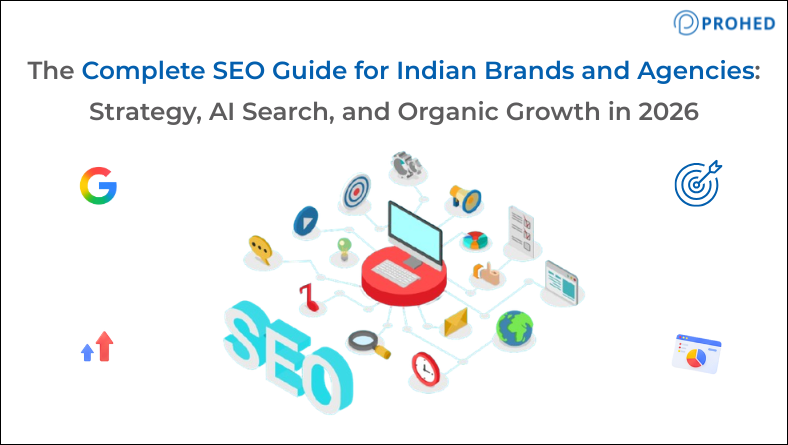
This complete SEO guide covers everything Indian brands and agencies need to build an organic growth strategy that works right now.
What SEO Actually Means in 2026
Before getting into tactics, it is worth being honest about what SEO has become, because the definition has genuinely expanded beyond what most people think.
Search engine optimisation used to mean ranking on Google. That is still important. In 2026, though, “search” happens across YouTube, ChatGPT, Perplexity, Google’s AI Overviews, Instagram, and even WhatsApp. Your potential customer might find your brand through a ChatGPT recommendation rather than a Google search result. They might discover you through a YouTube tutorial. They might read about you in an AI-generated answer without ever clicking through to your website at all.
None of this makes traditional SEO irrelevant. Rather, it makes the fundamentals more important than ever, while adding new layers on top. Brands that rank well on Google tend to get cited more often in AI search results too. Strong E-E-A-T signals, which stands for Experience, Expertise, Authoritativeness, and Trustworthiness, matter for both Google rankings and AI-generated answers.
The opportunity for Indian brands is also growing fast. According to TRAI’s 2024 annual report, India had over 954 million internet subscribers by the end of 2024, making it the second-largest internet market in the world. A significant proportion of these users rely on search to make purchase decisions, which means a well-executed SEO strategy offers more room for organic growth here than in nearly any other global market.
The Three-Layer SEO Foundation Every Brand Needs
Dominating the search results isn’t about luck; it requires a three-part framework used by every top-tier Indian brand. Missing even one of these elements creates a “leaky bucket” effect that will eventually tank your rankings. You need to align your technical health, content value, and authority to see real results.
Layer 1: Technical SEO
Technical SEO is the foundation everything else sits on. Without it, even genuinely great content struggles to rank. Think of it as making your website readable, crawlable, and fast enough that Google can find, understand, and index your pages without friction.
Here is what actually needs attention inside technical SEO:
Core Web Vitals: Google now actively penalizes sites with poor Largest Contentful Paint (LCP) scores. Aim for a render time under 2.5 seconds, especially since heavy third-party scripts often slow down Indian brand sites. Replacing bulky code with optimized assets is a non-negotiable step.
Crawl Budget Management: Large e-commerce platforms often waste their “crawl allowance” on low-value faceted navigation or duplicate pages. Fixing these silent leaks ensures Google prioritizes your high-margin product pages instead. Automation is the only way to manage this at scale.
Mobile-First Indexing: Search engines only care about your mobile performance in 2026. If your desktop site is beautiful but your mobile version lags, your rankings will suffer across the board. Every design choice must be made through a 6-inch screen perspective.
Schema Markup: Structured data is a massive missed opportunity for many Indian firms. Using FAQ, Product, and Review schema can boost your click-through rates (CTR) instantly by unlocking “Rich Snippets” in the search results.
Layer 2: On-Page SEO
On-page work determines whether your pages actually rank for the right terms and satisfy the intent behind each search. The key elements are keyword mapping, title tags, meta descriptions, content depth, internal linking, and proper heading structure.
A few things worth being specific about here:
Precision Tagging: Generic title tags are a waste of digital real estate. Every page needs a unique, manually crafted title that balances high-intent keywords with a compelling reason to click. Avoid auto-generated tags at all costs.
The Power of Internal Linking: Smart linking structures distribute “page juice” from your top-performing articles to newer pages. This simple lever can often push a page from the bottom of page two to a top-three spot without any new backlinks. It helps search engines map out your site’s content hierarchy effortlessly.
E-E-A-T & Quality: Google’s Helpful Content system now ruthlessly cuts down on generic, AI-spun fluff. Demonstrating first-hand experience, the “Experience” in E-E-A-T, is now the only way to stay relevant. Personal perspectives and expert author bios are mandatory for 2026 rankings.
Layer 3: Off-Page SEO
Off-page SEO is primarily about authority, building signals outside your own website that tell search engines your brand is credible and relevant.
Backlinks remain the most important off-page signal. Quality matters far more than quantity. Ten links from genuinely authoritative, relevant websites will consistently outperform a hundred links from low-quality directories.
A few things specific to Indian off-page SEO worth knowing:
Indian Media Authority: Backlinks from high-tier domestic outlets like Mint, YourStory, or The Economic Times carry immense weight for local search. Chasing high Domain Authority (DA) on global sites is less effective than securing mentions in regional, industry-specific Indian media. These links prove to Google that you are a key player in the Indian ecosystem.
Local Citation Consistency: Maintaining identical info across platforms like Justdial, Sulekha, and IndiaMart is crucial for city-level visibility. Inconsistent business details create confusion for Google and hurt your “near me” rankings. Local search is often the fastest path to high-intent leads.
Digital PR: Thought leadership isn’t just about the link; it’s about the context. Getting quoted in a credible industry analysis builds topical signals that basic link-building simply can’t match. This context helps AI search engines identify your brand as a primary source of truth.
The India-Specific Search Behaviours Most Guides Ignore
Generic SEO guides often treat India as a single, uniform market, but successful local growth requires a much more nuanced approach. Understanding these four specific search behaviors is the difference between ranking globally and actually converting locally.
1. The Hinglish Search Surge
Most international keyword tools are blind to the way Indians actually speak and type. Users frequently mix Hindi and English, searching for terms like “best digital marketing agency kaunsi hai” or “SEO kaise karte hain.”
The Strategy: Integrate natural Hinglish phrases into your headings and FAQ sections.
The Benefit: Doing this captures a high-intent audience that your purely English-focused competitors are completely missing.
2. Regional Language Expansion
Search volume in Hindi, Tamil, Telugu, Bengali, and Marathi is currently outpacing English growth in India. Data from Google’s 2024 reports confirms that the “next billion users” are primarily searching in their native mother tongues.
The Strategy: Build dedicated landing pages or subdomains for regional languages rather than relying on auto-translate.
The Benefit: You’ll face significantly lower competition and build deeper trust with users in Tier 2 and Tier 3 cities.
3. City-Level Intent Variation
A “one-size-fits-all” keyword list fails because search intent varies wildly across different Indian geographies. A founder in Bengaluru might prioritize “SaaS scalability,” while a business owner in Jaipur is likely searching for “reliable lead generation.”
The Strategy: Segment your keyword research by city tier and local industry clusters.
The Benefit: Matching your content format to the local decision-making timeline leads to much higher conversion rates.
4. Hyper-Local GBP Optimization
Google Business Profile (GBP) success in India requires more than just a verified address. You must account for local landmarks, regional spelling variants, and neighborhood-specific terminology to win the “near me” battle.
The Strategy: Upload photos and descriptions that reflect the actual local culture of the specific city branch.
The Benefit: Localized listings build immediate credibility, helping you dominate the map pack in competitive hubs like Delhi, Mumbai, or Pune.
Keyword Research for Indian Brands: What Is Different Here
Keyword research for the Indian market has a few nuances worth understanding before building any content strategy around it.
- Search volume data can be misleading: Many high-volume keywords in India carry very different intent than the same keywords in Western markets. “Digital marketing course” in India, for instance, is searched far more often by people looking for affordable certifications than by professionals seeking advanced training. Targeting the wrong segment within a high-volume keyword brings traffic that does not convert.
- Regional variation matters more than most brands acknowledge: India has 22 official languages and enormous regional differences in how people search for the same things. Brands targeting Tier 2 and Tier 3 markets often find that localised keywords perform very differently from metro-focused terms, even when the language is the same.
- Long-tail keywords are consistently undervalued: Much of Indian SEO is dominated by brands chasing head terms with huge competition. Meanwhile, long-tail keywords with clear purchase intent, such as specific product searches, location-based queries, and “best X for Y” formats, offer faster ranking opportunities with noticeably higher conversion rates.
- Voice search is growing faster in India than in most markets: Conversational, question-format queries are increasing rapidly. Structuring content around how people actually speak their questions, rather than how they type them, is becoming a meaningful differentiator for brands paying attention to it.
Doing an SEO Audit Before Building Your Strategy
Launching a strategy without an audit is like driving a car with a blindfold on. You need a clear picture of your current standing before spending a single Rupee on new content. A proper diagnostic reveals three things: what’s already working, what technical bugs are holding you back, and exactly where your competitors are stealing your traffic.
What a Practical SEO Audit Covers
- Technical Health: Check for crawl errors, broken links, and page speed bottlenecks using Search Console. These are the “silent killers” of organic growth.
- Content Performance: Analyze which pages are actually pulling their weight and which are cannibalizing each other. Grouping your data helps identify where to double down.
- Backlink Profile Review: Scrub your link profile for spammy or toxic sources that might trigger a penalty. High-quality diversity is the goal here.
- Competitor Gap Analysis: Find the specific keywords your rivals own that you’ve ignored. Identifying their content format gives you a blueprint to outrank them.
Skipping this phase is a recipe for disaster. Brands that ignore audits often end up with dozens of new blog posts that never see the light of page one.
SEO in the Age of AI Search: What Has Actually Changed
This is the section most SEO guides are getting wrong in 2026, either by overstating AI’s impact or ignoring it entirely.
The honest picture is straightforward. Google’s AI Overviews, ChatGPT search, and Perplexity are changing where people consume information. They are not, however, eliminating the need for well-optimised content. In fact, AI search systems draw heavily from high-quality, well-structured web content when generating answers. Brands that rank well on traditional Google tend to be cited more often in AI-generated responses too.
What Has Genuinely Shifted
According to a 2024 study by Semrush, organic click-through rates for informational queries dropped by an average of 15-25% following the rollout of Google’s AI Overviews in major markets. This makes ranking for transactional and commercial investigation queries more valuable than ever, since buyers closer to a purchase decision are far less likely to be satisfied by a generic AI summary.
- Answer Engine Optimisation (AEO) is the practice of structuring content to appear in AI-generated answers. Using clear question-and-answer formats, including structured data, and writing in a way that directly addresses specific queries rather than circling around them are the core techniques. Understanding the AEO vs SEO distinction is worth doing before shifting your content approach significantly.
- LLM seeding refers to getting your brand mentioned and recommended inside AI language models. As more buyers use ChatGPT or Perplexity to research products and services, LLM seeding is becoming a legitimate organic growth channel alongside traditional SEO.
- Search Everywhere Optimisation means building presence not just on Google but across YouTube, Instagram, Reddit, and AI platforms. Brands appearing in multiple search environments simultaneously are building a compounding organic advantage that single-channel SEO simply cannot match. Prohed’s guide on Search Everywhere Optimisation covers how this plays out in practice.
- YouTube SEO has become increasingly important as video search grows. Given how high video consumption is in India, a YouTube SEO strategy running alongside written content builds organic presence across two major platforms at once.
Local and Hyperlocal SEO: The Opportunity Most Indian Brands Miss
For Indian brands with physical locations or local service areas, local SEO represents one of the highest-ROI opportunities in organic marketing. It is also one of the most consistently underinvested areas across the board.
Google Business Profile optimisation, local citation building, review management, and location-specific landing pages are all components of a local SEO strategy that can dramatically increase visibility for “near me” searches.
Why the Indian Market Is Particularly Strong for Local SEO
With a large proportion of searches carrying local intent and significant variation in competition across cities, brands investing in local SEO in Tier 2 cities often find ranking considerably easier than in saturated metro markets.
Hyperlocal SEO takes this further, targeting neighbourhood-level or area-level keywords rather than just city-level terms. For real estate agencies, healthcare clinics, educational institutions, and local retailers, hyperlocal SEO in India can drive highly qualified leads at a very low cost per acquisition compared to paid channels.
Measuring SEO Success: Metrics That Actually Matter
One persistent problem with SEO reporting is that it tends to focus on vanity metrics, total organic traffic, keyword rankings, domain authority, while the metrics connecting to actual business outcomes get ignored.
Here is a more useful framework:
Metric | What It Actually Tells You |
Organic revenue contribution | What percentage of total revenue is coming from organic search |
Organic conversion rate | How well organic traffic is converting into leads or sales |
Keyword ranking velocity | How quickly target keywords are improving over a given period |
Share of voice | What percentage of available organic clicks in your category you are capturing |
Page-level organic traffic | Which specific pages are driving meaningful traffic, not just site-wide averages |
Backlink quality score | The authority and relevance of sites linking to you |
Core Web Vitals scores | Technical performance scores that directly influence ranking capability |
Rankings are a leading indicator. Revenue is the lagging indicator that actually matters. Building SEO reporting around the connection between those two is what separates data-driven organic marketing from activity that looks productive but delivers little.
Is your SEO strategy ready for the 2026 AI shift?
Don’t wait for a core update to find out your organic foundation is leaning on outdated tactics. From technical audits to AI-powered “Answer Engine” optimization, we help Indian brands claim the top spot and stay there.
Claim Your Free Organic Growth Audit with PROHED Today
Programmatic SEO: Scaling Organic Growth Without Losing Quality
Scaling content across thousands of products or locations requires a smarter approach than manual writing. Programmatic SEO allows you to use structured data to build helpful, templated pages at scale. The trick is ensuring every page provides unique value rather than just swapping out a city name.
Google rewards automated systems that actually help the user, but it ruthlessly penalizes “doorway” pages that offer no real substance. Programmatic SEO without quality loss is a legitimate strategy. Using it as a shortcut to mass content production is a fast route to an algorithmic penalty.
How to Choose the Right SEO Agency in India
Since SEO results take months to show, choosing the wrong agency is genuinely expensive. You may not realise things are going wrong until six months of budget and time have already been spent.
Green Flags Worth Looking For
They start with an audit before sending a proposal. Any agency pitching you a package before understanding your current technical state and content gaps is selling a product rather than a solution.
Their keyword strategy is explained clearly and specifically. Vague talk about “ranking you for high-volume keywords” without showing you which keywords, why, and how they connect to your business goals is a red flag worth paying attention to.
Reporting goes beyond rankings. Monthly reports showing keyword position improvements without connecting them to traffic, conversions, or revenue are hiding the real picture intentionally or unintentionally.
They understand the Indian market. Generic agencies applying international playbooks often miss the regional nuances, local search importance, and content consumption patterns specific to Indian audiences.
Red Flags Worth Walking Away From
Specific ranking timeline promises, particularly anything involving page one results in under 30 days, are almost always misleading. SEO timelines depend on domain authority, competition level, technical baseline, and content quality. No honest agency can guarantee rankings within a fixed short window.
For brands evaluating their options, this guide on choosing the right SEO service provider covers the full evaluation framework in detail.
The Google Core Update Factor: Adapting as Algorithms Evolve
Search rankings aren’t permanent. Google updates its core logic several times a year, shifting the goalposts for what qualifies as “quality.” In 2026, the focus has shifted entirely toward E-E-A-T and genuine user intent. If your content exists only to please an algorithm, you’re on borrowed time.
Practically, this means a few things worth building into any strategy:
- Verified Expertise: Content linked to real, credible authors with professional profiles performs significantly better. Google wants to see a human face behind the advice.
- Topical Authority: Stop chasing random keywords and start owning entire subjects. Becoming a comprehensive resource makes you an authoritative source in Google’s eyes.
- Engagement Signals: Metrics like scroll depth and time-on-page now influence your standing. High-quality writing keeps people reading, which signals to the algorithm that your site is worth visiting.
Building Brand Authority in AI-Powered Search
Beyond traditional SEO, one of the most forward-looking investments a brand can make right now is building the kind of authority that gets cited in AI-generated answers.
AI systems like ChatGPT, Perplexity, and Google’s AI Overviews draw from high-quality, frequently cited web content when generating responses. Brands mentioned consistently across authoritative publications, industry forums, and credible third-party sources tend to appear in AI-generated answers more often as a direct result.
Building brand authority for AI-powered search involves digital PR, thought leadership content, strategic link building, and ensuring your brand is mentioned and linked from sources that AI models treat as credible. It is a longer play than traditional SEO, but the compounding effect over 12 to 18 months is significant and genuinely hard for competitors to replicate quickly.
The Bottom Line
Waiting for paid ads to become “too expensive” before starting SEO is a tactical error that costs brands years of growth. Smart founders treat organic search as foundational infrastructure rather than a secondary luxury. Investing early allows traffic to compound quietly, eventually slashing your reliance on pricey acquisition channels.
India’s digital landscape is expanding rapidly across Tier 2 and Tier 3 markets, making this the perfect window to claim your territory. Prohed partners with brands in sectors like D2C, EdTech, and Fintech to build search systems that actually scale. Our process moves from deep audits to technical execution, ensuring your growth is built on a rock-solid base.
Frequently Asked Questions
1. How long does SEO take to show results in India?
Expect a three to six-month wait before organic traffic truly shifts. Competitive niches like Fintech take longer to crack. Progress happens faster if your technical base is solid and clean. Avoid anyone promising page-one rankings in thirty days. Such “shortcuts” usually lead to a permanent Google ban.
2. What is the difference between SEO and AEO in 2026?
Traditional SEO focuses on winning blue links and direct site visits. AEO shifts that goal toward appearing in AI-generated summaries for instant answers. Brands now need both to stay visible. Some users want deep research, while others just need a quick tip without clicking through to a website.
3. How much should an Indian brand budget for SEO?
Professional growth strategies usually start between ₹50,000 and ₹1,50,000 monthly. Enterprise brands in crowded categories will naturally spend more to stay ahead. See this as a long-term asset rather than a simple fee. You are essentially buying back future ad spend by owning your organic traffic.
4. Is local SEO different from regular SEO?
Map packs and Google Business Profiles are the core of local search success. National SEO targets broad terms while local work wins the neighborhood battle. Citations and reviews are your primary tools here. For service brands in specific cities, this is often the highest ROI investment they can make.
5. What is the difference between SEO and GEO?
SEO focuses on list-style rankings while GEO targets AI-generated citations. Generative Engine Optimization ensures your name pops up in ChatGPT or Perplexity. High-authority third-party mentions are the key to winning here. AI models only recommend brands they find cited across credible, factual sources.
6. How do I rank in Google’s AI Overviews in India?
Structure your content into direct, punchy Q&A blocks to win this spot. FAQ schema helps robots identify your data points instantly. Strong topical authority remains the biggest factor for being cited. Google only highlights brands it considers a “voice of truth” within their specific industry or niche.
7. Does SEO still work in the age of ChatGPT and Perplexity?
Search is more vital than ever since AI bots use indexed web data to learn. Informational clicks might drop, but high-intent commercial traffic remains steady. Real buyers still want to visit a website before spending money. Modern SEO ensures you remain the credible destination for those final conversions.
8. What is the right content publishing frequency for Indian brands?
Quality beats sheer volume every single time. Posting two expert-led articles a month is far better than dumping ten thin, robotic updates. Google rewards those who follow a predictable, high-value pattern. Consistency builds a level of authority that sporadic bursts of content simply cannot achieve.
Schedule a Free Strategy Call with PROHED Today