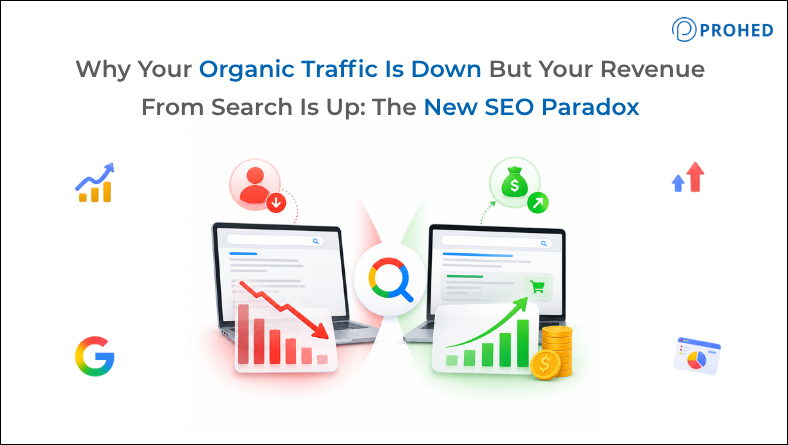
Organic traffic is visitors who land on your website through unpaid search results. Traditionally, more of it meant more revenue opportunity. That relationship has broken. In 2026, a measurable and growing number of Indian brands are watching website traffic from search fall, while search-attributed revenue holds steady or quietly climbs. At Prohed, a performance marketing agency in Gurgaon, we’re tracking this shift across D2C, EdTech, healthcare, and real estate accounts. The data tells a consistent story, and misreading it is one of the most expensive mistakes a brand can make right now.
Open your analytics. Sessions are down. The team is worried.
Pull the revenue report. Search is still delivering.
Both numbers are real. And they seem to contradict each other completely.
This is the SEO paradox that’s quietly playing out across Indian brand accounts in 2026. It isn’t a tracking error. It isn’t a GA4 configuration issue. It’s a structural change in how search works, and understanding it is the difference between making smart decisions and cutting the wrong budget at the wrong time.
What the Numbers Are Actually Saying
Here’s what’s happening at the search results page level, and why it explains everything.
Google’s AI Overviews, featured snippets, People Also Ask boxes, and knowledge panels now resolve a significant portion of search queries directly on the results page. The user searches. They read the answer Google surfaces. They leave, without clicking any link at all.
This behaviour is especially pronounced on informational queries. Research questions. Definition searches. How-to queries. Comparison searches. These used to send consistent streams of website visitors to blogs, guides, and resource pages. That stream has thinned considerably.
According to BrightEdge research published in 2025, Google search impressions rose close to 49% in the year following AI Overviews’ launch. Over that same period, average click-through rates dropped by nearly 30%.
More searches. Fewer clicks. That gap is where your traffic went.
But here’s the part that changes everything: the users who do click through are different from the ones who used to.
Who Is Still Clicking, and Why It Matters
The users that AI Overviews filter out are almost entirely research-stage visitors. They came to learn something. Now they learn it from the AI block and move on.
What’s left clicking through to websites is a far more commercially motivated group. These users have typically already done their research, often through AI-powered tools like Perplexity, ChatGPT, or Google’s own AI answers. They’ve narrowed their options. They’re clicking because they want something specific: a price, a demo, a product to buy, a team to call.
In other words, the low-intent browse traffic has been absorbed upstream. What remains is a smaller pool of visitors who are significantly closer to a conversion decision.
Consequently, conversion rates from organic traffic are rising for brands that haven’t changed anything about their website or offer. Revenue-per-session has increased. And total search revenue has held on a reduced visit base.
This isn’t coincidence. It’s the logical outcome of a search landscape that pre-qualifies users before they arrive.
The India-Specific Layer That Makes This More Complex
The global pattern is real. However, for Indian brands, there are additional dynamics worth understanding separately.
- AI tool adoption in India is accelerating faster than most markets: ChatGPT usage in India grew over 200% year-on-year through 2024-25, driven by affordable data and rising smartphone penetration across Tier 2 and Tier 3 cities. Consequently, the informational query absorption happening globally through AI tools is happening in India at a compressed timeline.
- Vernacular search behaviour adds a nuance that global data misses: A significant portion of Indian users are now searching in Hindi, Tamil, Telugu, Kannada, and other regional languages. AI Overviews in English cover fewer of these queries reliably, which means organic traffic from vernacular searches is still flowing to websites more consistently than English-language search traffic. Brands with strong vernacular content are, therefore, experiencing a less severe traffic paradox than English-only content strategies.
- Branded search in India carries a specific trust signal: An Indian consumer who searches a brand name directly has cleared a high bar of intent. They’ve encountered the brand somewhere, decided it’s worth investigating, and come looking deliberately. Branded organic traffic to website in India converts at two to three times the rate of non-branded organic traffic in most categories. Watching branded search volume, therefore, is one of the most important leading indicators of actual business health right now.
The PROHED Search Revenue Framework: What to Measure Instead
At Prohed, we’ve restructured how search performance is reported for clients experiencing this pattern. The Prohed Search Revenue Framework replaces session volume as the primary metric with four commercial signals that give a more accurate picture of what search is actually delivering.
Signal 1: Organic Conversion Rate Trend
If organic traffic volume is falling but the organic conversion rate is rising, the brand is retaining the commercially valuable visitors while losing the browsers. That’s the healthiest version of this paradox.
Specifically, track organic conversion rate month-over-month rather than comparing it to a year-ago baseline. The shift typically happened gradually through 2024 and 2025 as AI Overviews expanded, so year-on-year comparisons can mask the trend. A rising organic conversion rate on falling sessions is a signal to lean into the channel, not pull back from it.
Signal 2: Revenue Per Organic Session
Divide organic search revenue by organic sessions. If this number is climbing, each visitor arriving from search is worth more commercially than they used to be. For Indian D2C brands in beauty, health, and baby care, revenue per organic session improvements of 20-40% have been observed across Prohed-managed accounts in 2025-26, even where session volume fell meaningfully.
This metric reframes the conversation with leadership. Instead of “organic traffic is down 25%,” the more accurate framing is “each organic visitor is now worth 35% more to the business.” Those are two entirely different strategic situations.
Signal 3: Branded Search Volume in Google Search Console
This is the metric most Indian SEO teams are underweighting right now.
When an AI tool recommends your brand by name, and a user then searches specifically for you, that shows up as branded search volume in Search Console. It’s demand that AI created and that your brand captured. It doesn’t show up cleanly in referral traffic because AI tools rarely pass referral data correctly. Instead, it registers as a direct or organic branded session.
Branded search volume is therefore one of the clearest leading indicators of whether your brand is being cited in AI-generated answers. A rising branded search trend alongside falling overall organic traffic is a strongly positive signal: the brand is gaining AI-driven awareness that’s translating into deliberate search behaviour.
Signal 4: AI-Referred Traffic as a Separate Segment
Most Indian brands are not tracking this yet. They should be.
In GA4, segment your direct channel visits by source domain. Search for visits from the domains of chatgpt.com, perplexity.ai, claude.ai, gemini.google.com and other AI tool domains. These sessions are misclassified as direct traffic because AI tools often don’t forward the referral properly.
Across the categories Prohed tracked in 2025-26, AI-referred visits are a small but quickly growing part of overall traffic, and they convert much better than the average organic visitor. A user arrived from a ChatGPT recommendation. The AI already qualified them with an answer. They arrived with context, the question and the answer. A regular organic visitor doesn’t have these.
Set this up as a custom channel grouping and track it monthly. What looks like a rounding error today will be a meaningful channel within twelve months.
What This Means for How to Increase Website Traffic Organically
Here’s where the paradox changes the playbook for how to increase website traffic organically in 2026.
The instinctive response to falling session numbers is to produce more content targeting more keywords. More articles, more informational posts, more top-of-funnel coverage.
In the current environment, that approach often makes the situation worse rather than better.
More informational content means more pages competing for exactly the query types that AI Overviews now resolve without a click. The sessions won’t materialise. The content investment produces impressions and zero commercial return.
The more productive approach has three parts.
1. Shift content investment toward transactional intent
Service pages, product pages, pricing pages, comparison content, and case studies sit closest to a purchase decision. These are the pages where the click still happens consistently, because AI Overviews are far less likely to fully resolve a query with specific commercial intent. A user searching “best performance marketing agency for D2C brands in India” isn’t satisfied by an AI summary. They want to evaluate specific providers.
2. Build content that earns AI citation on informational queries
Informational content should still be produced, but with a different objective. Rather than chasing clicks, the goal is to be referenced inside AI-generated answers. Content that earns citations builds brand exposure to users who never visit the site, and that exposure feeds the branded search volume described above.
Content that earns AI citation consistently shares specific characteristics:
- A direct answer block immediately after the heading that resolves the query in three to four sentences
- A named, proprietary framework or methodology that AI engines can attribute to the brand
- India-specific data with ₹ figures, tier-based city context, and Indian platform references
- A structured FAQ section with schema markup that creates clean extraction points for AI-generated answers
3. Use search engine optimization and paid search together, not separately
As organic traffic thins on informational queries, paid search covers high-commercial-intent queries where a click is still the expected behaviour. The two channels should be planned around the same commercial objectives rather than managed as competing line items in the same budget.
Related Read: The Complete Guide to AI Search Optimization for Indian Brands in 2026
What to Actually Do in Your Account Right Now
If your brand is experiencing this paradox, here’s where to focus attention first.
- Check whether the traffic decline is intent-driven or ranking-driven: Pull Google Search Console impression data. If impressions are stable or rising while clicks are falling, you’re experiencing AI Overview suppression on well-ranked pages. If impressions are also falling, the issue is different and is more likely a ranking problem that needs a separate diagnosis.
- Review which pages are losing traffic by content type: If informational blog content is losing sessions while service pages and product pages are holding, the pattern matches the intent concentration effect exactly. That’s very different from a site-wide SEO problem.
- Set up AI referral tracking before Q3: Add ChatGPT, Perplexity, Claude, and Gemini as custom sources in your GA4 channel groupings. Even if the numbers are small today, the baseline you establish now gives you a comparative reference point as the channel grows.
- Shift the primary reporting metric in your next leadership review: Replace sessions-from-organic as the headline number with organic revenue, organic conversion rate trend, and branded search volume. This reframes the conversation from a perceived crisis to an accurate picture of what’s actually happening.
At Prohed, this is how search engine optimization in India strategy is reported and managed across client accounts. Beyond SEO, our full services including Performance Marketing, E-commerce Marketing, B2C Lead Generation, and Social Media Marketing are designed to work together rather than as isolated channels, because the traffic paradox described here is solved by treating paid and organic as one connected system, not two competing ones.
Conclusion
Falling organic traffic alongside stable or growing search revenue is not a data problem. It’s not a tracking misconfiguration. It’s the logical outcome of a search landscape that has fundamentally changed what happens between a search query and a website visit.
AI Overviews and conversational AI tools now absorb the research-stage user before they ever reach a website. What remains clicking through is a smaller, more commercially motivated audience that converts better and generates more revenue per session than the mixed-intent audience that used to arrive.
The brands navigating this well have done three things: they’ve changed what they measure, they’ve shifted content investment toward transactional and citation-eligible pages, and they’ve integrated organic and paid strategy around shared commercial outcomes rather than separate traffic targets.
The brands still measuring website traffic volume as the primary SEO success metric will continue to see a metric that looks like it’s deteriorating, even when the underlying business outcome from search is actually healthy.
If your team needs help making sense of this pattern in your specific account, or if both traffic and revenue are falling and you need to understand which problem you’re actually solving, Prohed works with brands across India as one of the leading SEO companies in Gurgaon. As a full-service SEO agency in Gurgaon, we audit search performance through a commercial lens, identify exactly where the traffic change is coming from, and rebuild the strategy around the metrics that reflect real business health.
Frequently Asked Questions
1. Why is organic traffic falling even when SEO rankings haven’t changed?
AI overviews, featured snippets, and knowledge panels are answering queries directly on the search results page, so users no longer have to click through to a website. A page can have position one placement, a high impression volume, and yet receive fewer searches than it did the year ago because the AI block circled above answered the question first.
2. Is falling organic traffic always a sign of poor SEO?
No. If organic conversion rate is rising and search-attributed revenue is stable or growing, falling traffic is more likely to reflect AI-driven intent concentration than an SEO failure. The signal to investigate is traffic and revenue falling simultaneously, which points to a different kind of problem.
3. What should replace sessions as the primary SEO metric?
Organic conversion rate trend, revenue per organic session, branded search volume in Search Console, and AI-referred traffic as a separate segment. Together, these four signals give a more accurate picture of search performance than raw session volume alone.
4. How do I track AI-referred traffic in Google Analytics 4?
Create a custom channel grouping in GA4 that segments traffic from chatgpt.com, perplexity.ai, claude.ai, and gemini.google.com. These sessions often appear as direct traffic by default because AI tools don’t always pass referral parameters. Setting up the custom grouping allows you to track this channel separately as it grows.
5. What content types are most resistant to the AI Overview click suppression effect?
Transactional and bottom-of-funnel content holds click-through rate most strongly: service pages, product pages, pricing pages, and specific comparison content. Informational content is most affected, but it still has a role in earning AI citations that build branded search volume over time.
6. How does this pattern affect Indian brands differently from global brands?
India’s rapid AI tool adoption, particularly ChatGPT and Perplexity in Tier 1 cities, means the informational query absorption is happening faster than in many markets. However, vernacular content in regional languages is less affected by AI Overviews, and branded search in India carries a high trust signal that makes branded organic traffic especially valuable.
7. Should organic SEO budget be cut if traffic is falling?
Only if both traffic and commercial outcomes are falling simultaneously. If traffic is down but revenue per session and conversion rate are improving, cutting SEO budget removes the channel that is quietly becoming more efficient. The right response is to shift the investment mix within SEO toward transactional and citation-eligible content.
8. How does Prohed approach SEO for brands experiencing this traffic paradox?
Prohed audits the content portfolio by intent layer, separates ranking problems from AI Overview suppression problems using Search Console impression data, sets up AI referral tracking in GA4, and restructures reporting around commercial outcomes rather than session volume. SEO strategy is integrated with paid search planning so both channels work toward the same revenue targets.
Is your organic traffic falling and you’re not sure whether it’s an SEO problem or an AI search problem? Prohed can run the audit that tells you exactly which one it is, and what to do about it.
Schedule a Free Strategy Call with PROHED Today