What is speed to lead? It’s the time that passes between a prospect submitting a lead form and your sales team making first contact. It sounds like a minor operational detail. In practice, it’s one of the highest-leverage variables in your entire sales conversion rate, and most brands are getting it badly wrong. At Prohed, a performance marketing agency in Gurgaon, speed to lead is one of the first things audited when a client’s lead volume looks healthy but their pipeline isn’t converting.
Most brands generating leads in India are losing a significant portion of them to a competitor who simply responded faster. Not a better product. Not a better price. Just a faster call. That’s how unforgiving the speed to lead window actually is, and most sales teams don’t realise how much it’s costing them until the pipeline numbers don’t match the lead volume.
This isn’t a hypothetical. It’s a pattern that plays out thousands of times every day across B2C, EdTech, real estate, and healthcare brands in India. And the cost isn’t just one lost deal. It’s a systematic conversion problem that compounds across every lead the campaign generates.
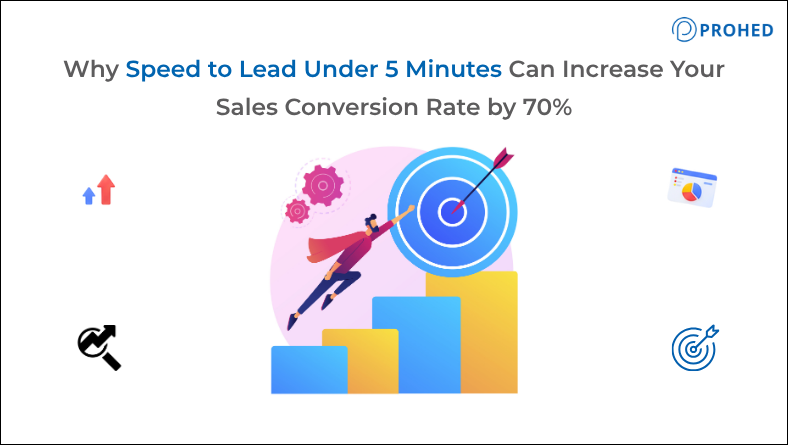
At Prohed, a performance marketing agency in Gurgaon, speed to lead is treated as a campaign metric, not an operations afterthought. Across B2C and lead generation clients managed in 2025-26, brands that implemented sub-five-minute lead response systems consistently saw sales conversion rate improvements of 40-70% on the same lead volume, without any change to targeting, creative, or ad spend. The leads didn’t get better. The response did.
Here’s why that five-minute window matters so much, and exactly how to build a system that captures it reliably.
Why the Five-Minute Window Exists at All
When someone fills in a lead form, they are at peak intent. Something motivated them to stop what they were doing, engage with your ad or landing page, and take a deliberate action. That motivation is real, but it’s also time-sensitive.
Within minutes of submitting a form, the same person has typically returned to whatever they were doing before. Their attention has shifted. The tab with your landing page has been closed. The intent that drove the conversion is still there, but it’s no longer front of mind.
Furthermore, in most competitive categories, your prospect has almost certainly submitted forms to more than one brand. Real estate buyers enquire with multiple developers simultaneously. EdTech prospects compare three or four programmes before deciding. Healthcare enquiries are often sent to two or three providers in a single session.
The brand that calls first doesn’t just get the first conversation. It shapes the entire comparison that follows. Consequently, every minute that passes after form submission is a minute in which a competitor can establish a conversation, build rapport, and begin the process of earning the sale.
What the Data Actually Says
The research on speed to lead conversion rate is remarkably consistent, and the numbers are more dramatic than most sales managers expect.
According to research by Velocify and InsideSales, leads contacted within five minutes are between 21 and 100 times more likely to convert than those contacted after 30 minutes. A separate study by Harvard Business Review and MIT found that the probability of actually reaching a lead drops by over 80% if first contact happens after five minutes rather than within it. And by the 24-hour mark, which is where many Indian sales teams are still operating, the chance of a meaningful conversation drops to a fraction of what it would have been at the five-minute mark.
Additionally, the five-minute threshold isn’t arbitrary. It reflects the natural attention cycle of a digital consumer. Within five minutes, a lead is still thinking about the problem that brought them to you. After that, context shifts, and re-engaging someone who has mentally moved on is a fundamentally harder sales challenge than continuing a conversation already in motion.
Over multiple B2C clients managed by Prohed in 2025-26, brands that transitioned from a next-day callback process to a sub-five-minute automated first touch followed by a same-hour human call saw lead conversion rates increase on average by 55% in the first 60 days of implementation. The same leads, an identical sales team, and the exact same product. Just a faster response.
For context on how Indian sales teams currently perform: industry data suggests that the average first response time for digital leads across B2C categories in India sits between 2 and 8 hours, well outside the five-minute window where conversion probability is highest. That gap is precisely where the opportunity lives for brands that build faster systems.
The Three-Layer Speed to Lead System
Building a reliable sub-five-minute lead response doesn’t require a large team or expensive technology. It requires three layers working in sequence, automation handles the first touch, routing handles the handoff, and the human conversation happens inside the golden window.
Layer 1: Automated First Touch Within 60 Seconds
The automated first touch should go out within 60 seconds of form submission. No exceptions.
In India’s B2C context, WhatsApp is consistently the highest-performing channel for this. Open rates are significantly higher than email, response rates are faster, and the conversational format matches how most consumers prefer to communicate.
What the message should say: Something specific, not generic. “Hi Priya, thanks for your interest in our 12-week programme. Our team will call you in the next few minutes to walk you through the details” lands completely differently from a generic “Thank you for your enquiry” autoresponder. Specificity signals that the brand paid attention. That distinction builds immediate trust, even in an automated message.
Additionally, the WhatsApp message can include a short video, a relevant page link, or a quick product explainer that keeps the prospect’s attention on your brand while they wait for the call. This is a small thing. The impact is not small.
Layer 2: Intelligent Lead Routing Within Two Minutes
The single biggest operational bottleneck in most sales teams isn’t the team’s willingness to call quickly. It’s the time lost between a lead arriving and a salesperson knowing it exists.
When leads arrive in an email inbox that someone checks every hour, or in a CRM that requires manual assignment, the five-minute window closes before the human conversation even begins. Intelligent routing eliminates this lag entirely.
How it should work: A lead submits a form. The CRM entry is created automatically. Routing logic assigns the lead to the right salesperson based on geography, product category, or availability. That salesperson receives a real-time WhatsApp notification, not an email, with the lead’s name, what they enquired about, and a direct call link.
One additional rule that often gets missed: after-hours leads should still be routed immediately, but flagged for a 9am callback the following morning with a context note that the prospect submitted late the previous evening. This prevents cold callbacks while maintaining the impression of attentiveness.
Layer 3: Human Call Within Five Minutes During Working Hours
This is where the sale actually begins.
Within the five-minute window, the prospect is still thinking about the problem that brought them to you. They’re engaged, and a good conversation at this moment can meaningfully advance the relationship. After the window closes, that same conversation requires significantly more effort to reach the same outcome.
What the opening of that call should do: Reference the specific thing the prospect enquired about. Not “I’m calling about your enquiry” but “Hi Priya, I saw you were looking at our EdTech programme for working professionals. I wanted to walk you through what the first 30 days look like.” That specificity transforms a sales call into a continuation of an intent that the prospect themselves initiated.
One more thing worth noting: the goal of the first call is not to close. It’s to qualify and schedule. Understanding the prospect’s situation, timeline, and decision criteria in the first call gives the sales team the information needed to make a genuinely tailored second conversation, which is where most deals are actually won.
What This Looks Like in Practice
A B2C EdTech client managed by Prohed had been generating consistent lead volume through Google Search campaigns, approximately 180 leads per month at a reasonable CPL. However, their sales-to-enrolment rate was sitting at 6%, producing around 11 enrolments monthly. The lead management process involved manual CRM entry and a same-day callback target that was being met roughly 60% of the time, with average first contact happening 4-6 hours after submission.
Prohed worked with the client to implement a three-layer speed to lead system. An automated WhatsApp message went out within 90 seconds of every form submission. We connected lead routing directly to the CRM and sent real-time WhatsApp notifications to the assigned salesperson. We also changed the callback target from same-day to within five minutes during working hours.
The result: Within 45 days of implementation, the sales-to-enrolment rate climbed from 6% to 16%, without any change to the campaigns, creative, targeting, or product offer. On the same 180 leads per month, enrolments increased from 11 to approximately 29. Cost per enrolment fell by over 60% as a direct result of the faster response infrastructure, not any change in marketing spend.
That’s what speed to lead done properly actually looks like in a P&L.
The After-Hours Problem and How to Solve It
One of the most common objections to speed to lead systems is that a significant proportion of leads come in outside working hours. If the five-minute window can’t be met for those leads, does the system still matter?
Yes. And the fix is simpler than most brands expect.
After-hours leads should receive the same automated WhatsApp first touch within 60 seconds of submission, but the message should be calibrated to the time. Rather than promising a call in the next few minutes, it should acknowledge the hour and commit to a specific callback window: “Our team will call you first thing tomorrow morning between 9 and 10am.”
This does two things simultaneously. First, it sets a clear expectation rather than leaving the prospect uncertain about when to expect contact. Second, it gives the sales team a specific commitment to honour, which structures the morning callback as a priority rather than another item in the queue.
Furthermore, for premium B2C categories where leads carry high ticket value, a live WhatsApp conversation option after hours, either staffed by a trained team member or a well-designed qualification chatbot, can meaningfully reduce the intent decay that happens between an evening form submission and the morning callback.
The Lead Tracking Setup That Makes All of This Possible
None of the above works reliably without proper lead tracking infrastructure connecting the marketing funnel to the sales response system. In many brands, this is the missing link entirely.
Leads arrive through a form. They pass through an email notification. They enter a CRM that the sales team checks periodically. Every step in that chain adds latency. And latency kills conversion.
The setup that actually works:
Form submission triggers instant CRM entry. CRM entry triggers instant routing logic. Routing logic triggers an instant WhatsApp notification to the assigned salesperson. And lead response time is tracked on the same dashboard as CPL and conversion rate, so that breakdowns in the system are visible before they compound into revenue impact.
Additionally, this tracking setup creates a feedback loop that improves both marketing and sales over time. When response time data is combined with conversion data, it becomes possible to see exactly how conversion rate changes across different response time brackets. That data makes the internal business case for speed to lead, and it identifies when the system is failing before the revenue numbers catch up.
Prohed’s Take on This and What We Actually Do About It
Most agencies build campaigns and hand over leads. We build the campaign and then ask what happens to the lead next, because that question is where the actual ROI lives.
Speed to lead is built into every lead generation engagement from the start. That means the campaign brief includes first-touch automation, not just ad structure. The CRM setup includes routing logic and response time tracking, not just lead fields. And the weekly review includes average response time as a metric alongside CPL and conversion rate, because the three numbers are connected.
Specifically, this is how it shows up across Prohed’s services. We build B2C lead generation campaigns with automated WhatsApp first-touch sequences connected directly to the form submission. For B2B lead generation accounts, we structure routing logic that eliminates manual assignment delays entirely. We connect Search Engine Marketing campaigns to lead tracking dashboards where response time sits next to CPL and conversion rate as a standard campaign metric. Finally, our ad account audit process always includes a review of what happens after a lead converts, because that’s consistently where accounts that otherwise look well-run waste their budget.
The lead came in. Someone wanted to buy. The only question is whether your system was fast enough to be there when they did.
Frequently Asked Questions
1. What is speed to lead?
The speed to lead is the amount of time between a prospect submitting a lead form and when your sales team first reaches out. Response time dictates a massive portion of your sales conversion rate. Studies consistently show that sales teams who answer leads within five minutes close far more deals than those who wait 30 minutes or longer.
2. Why does the five-minute window matter so much?
Within five minutes, your prospect still holds the mental context of the problem that prompted them to convert. They maintain peak intent, keep their attention engaged, and haven’t yet researched alternatives or lost their initial sense of urgency. After five minutes, that context changes, and re-engaging someone who has mentally moved is significantly harder than continuing a conversation that is already underway.
3. How much does slow lead response actually cost in conversion terms?
According to Velocify/InsideSales research, leads contacted within five minutes are between 21 and 100 times more likely to convert than those contacted after 30 minutes. The Harvard Business Review/MIT study found that the probability of reaching a lead at all drops by over 80% after that window closes.
4. What should an automated first touch message include?
Tailor the response specifically to the prospect’s actual submission instead of keeping it generic. It must acknowledge their inquiry, guarantee a human call within a clear timeline, and ideally share a piece of content to keep them engaged with your brand while they wait. In India in B2C, WhatsApp is consistently the best channel for that first touch.
5. What lead tracking setup is needed to support sub-five-minute response?
Form submissions must trigger instant CRM entry, automated routing, and immediate notifications via WhatsApp instead of email. Additionally, track response times alongside CPL and conversion rates to catch system breakdowns early.
6. Does speed to lead matter for B2B as well as B2C?
Yes, though the dynamics shift slightly. B2B leads often involve longer sales cycles and multiple stakeholders, so the urgency isn’t always about closing the deal in minutes. But first response time still determines whether a real relationship gets built or whether the lead goes cold waiting in an inbox. A fast, thoughtful first response in B2B signals seriousness and sets the tone for everything that follows.
7. What is lead response management?
Lead response management is the system, covering routing logic, notification infrastructure, response time tracking, and first-touch sequencing, that determines how quickly and effectively a sales team responds to incoming leads. It sits at the intersection of marketing operations and sales operations, and it’s the infrastructure that makes speed to lead achievable consistently rather than occasionally.
8. How does speed to lead connect to overall lead generation strategy?
Speed to lead is therefore both a campaign metric and a sales operations metric, it sits at the intersection of what marketing builds and what sales converts, and neither team can optimise for revenue without owning it together.
9. How does Prohed help brands improve their speed to lead?
Prohed builds lead response infrastructure as part of the campaign setup, not as a separate project. This setup connects automated first-touch sequences to form submissions, routes CRM leads instantly, and tracks response times alongside conversions. We ensure your ad spend contacts leads while intent remains live.
If you’re generating leads but not converting them at the rate your spend should justify, and you’re looking for a Lead Generation Agency in India that treats the full lead journey as part of the campaign, Prohed is worth a conversation.
Schedule Free Consultation to Maximize Your Performance