Lead generation is the process of targeting and engaging with potential customers and moving them towards a purchase decision via targeted marketing and nurturing. In 2026, it isn’t about collecting contact details. It’s about attracting the right people, at the right time, via channels that they actually use. At Prohed, a performance marketing agency based in Gurgaon, we’ve run lead generation campaigns across D2C, EdTech, fintech, healthcare, and B2B categories. The gap between brands getting quality leads and brands getting volume without conversions almost always comes down to strategy, not spend.
Most brands treat lead generation as a numbers game. More forms filled, more calls booked, more contacts in the CRM. The pipeline looks full, the team looks busy, and then the sales team reports that most of those leads are going nowhere.
The problem is rarely the quantity of leads. It is almost always the quality. And quality starts with understanding what kind of lead generation your business actually needs before deciding which channels to run and which budget to allocate.
This guide is perfect for leading you through all aspects: Understanding the difference between B2B, B2C, and high-ticket lead generation, the state of inbound and outbound strategies in the Indian market 2026, creating a lucrative nurture system, and measuring the results to see what’s actually working.
What Lead Generation Actually Means in 2026
The definition has not changed dramatically. The execution has.
Running a few Google Ads and capturing form fills was considered a lead generation strategy in 2020. In 2026, that strategy will produce a CRM full of low-quality leads and a sales team that no longer trusts the marketing funnel.
What’s changed is that the buyer’s journey has changed. Indian buyers, in more than just one category, are researching longer, comparing more, and making decisions with far more information than they did even three years ago. A B2B decision-maker will research a vendor across their website, LinkedIn, third party reviews, recommendations from peers and, increasingly, AI tools such as ChatGPT and Perplexity before they respond to an email or fill out a form.
A B2C buyer will discover about a product on Instagram, watch a YouTube review, ask friends on WhatsApp, look at Amazon reviews and then, finally, convert. The number of touchpoints before converting has increased dramatically. It has made the single channel strategy of lead generation completely vulnerable.
Lead generation in 2026 isn’t about generating leads in the moment of intent either. It’s about showing up across the buyer’s journey by developing systems that qualify and nurture leads instead of just collecting them. Ultimately, success is measured by revenue contribution rather than a high volume of leads.
B2B vs B2C vs High-Ticket: The Differences That Actually Matter
These three categories are often lumped together under “lead generation” but they are fundamentally different in their strategies. Knowing what the differences are before you build any pipeline is the difference between a focused and efficient pipeline and one that is expensive and confused.
B2B Lead Generation
In B2B the buyer is usually not one person. You talk to procurement, finance, the actual end user, and then potentially a senior stakeholder who didn’t front loop on you in the initial call. Sales cycles go from weeks to months for mid-ticket SaaS deals and quarters to years for enterprise deals. Coupled with a lower volume of leads, lead quality becomes even more important than in any other category.
The goal of B2B lead gen isn’t to fill out a form. It’s to get the right soul in the right company into a structured conversation. Channels that are effective in B2B include LinkedIn outreach, Google Search for high-intent queries, webinars, thought leadership content, and account-based marketing focusing on specific companies rather than broad audience segments.
The most consistent finding across B2B campaigns Prohed has run for tech and manufacturing clients is this one: brands that invest in content answering the specific questions a decision-maker is researching – before they are ready to buy – end up being consistently better, with less, than brands that run pure bottom-of-funnel paid campaigns. A B2B SaaS client cut their cost per qualified lead by 38% over a period of six months, after shifting 30% of their budget from paid search to Linked In thought leadership content, which warmed the audience before they ran into conversion campaigns.
B2C Lead Generation
B2C lead generation operates at higher volume, shorter cycles, and much lower average ticket sizes. The audience is broader, the decision-making is faster, and the emotional component of the purchase is often higher than the rational consideration.
Meta Ads, Google Display, YouTube, and WhatsApp are the primary B2C lead generation channels in India. Creative quality matters enormously here. In a high-volume B2C environment, the ad that gets attention gets the lead. Targeting can find the right audience, but creative decides whether that audience acts.
The most common B2C lead generation mistake is optimising for lead volume rather than lead quality. Getting 1,000 leads for ₹30 each sounds impressive until the sales team reports that 850 of them are unreachable, uninterested, or completely outside the target profile. The metric worth optimising is cost per qualified lead, not cost per lead.
For brands scaling D2C or e-commerce, Prohed’s post on reducing customer acquisition cost in e-commerce covers the levers that matter most at scale.
High-Ticket Lead Generation
High-ticket lead generation sits somewhere between B2B and B2C in structure but with its own distinct requirements. Categories like premium EdTech, real estate, high-end financial products, and professional services typically involve a single decision-maker, a longer consideration cycle than typical B2C, and a much higher emotional and financial stake in the decision.
In high-ticket categories, trust is the primary conversion factor. A buyer considering a ₹2 lakh EdTech programme or a ₹50 lakh property is not converting on a form fill alone. They need evidence of credibility, including testimonials, credentials, proven outcomes, and a nurture sequence that addresses their specific objections before asking them to commit.
High-ticket lead generation requires a narrower, more focused channel mix.
- Google Search – for high-intent queries.
- YouTube – for trust-building video content.
- WhatsApp – for one-to-one nurture conversations.
“Broader” awareness campaigns at the top of the funnel don’t deliver good ROI on high-ticket leads.
Inbound vs Outbound Lead Generation: Knowing Which One Your Business Needs
This distinction trips up a lot of marketing teams because both approaches have their place. Mixing them up, or choosing the wrong one for the wrong stage, wastes budget and confuses the sales team.
Inbound Lead Generation
Inbound lead generation is using content, visibility, and value to attract potential buyers to your brand instead of interrupting them with outreach. SEO-generated content, organic social, webinars, YouTube, podcast appearances, and thought leadership are all inbound channels.
The biggest benefit of inbound is that the leads that come to you show intent. Anyone who finds your article via Google search, reads it, and then says “yes” by filling a form will always be a lot more qualified than someone who answered a cold call. Inbound leads also become cheaper on a cost-per-qualified-lead basis once you have the content infrastructure in place, but building that infrastructure takes time.
The limitation is timeline. Inbound lead generation through SEO and content typically takes three to six months before meaningful volume begins. For brands that need pipeline now, inbound alone is rarely sufficient.
Outbound Lead Generation
Outbound means going to potential buyers rather than waiting for them to find you. Cold email, LinkedIn outreach, paid media, telemarketing, and trade show presence are all outbound approaches.
The advantage of outbound is speed. A well-targeted LinkedIn campaign or a paid Google Search campaign can generate qualified leads within days of launch. The limitation is cost. Outbound lead generation is almost always more expensive on a per-lead basis than inbound, and the quality of leads tends to be more variable because the buyer was interrupted rather than self-selecting.
Running Both in Sequence
The Prohed Lead Generation Framework recommends launching outbound first to build near-term pipeline while also investing in the inbound infrastructure that drives down cost per lead and improves quality over time. New brands, and brands launching in a new category, rely on paid outbound to generate the data to understand which audiences convert. That audience data then directly informs the content strategy for inbound.
Across EdTech and fintech campaigns specifically, Prohed has found that brands running this sequenced approach consistently achieve 25-30% lower blended cost per qualified lead at the 12-month mark compared to brands running only paid outbound indefinitely.
Lead Generation Channels That Work in India in 2026
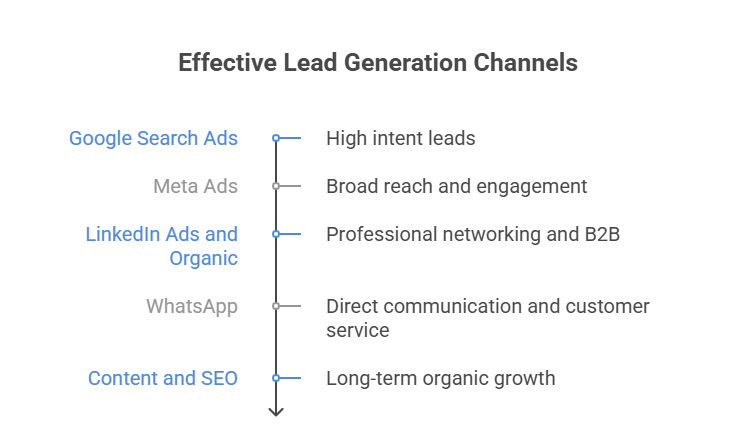
Channel selection depends on category, ticket size, and sales cycle. Several channels, however, consistently perform across Indian lead generation contexts.
1. Google Search Ads
High-intent search campaigns capture buyers who are already researching a purchase. For both B2B and high-ticket B2C categories, Google Search is typically the highest-conversion lead generation channel because the intent signal is explicit. Prohed’s guide on fixing paid ads funnel conversions covers where most brands lose leads between the click and the form fill.
2. Meta Ads
Facebook and Instagram ads are still the best scalable B2C lead gen channel in India. Meta native lead gen through lead forms results in higher leads and lower CPLs than when traffic is redirected towards a website. Lead gen quality is relatively more variable than when done through websites and therefore, it is vital to pair Meta lead gen with a solid nurturing sequence.
3. LinkedIn Ads and Organic
For B2B categories, LinkedIn’s targeting by job title, seniority, company size, and industry is genuinely unmatched. Both paid LinkedIn Lead Gen Forms and organic thought leadership content contribute to B2B pipeline. The CPL on LinkedIn is higher than other platforms, but for the right B2B category, the lead quality justifies the premium significantly.
4. WhatsApp
WhatsApp is increasingly being used as a lead generation and nurture channel for both B2C and high-ticket categories in India. Click-to-WhatsApp ads on Meta that open a conversation directly in WhatsApp remove the landing page friction entirely. These are particularly effective for categories where buyers want to ask questions before committing to a form fill. Prohed’s guide on WhatsApp as a performance marketing channel covers how to set this up as a proper lead generation system rather than a manual messaging tool.
5. Content and SEO
Long-form content that targets high-intent, low-competition keywords consistently generates qualified inbound leads at a lower cost over time. Content that generates leads requires a clear strategy with buyer intent at each funnel stage, strong internal linking, and time. The compounding return on investment at the 12-18 month mark, however, is genuinely meaningful for most categories.
Lead Nurturing: The Step Most Brands Skip
Here is a reality that shows up consistently across lead generation campaigns. Most of the leads a brand generates are not ready to buy right now. Research by Marketo suggests that approximately 50% of leads in any system are not ready to purchase at the time of initial capture but will be within 12 months if nurtured properly.
Most Indian brands do not have a nurture system. A lead fills a form, gets one call, does not answer, and then sits in the CRM going stale. The sales team eventually stops calling. Marketing generates more leads to replace them. The cycle repeats without ever addressing the real problem.
A functional lead nurture system changes that dynamic entirely.
- Email sequences: triggered by lead behaviour, such as visiting a pricing page, downloading a resource, or clicking a specific link, deliver relevant content at the right moment rather than a generic follow-up that arrives at the wrong time.
- WhatsApp nurture flows: are particularly effective in the Indian market. Open rates of 85-95% mean messages actually get read rather than archived. For EdTech and high-ticket categories especially, a structured WhatsApp conversation sequence between initial inquiry and final conversion can significantly improve close rates without adding to media spend.
- Retargeting campaigns: Meta and Google keep your brand message on leads that have shown interest in the brand but have not converted thereby changing the message across touchpoints during the consideration period.
- Sales team handoff with context: this allows the sales team to have the exact content a lead has seen, the pages they have visited and what stage of purchase they are in before exchanging any slayer contact. This significantly improves conversion from qualified lead to closed as opposed to a cold handoff with no prior knowledge.
For brands already investing in AI-driven marketing, automated nurture sequences triggered by real-time behavioural signals are increasingly replacing manually managed follow-up workflows, producing better lead engagement at lower operational cost.
The Prohed Lead Quality Framework
One of the most consistent problems Prohed encounters when auditing lead generation campaigns is that brands are measuring the wrong things. Cost per lead is being optimised. Lead volume is being tracked. But lead quality is not being scored consistently, which means the optimisation work is making the wrong metric better.
The Prohed Lead Quality Framework evaluates every lead generation campaign across four dimensions:
- Intent Score: Captures how strong the buyer’s stated or inferred intent is at the point of lead capture. A lead generated from a high-intent search query scores higher than a lead generated from a broad interest-targeting Meta campaign.
- Profile Match Score: Measures how closely the lead’s characteristics match the ideal customer profile. For B2B, this includes company size, industry, and role. For B2C, it includes income range, geography, and purchase readiness signals.
- Engagement Depth Score: Reflects how much the lead has engaged with the brand before converting. A lead who visited four pages, read a case study, and watched a product video before filling a form is meaningfully more qualified than someone who clicked an ad and immediately filled the first form they saw.
- Conversion Velocity Score: Tracks how quickly a lead moves from inquiry to decision by source and campaign type. This reveals which channels are producing genuinely ready buyers versus which are producing leads that stall and go cold.
When lead quality is scored across these four dimensions rather than treated as a binary – lead or not a lead, campaign optimisation becomes significantly more targeted. Prohed applies this framework across B2B, B2C, and high-ticket campaigns. The consistent finding is that optimising for quality score rather than volume reduces cost per closed deal by 20-35% over a six-month period.
Lead Generation for the Indian Market: What Works Differently Here
Global lead generation playbooks do not always translate cleanly to India. Several factors make the Indian market distinct enough to require locally adapted strategies.
- WhatsApp is a primary communication channel, not a secondary one: In most Western markets, email is the default lead nurture channel. In India, WhatsApp dramatically outperforms email in open rates and response rates across almost every category. Lead generation strategies that treat WhatsApp as optional are operating at a significant disadvantage.
- COD and trust barriers affect B2C lead quality: Indian B2C buyers, particularly in Tier 2 and Tier 3 cities, have higher friction around online transactions than metro buyers. Lead generation strategies that offer a lower-commitment next step, such as a free consultation, a product sample request, or a WhatsApp conversation, often outperform hard conversion campaigns in these markets.
- Vernacular language lead generation is underutilized: A significant proportion of high-value B2C leads in non-metro India are more comfortable engaging with content and ads in Hindi or their regional language than in English. Brands running lead generation exclusively in English are missing a meaningful segment of their addressable market.
- Reference and word-of-mouth signals affect conversion rates significantly: Indian buyers across categories place high weight on peer recommendations. Lead generation strategies incorporating referral loops, customer testimonial content, and social proof at key decision points consistently produce better conversion rates than those relying entirely on brand-controlled messaging.
Lead Generation Strategies for 2026
After running campaigns across D2C, EdTech, fintech, healthcare, and B2B categories, certain strategies consistently produce better outcomes than others. These are the ones worth building into your approach from day one.
1. Start With Audience Definition Before Channel Selection
Most brands pick their channels first and then figure out who they are targeting. The better sequence is the reverse. Define your ideal customer profile with enough specificity that you can describe exactly what they search for, which platforms they use, and what objection they need addressed before converting. Channel selection becomes obvious once that clarity exists.
2. Match Landing Pages to the Specific Campaign
Sending every ad to the same homepage or generic landing page is one of the most consistent conversion killers in Indian lead generation. A B2B decision-maker clicking a LinkedIn ad and a first-time B2C buyer clicking a Meta carousel ad need to land on pages that speak directly to their specific situation. Matching the landing page message to the ad message is a simple change that consistently improves conversion rates without any additional media spend.
3. Build Quality Over Volume Into the Campaign Brief
The brief for a lead generation campaign should include a definition of what a qualified lead looks like, not just a target CPL. When the performance team knows that a qualified lead has a specific job title, company size, budget range, or purchase timeline, they can optimise toward that definition rather than toward raw form fills. This single change in how campaigns are briefed produces more useful output than most technical campaign optimisations.
4. Use Retargeting as a Nurture Tool, Not Just a Conversion Tool
Nearly every brand’s retargeting ad is just repeating the same conversion offer to everyone who visits their website. The better retargeting ad is splunking its retargeting audiences by what the visitor actually did on the site and sending each segment a message appropriate to where they landed. If they landed on a pricing page, then they’ll get sent a nudge different than if they landed on a blog. If they’re sent a nudge, they didn’t fill out a form, then they’ll get sent a nudge different than if they only looked at the homepage.
5. Make the First Conversation Easy
Reducing friction at the point of initial contact consistently improves lead volume and quality simultaneously. Click-to-WhatsApp campaigns, booking tools that show real availability, and chatbot flows that answer the three most common questions before asking for contact details all lower the barrier enough that buyers who would otherwise drop off take the first step instead. That first step is what gets them into the nurture system.
6. Track Lead Source Revenue, Not Just Lead Source Volume
Knowing which campaigns generate the most leads is useful. Knowing which campaigns generate the most revenue is essential. Setting up tracking that connects lead source to closed deal through the CRM gives you a true picture of which channels deserve more budget and which are generating noise that consumes sales team time without producing returns. Prohed’s guide on marketing attribution models covers how to set up this kind of full-journey tracking properly.
Measuring Lead Generation Success: Metrics That Actually Matter
Most lead generation reporting focuses on metrics that feel productive but do not connect to business outcomes. Here is a more useful framework:
Metric | What It Actually Tells You |
Cost Per Qualified Lead (CPQL) | The real cost of attracting a genuinely viable buyer, not just anyone who filled a form |
Lead-to-Opportunity Rate | What percentage of leads the sales team considers worth pursuing — a direct quality signal |
Lead-to-Close Rate | What percentage of leads ultimately become customers — the true efficiency measure |
Time to Conversion | How long leads take to move from inquiry to purchase by source and channel |
Lead Source Revenue Contribution | Which channels produce leads that actually close, not just leads that look good in a dashboard |
Cost Per Acquisition (CPA) | The total cost to acquire one paying customer, traced back to lead generation spend |
The most important shift in lead generation measurement is moving from CPL to CPQL as the primary optimisation target. A campaign generating leads at ₹200 each looks better than one generating leads at ₹800 each until you discover the ₹200 leads have a 2% close rate and the ₹800 leads have a 25% close rate. At that point, the “expensive” campaign is four times more cost-efficient.
Connecting lead generation data to marketing attribution that accounts for the full customer journey is what makes this kind of analysis possible.
The Bottom Line
Lead generation without a quality framework is just expense. Volume without conversion is noise. And a full CRM that the sales team has stopped trusting is not an asset, it is a symptom of a strategy that optimised for the wrong thing from the beginning.
Brands that build genuinely effective lead generation systems in 2026 start with quality over quantity, match their channel mix to their buyer’s actual journey, build nurture infrastructure from day one, and measure success in revenue contribution rather than form fills.
Frequently Asked Questions
1. What is lead generation and why does it matter
Lead generation is discovering and attracting people who could buy from you and moving them toward purchase. Without a reliable and repeatable lead generation system, even the best product remains undiscovered. The engine that powers a sales pipeline.
2. What is the difference between B2B and B2C lead generation
B2B and B2C differ in cycletime, volume, decision makers, and language. B2B tends to be longer cycle, fewer buyers with more buying power. And B2C higher volume, lower GC, more emotion based decisions. Because of these differences, the channels used, the messages used, and the metrics to determine success vary greatly. This is why a single generic approach will almost always fall short with both.
3. What are the best lead generation channels for Indian brands in 2026?
It genuinely depends on the category. Google Search works best for high-intent B2B and high-ticket queries. Meta works best for B2C volume at scale. WhatsApp works exceptionally well for nurture and conversion in both B2C and high-ticket categories. LinkedIn is the strongest B2B channel for reaching decision-makers. Most brands benefit from two or three channels working together rather than one channel at maximum budget.
4. How do I improve lead quality without increasing budget?
Start by improving the landing page and targeting it to the specific audience of each campaign. Then create a simple nurture sequence for leads that do not convert immediately. Then measure lead quality by source and reallocate budget towards the channels that generate leads that close rather than those that simply fill in a form.
5. What is lead nurturing and why is it effective?
Leads that are not ready to buy yet need to remain in contact and be provided with relevant information until they are prepared to buy. This can be done through email sequences, WhatsApp flows, retargeting and personal personal follow-up, triggered by the leads’ behaviour rather than by a set calendar.
6. How long does it take for lead generation to show results?
Paid channels like Google and Meta can generate leads within days of launch. Quality typically stabilises over two to four weeks as the platform optimises toward your conversion goal. Inbound channels like SEO and content take three to six months before meaningful lead volume begins. The most effective setups run both in parallel – paid for immediate pipeline and inbound for long-term cost reduction.
7. What is a good cost per lead for Indian brands?
It depends entirely on your average deal size and close rate. A ₹500 CPL is excellent for a ₹50,000 product with a 20% close rate. The same ₹500 CPL is unsustainable for a ₹2,000 product with a 5% close rate. The metric worth optimising is cost per acquisition, the total cost to generate one paying customer, rather than cost per lead in isolation.
Ready to turn these 2026 strategies into actual revenue?