Marketing campaigns used to need a human clicking every button, approving every send, adjusting every bid by hand. That’s changing fast. AI agents are now planning audiences, shifting spend, and publishing content with a lot less hand-holding than the tools we were using even a year ago. At PROHED, a performance marketing agency built around measurable execution, this shift is already reshaping how campaigns actually get run day to day.
What Is Agentic AI?
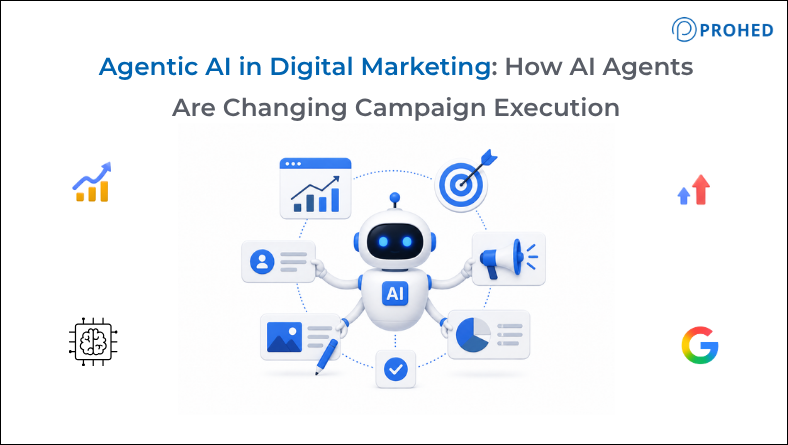
Agentic AI is artificial intelligence built to pursue a goal, rather than just respond to a single prompt. An AI agent can create a plan of action, gather the tools and data it needs, see how things are going, and change course, without waiting for someone to tell it each and every step to take. That really is what distinguishes it from older automation that could only ever follow the fixed if-then rules someone had already written into it.
In practice, this might look like an AI agent pulling audience data, drafting a few ad variants, launching a test, watching how it performs, and shifting budget toward whatever’s working, all inside one connected workflow. The human still decides what the goal is and where the guardrails sit. The agent handles the repetitive execution in between.
How AI Agents Are Changing Campaign Execution
For years, AI marketing automation meant scheduled emails, rule-based drip flows, and basic A/B tests that still needed someone to review the results and decide what came next. This newer approach pulls that decision-making closer to the system itself. Rather than just suggesting an action, the agent takes it, then reports back on what happened.
It shows up across several parts of a campaign at once, too, not just one channel in isolation. A campaign planning agent might put together an initial media mix. A content agent might draft first-pass copy. An optimization agent might shift budget between platforms as performance data rolls in. More teams are moving toward this kind of AI powered marketing setup instead of treating each of these as its own separate manual task.
Traditional Automation vs Agentic AI
Capability | Traditional Automation | Agentic AI |
Follows instructions | Fixed rules only | Works toward a goal |
Decision-making | Human decides every step | Agent decides within set limits |
Adapts to new data | Rarely, without a rebuild | Continuously, in real time |
Works across tools | Usually one platform | Multiple connected systems |
Human role | Operator | Strategist and reviewer |
Where AI Agents Are Already Being Used
A handful of use cases have already become fairly common across AI powered digital marketing setups this year:
- Audience segmentation that keeps updating on its own, instead of getting rebuilt every quarter.
- Bid and budget adjustments made in near real time, based on how things are actually performing.
- First-draft content for ads, emails, and landing pages, built around a defined brief.
- Monitoring that flags anomalies, like a sudden cost spike, before it drains the budget.
- SEO and content tracking that surfaces ranking shifts and gaps worth filling.
Related Read: Agentic AI vs Generative AI: Key Differences and What They Mean for How People Buy Online
An Autonomous Marketing Campaign in Practice
An autonomous marketing campaign does not necessarily mean that no one is overseeing it. Usually, there is an agent which deals with the monotonous elements of marketing campaigns, like the writing, testing, bid adjustments, and reporting, and a marketer who lays out the foundation for the agent to work with, establishing the brand’s voice and guidelines the agent must follow. This division of work is especially useful, because fully autonomous marketing campaigns which do not require any human interference, while convenient, can quickly lead to catastrophe if the data the agent works with is inaccurate.
That’s also why governance has become such a bigger part of the conversation lately, right alongside AI marketing automation itself. Clear approval steps for anything customer-facing tend to be what separates teams actually getting value from this from teams left cleaning up mistakes that were easy to avoid.
What to Check Before Handing Off Execution to AI Agents
- Is the underlying data clean and consistently structured?
- Are there guardrails around spend limits, tone, and what needs approval?
- Is there a review layer for anything going straight to customers?
- Can the team actually see why an agent made a particular decision?
- Is performance being measured against the goals a human would have set anyway?
Where PROHED Fits Into This
PROHED’s already testing this approach across paid media, SEO, and content operations, keeping human strategy and brand judgment firmly in the loop the whole time. That spans everything from performance marketing and paid media management to SEO, social media management, WhatsApp marketing, and creative production, each of which now has some layer of AI-assisted execution running underneath the strategy a human still owns. It mirrors how most of the industry seems to be treating this technology right now: let the agents handle repetitive execution, and keep people accountable for the outcome.
If you’re working with an ad agency in Gurgaon, or weighing digital marketing agencies Gurgaon has to offer, this is worth asking about directly. Not every agency is set up to manage AI agents responsibly across channels like SEO, paid media, and social all at once. The ones that are tend to pair strong data hygiene with real governance, not just access to newer tools.
Conclusion
This isn’t replacing the strategic side of marketing. It’s absorbing the repetitive execution layer that used to eat up most of a team’s time. Campaigns are becoming more continuous, less bursty, with agents handling adjustments that used to sit and wait for a weekly review. Brands building clean data and clear guardrails now will get a lot more out of agentic AI than the ones bolting agents onto messy workflows later and hoping for the best.
FAQs
1. What is agentic AI?
It’s artificial intelligence designed to chase a goal on its own, rather than just respond to a single prompt. It can plan out steps, use tools, check what happened, and adjust with barely any human input needed along the way.
2. How is agentic AI used in marketing?
Mostly for repetitive execution work, things like audience segmentation, ad testing, budget shifts, and first-draft content. The team sets the objective and the guardrails; the agent handles the moving parts in between.
3. What is the difference between generative AI and agentic AI?
Generative AI creates something, text, an image, when you prompt it, then it just waits for the next instruction. Agentic AI takes that output and actually acts on it, chaining several steps together toward a defined goal.
4. How can AI agents optimize advertising campaigns?
They can watch performance data continuously and shift budget, bids, or creative toward whatever’s working, usually faster than a manual review cycle would catch it. That tends to cut down on wasted spend, as long as the data feeding the agent is accurate to begin with.
5. Will agentic AI replace digital marketers?
Not entirely. It’s shifting the role away from manual execution and toward strategy, brand judgment, and keeping an eye on what the agents are actually doing, which still needs a human making the real calls.
6. Is agentic AI safe to use for customer-facing campaigns?
It can be, as long as there are clear guardrails and someone reviewing anything before it reaches customers directly. Fully unsupervised execution is riskier, especially early on, so most teams keep a human checkpoint for anything sensitive.
7. Do small businesses need agentic AI, or is it only for large enterprises?
Smaller teams often get more out of it, honestly, since it can cover tasks that would otherwise mean hiring someone new. Start narrow, with one well-defined use case, instead of trying to automate the whole marketing function at once.
8. How is agentic AI different from regular AI marketing automation?
Traditional automation just follows the rules someone already wrote. Agentic AI works toward a broader goal and adapts as new data comes in, which makes it more flexible but also means it needs clearer boundaries to stay on track.
Ready to Explore Agentic AI for Your Campaigns?
Adopting agentic AI without clean data or clear guardrails usually just creates more work, not less. PROHED is a performance marketing agency and ad agency in Gurgaon, working alongside other digital marketing agencies Gurgaon businesses rely on for SEO, paid media, and content strategy.
Schedule a Free Strategy Call with PROHED Today