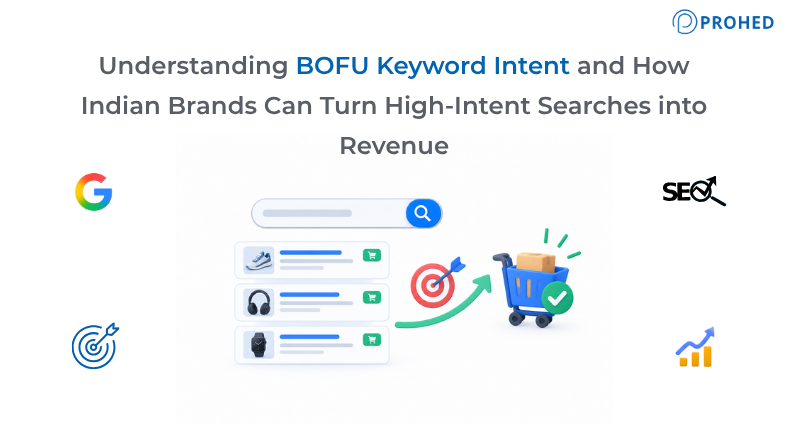
Keyword intent is the reason behind a search, and bottom of funnel keywords are the ones typed by people who are ready to act. At PROHED, we treat them as the shortest route from traffic to revenue, because a ranking only pays off when the searcher is close to a decision.
A page can sit at position one and still earn nothing. That usually happens when the traffic arrived to learn, not to buy. Many Indian brands celebrate sessions while the sales team asks where the leads went.
The fix is not more content. It is content aimed at the right keyword intent.
What Is Keyword Intent? The 4 Types Explained
Every query carries a mood. Someone typing “what is CRO” wants an explanation. Someone typing “CRO agency in Gurgaon pricing” wants a shortlist.
| Intent type | Example search | Funnel stage | Best-fit content |
|---|---|---|---|
| Informational | what is performance marketing | TOFU | Guides, explainers |
| Commercial | best SEO agencies in India | MOFU/BOFU | Comparisons, reviews |
| Transactional | hire Google Ads agency Delhi | BOFU | Service and pricing pages |
| Navigational | PROHED clients and results | BOFU | Brand and proof pages |
Commercial intent keywords and transactional keywords in India sit closest to the sale. These conversion keywords for SEO are the focus of this article.
BOFU vs MOFU Content: What Is the Difference?
The difference is easier to see than to define. MOFU content helps a buyer compare approaches. BOFU content helps a buyer choose a provider or product.
- MOFU: “SEO vs paid ads for D2C brands” (weighing options)
- BOFU: “D2C SEO agency in India, pricing and process” (picking a partner)
Mixing the two on one page is a common mistake. A page that tries to teach and sell at once usually does neither well.
Types of Bottom of Funnel Keywords (With Indian Examples)
Most buyer intent keywords fall into a handful of patterns. Here is what each looks like for Indian brands.
- Modifier terms: “buy,” “price,” “cost,” “near me,” “COD available,” “EMI,” “GST invoice.”
- Comparison terms: “X vs Y,” “alternatives to X,” “best X for startups.”
- Service plus location: “performance marketing agency Gurgaon,” “SEO company in Delhi.”
- Proof terms: “reviews,” “case study,” “results,” “testimonials.”
- Hinglish and regional phrasing: these terms often face less competition, so they are worth testing.
Transactional keywords in India often carry trust signals such as COD, EMI and local support, so check your own query data for them.
How to Find High Intent Keywords for SEO in India
Keyword tools give volume. They rarely give intent. These steps usually surface better terms.
- Mine your sales calls: The exact phrases prospects use before buying are your best keyword list.
- Check Search Console against conversions: Queries tied to leads matter more than queries tied to clicks.
- Review Google Ads search term reports: Paid data shows which words convert before you invest months in ranking for them.
- Read the results page: Product listings, ads and comparison pages signal commercial intent. A wall of blog posts signals the opposite.
- Study competitor money pages, not their blogs.
PROHED’s Google Ads and search engine marketing work often supplies this data first. It makes the SEO plan less of a guess.
BOFU Content Strategy: How to Build Pages Around Buyer Intent Keywords
A strong BOFU content strategy starts with matching the keyword type to the right page. Writing more blogs is rarely the answer.
| Keyword type | Page to build | Must include |
|---|---|---|
| Service plus location | Service landing page | Process, pricing range, proof |
| Comparison | Comparison page | Honest trade-offs, a clear verdict |
| Alternatives | Alternatives page | Who each option suits |
| Pricing | Pricing explainer | What drives cost, what is included |
| Proof | Case study | Problem, action, measured result |
Each row above reflects a different keyword intent, so each needs its own page. Every page then needs four things:
- A first paragraph that answers the query without warming up.
- Specifics a buyer can verify, including timelines and deliverables.
- One clear action, not five competing buttons.
- Internal links to related proof, such as the e-commerce marketing or SEO services pages.
This is what SEO content that converts in India looks like. It reads like a helpful salesperson, not a brochure.
Keyword Intent SEO in 2026: Why BOFU Pages Matter More
AI-generated answers now cover many informational queries, so fewer people click through for definitions and basic guides. Searchers who are ready to compare or buy still need a website. That makes bottom of funnel pages the steadiest part of any keyword intent SEO 2026 plan.
Clear, specific pages also give AI tools something solid to quote. Pricing explainers, comparison pages and service pages with plain answers suit that purpose well. If you are unsure whether a traffic drop comes from search changes or your own site, this organic traffic diagnostic walks through it step by step. For the AI visibility side, our guide to generative engine optimization agencies in India covers what to look for.
Using Paid Search Data to Choose Conversion Keywords for SEO
Keyword intent data gets sharper when paid and organic share one keyword list. Paid search proves a term converts. Organic then lowers the cost of capturing it over time.
For quick-response channels, high intent traffic can also move into chat. Our Click-to-WhatsApp ads plan shows how that handoff works for first-time buyers.
How to Measure Revenue Driving SEO Content
Sessions will not tell you much here. Track these instead:
- Leads or orders per landing page
- Lead quality, based on sales feedback
- Assisted conversions from organic
- Revenue per page, once volume allows
A BOFU page with 200 visits and 20 enquiries beats a blog with 20,000 visits and none.
Case Study: How PROHED Cut Acquisition Costs by 40% for A Box Of Stories
A Box Of Stories, a subscription commerce platform, worked with PROHED on a multi-funnel approach to growth. The results were 35% more subscriptions and 40% lower acquisition costs. You can read the full breakdown in our subscription marketing strategy case, and more stories sit on the clients and results page.
Conclusion
Understanding keyword intent changes what you build and what you measure. Bottom of funnel keywords are fewer and smaller in volume. They are also where revenue quietly collects. Start with the searches that sound like a purchase, give them pages that answer plainly, and judge the work by leads and sales.
FAQs
1. What is the difference between keyword intent and search intent?
They are used almost interchangeably. Search intent describes what the user wants, while keyword intent describes what a specific term signals about that want.
2. Which keywords convert best for Indian e-commerce brands?
Terms with price, COD, EMI, brand plus product and “near me” modifiers often convert well because they sit near the purchase.
3. Are BOFU keywords worth targeting if search volume is low?
Yes. A term with 50 monthly searches can bring more revenue than one with 5,000 if the searchers are ready to buy.
4. How many BOFU pages does a website need?
Start with one page per core service or product category, then add comparison and pricing pages for your most contested terms.
5. Can one page target both MOFU and BOFU keywords?
Rarely. Separate pages keep the message clear and let each rank for its own intent.
6. How long does BOFU SEO take to show results?
Timelines vary by competition and site strength. Pairing it with paid search on the same terms gives earlier signals.
7. How can I tell if a keyword has commercial intent?
Check the results page. Ads, product listings, comparison articles and agency pages point to buyers, while guides and definitions point to learners.
Want a keyword plan built around buyers instead of traffic? Book a free strategy session with PROHED, and we will map your highest-intent search terms to pages, ads and measurable revenue.
Schedule a Free Strategy Call with PROHED Today