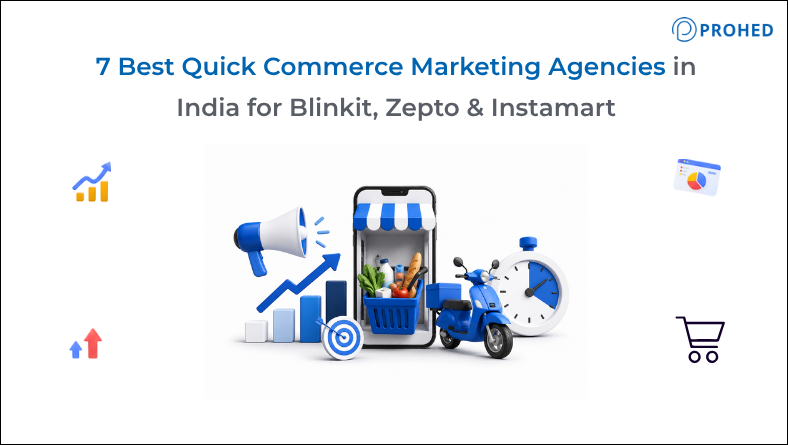
Quick commerce has rewired how people in India shop, and it’s forcing brands to rethink marketing along with it. When your entire delivery promise is 10 minutes, there’s no room for a lazy, copy-pasted ad strategy. Quick commerce marketing is the specialised work of winning visibility, clicks, and conversions on apps like Blinkit, Zepto, and Instamart. A handful of agencies, PROHED among them, have built dedicated playbooks for FMCG, D2C, and retail brands trying to crack this, playbooks that look nothing like standard e-commerce marketing.
The stakes here are real money, not a niche experiment. Quick commerce GMV in India touched roughly ₹11,000 crore in a single month in early 2026, nearly double what it was a year earlier, with order volumes climbing to about 7.8 million a day (Redseer). That kind of growth is exactly why brands are now hiring specialist agencies instead of treating quick commerce as a side project for their existing marketplace team.
So if you’re a brand owner trying to figure out who can actually run this well, here’s a straight, no-fluff rundown of the agencies worth talking to.
Why Quick Commerce Marketing Is Different From Regular E-commerce Marketing
Before you pick an agency, it’s worth understanding why this category needs its own specialists in the first place.
Think about how people shop on Amazon or Flipkart, they might spend ten minutes comparing five products, reading reviews, checking seller ratings. On Blinkit or Zepto, that whole decision plays out in under 30 seconds. The algorithms are different. The ad formats are different. Even the psychology of what makes someone tap “add” is different.
A few things that set this space apart:
- Hyperlocal targeting based on dark store inventory and delivery radius
- Impulse-driven buying behaviour, where visibility often beats brand loyalty
- Real-time bidding systems, similar in concept to Amazon Ads but with tighter windows
- Sponsored placements and banner ads that need constant optimisation
- Inventory-linked advertising, where stockouts directly hurt ad performance
Brands that treat this like a scaled-down version of e-commerce marketing usually just burn budget. That gap is exactly where a specialised agency earns its keep.
What to Look For in a Quick Commerce Marketing Agency
Not every digital shop is built for this kind of speed. Here’s what’s worth checking before you sign anything.
Factor | Why it matters |
Platform-specific experience | Blinkit Ads, Zepto Ads, and Instamart Ads each behave differently, a generalist agency will often get this wrong |
Category expertise | An FMCG brand and a personal care brand need different creative and bidding approaches entirely |
Data and reporting access | You want to actually see keyword rankings, share of voice, and ROAS broken down by SKU, not a vague summary deck |
Creative capability | These ads live on small screens and get maybe a second of attention; the creative has to earn that second |
Performance marketing depth | A lot of quick commerce demand is generated off-platform, so the agency should be comfortable running Google and Meta too |
7 Best Quick Commerce Marketing Agencies in India
1. PROHED
PROHED is a Gurgaon-based performance marketing agency serving D2C, FMCG, EdTech, FinTech, and B2B clients. In quick commerce, PROHED’s approach centres on connecting platform advertising with the rest of a brand’s digital funnel rather than treating it as an isolated channel. This is the same integrated model PROHED applies across its client base, where performance marketing, SEO, and CRO run together instead of as separate line items, which matters in quick commerce specifically because a stockout or a mistimed campaign pause can undo weeks of ranking work overnight. What that looks like in practice:
- Setting up and running Blinkit, Zepto, and Instamart ad accounts
- Keyword and category targeting to push in-app search visibility
- Testing creative variations for sponsored banners and listings
- Running Google Ads and Meta Ads to funnel off-platform demand into the apps
- SEO and CRO work on the brand’s own website, so quick commerce growth isn’t disconnected from everything else
For D2C and FMCG brands looking for a digital marketing agency for D2C brands that connects quick commerce spend to broader growth metrics, PROHED is worth evaluating alongside the more established names above.
2. Interactive Avenues
Part of the WPP network, Interactive Avenues has been running large-scale quick commerce campaigns for FMCG and personal care brands for a while now. Their edge is retail media planning at scale, backed by WPP’s broader data infrastructure. This tends to suit mid-to-large brands that already have national distribution and need synchronized campaigns across cities and platforms at once. Expect enterprise-grade dashboards, the kind built for marketing teams who need to defend spend to leadership.
3. Schbang
Schbang runs a dedicated e-commerce and marketplace vertical inside its wider digital offering, which covers content, social, and creative production too. Brands often go with Schbang when they want quick commerce advertising paired with genuinely strong creative direction, the agency’s roots are in content-led work, not pure performance. That makes them a good match for consumer brands where packaging and storytelling carry as much weight as bid strategy. Their client base spans D2C, lifestyle, and F&B.
4. iProspect India
A Dentsu company, iProspect brings serious programmatic and performance chops to quick commerce, particularly for enterprise clients juggling big budgets across multiple platforms. They’re known for sophisticated bid automation and cross-channel attribution, useful if you want to understand how quick commerce spend actually interacts with the rest of your digital funnel. This is more of a fit for brands that already have marketing maturity and want quick commerce plugged into an existing measurement setup, rather than one built from zero.
5. WATConsult
Also under Dentsu, WATConsult leans into integrated retail media and social commerce. Their approach usually blends quick commerce ads with influencer campaigns, which works well for brands trying to build category awareness and drive platform sales at the same time. They’ve handled several FMCG and beauty brands making their first move into quick commerce, and offer onboarding help for teams unfamiliar with dark store logistics and platform auction mechanics.
6. Gozoop
Gozoop takes a creative-first approach, pairing strong visual content with performance execution. For quick commerce specifically, this shows up in banner and listing creative that’s designed to stop the scroll within the first second, which matters given how quickly users move through app home screens. Gozoop works with a mix of D2C and lifestyle brands and is often chosen by companies that feel their existing ad creative is functional but not distinctive enough to compete on crowded platform search pages.
7. Rite Media Group
Rite Media built its name managing Amazon and Flipkart marketplace advertising before moving into quick commerce, and that marketplace background shows in how they structure campaigns. They’re particularly strong on keyword and category optimisation within platform search, essentially managing Blinkit and Zepto listings the way they’d manage an Amazon storefront. Brands with existing marketplace ad experience often find their process familiar to plug straight into.
How to Choose the Right Agency for Your Brand
Which of these fits depends on your brand’s size, category, and goals. A few questions worth asking before you sign:
- Do they have direct, hands-on experience in your specific product category?
- Can they show real ROAS or share-of-voice numbers from past quick commerce work, not just case study screenshots?
- Do they only manage platform ads, or do they handle integrated performance marketing too?
- How do they handle ad pauses when inventory runs out?
- What does their creative testing process look like, concretely?
If you’re a smaller D2C brand entering quick commerce for the first time, working with a best D2C marketing agency that understands your category and budget constraints usually delivers better results than a large enterprise agency that treats you as a minor account.
Related Read: D2C Growth Strategy: The 180-Day Roadmap to Scale Your Brand Faster
The Role of Performance Marketing in Quick Commerce Success
Quick commerce ads harvest demand, they don’t create it: Running ads on platforms like Blinkit and Zepto works best when people already know your brand name. If zero search volume exists off-platform, bidding blindly against established competitors becomes an expensive uphill battle.
Treat in-app ads as the finish line, not the start: High-performing brands view quick commerce platforms as the conversion point at the very end of their marketing funnel, rather than expecting the marketplace ads to do all the heavy lifting.
Use Google Ads to capture high-intent searches: Google works exceptionally well for personal care and FMCG categories. It captures buyers actively looking for a product type and redirects them to an app where they can check out in minutes instead of waiting days for delivery.
Rely on Meta Ads to build recall and nurture warm leads: Meta’s visual formats drive initial awareness for product launches or special deals. Retargeting people who have already engaged with your brand elsewhere leads to significantly higher conversion rates once they see your product on Blinkit or Zepto.
Play the long game with SEO and organic social: Organic search builds compounding visibility for your core category terms over time, while active social communities drive repeat purchases. This prevents you from having to buy every single order through paid ad auctions.
Agencies offering FMCG brands quick commerce marketing services alongside these channels tend to deliver better long-term ROI than those focused solely on in-app advertising.
The Bottom Line
Quick commerce marketing rewards speed, precision, and category know-how, not the flashiest case study on a pitch deck. The right agency depends less on their portfolio and more on whether they understand your product, your customer, and how quick commerce fits into your wider strategy. Interactive Avenues and iProspect suit larger enterprise budgets. Schbang and Gozoop lean creative. Rite Media brings marketplace discipline. PROHED offers a more integrated route for D2C and FMCG brands who want quick commerce tied back to overall growth. Whichever way you go, judge agencies on data, category fit, and creative quality, not platform buzzwords.
FAQs
1. How much does quick commerce marketing cost in India?
It varies by platform and category, but most brands start somewhere between ₹50,000 and ₹5 lakh a month, depending on SKU count and how many cities they’re targeting.
2. Blinkit, Zepto, or Instamart – which is best?
Depends on your target cities and category. Blinkit currently has the widest reach, while Zepto and Instamart perform strongly in certain metros. Most brands end up running all three.
3. Can a small D2C brand advertise on Blinkit without a big budget?
Yes, Blinkit allows flexible daily budgets, so smaller brands can get in, though visibility naturally scales up with spend.
4. How’s this different from Amazon Ads?
Quick commerce ads are hyperlocal and tied to inventory, visibility depends on what’s in the nearest dark store, unlike Amazon’s national fulfilment model.
5. Do these agencies also handle Google and Meta Ads?
Full-service ones do, since off-platform demand generation directly affects how quick commerce campaigns actually perform.
6. How long before you see results?
Most brands notice visibility improvements within 2–4 weeks, with meaningful ROAS data showing up after about 6–8 weeks of steady optimisation.
7. What creative formats work best on Blinkit and Zepto?
Simple, high-contrast banners with a clear product benefit, people are deciding in seconds while scrolling, so there’s no time for subtlety.
8. Is SEO even relevant for quick commerce brands?
Yes. Solid brand SEO drives search traffic that eventually turns into app downloads and purchases, making it a useful supporting channel rather than a replacement.
Want help building a quick commerce strategy that actually moves product? Talk to PROHED’s performance marketing team about a Blinkit, Zepto, and Instamart plan built around your brand.
Schedule a Free Strategy Call with PROHED Today