Growing a D2C brand sounds exciting, until growth starts becoming unpredictable.
One month, sales jump. The next, acquisition costs climb, conversion rates drop, and scaling suddenly feels like pushing a boulder uphill. This is the point where most brands discover an uncomfortable truth: running more ads is not a growth strategy.
The brands that actually scale, the ones going from ₹1 crore to ₹10 crore in monthly revenue — don’t have a secret hack. They have structure. They build systems that make growth repeatable before they try to make it faster.
A strong growth strategy moves through stages: laying the right foundation first, then improving conversion, then building retention, and finally creating a scalable acquisition engine that can run without founder intervention.
Over the years, Prohed has worked closely with growing D2C brands across categories, and one pattern shows up every single time: brands that follow structured growth phases scale faster and more sustainably than brands chasing short-term wins.
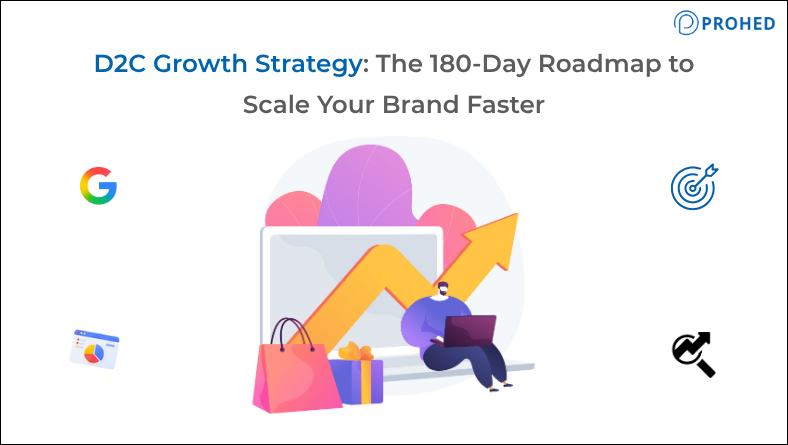
So what does an effective 180-day roadmap actually look like? Let’s break it down phase by phase.
Why a Structured Growth Strategy Matters for D2C Brands
One of the biggest mistakes growing brands make is assuming scale comes from increasing marketing budgets.
If Google went down tomorrow and Meta was blocked, would your brand still be discoverable? That’s the question structured growth answers. Customer acquisition, retention, creative production, conversion optimization, and analytics all influence growth simultaneously, which is exactly why brands that fix only one thing still hit plateaus.
A structured growth strategy helps brands:
- Scale predictably
- Improve profitability
- Reduce dependency on single channels
- Increase customer lifetime value
- Build stronger acquisition systems
The goal is not simply faster growth. The goal is growth that holds.
Phase 1 (Day 1–30): Build the Foundation Before Scaling
Most brands want immediate scale. Scaling without infrastructure, though, creates expensive problems fast.
Before increasing a single rupee of ad spend, brands need to answer four questions clearly: What is the actual CAC? Which products generate healthy margins? Are tracking systems accurate? Where are customers dropping off?
At this stage, brands should focus on:
- Understanding contribution margins
- Fixing analytics tracking
- Creating clear acquisition goals
- Identifying winning products and hero SKUs
- Setting baseline performance metrics
A healthy contribution margin for D2C brands in India typically sits above 40% before significantly increasing acquisition budgets. For a ₹500 AOV brand, a CAC above ₹300 is a red flag — for a ₹3,000 AOV brand, the same CAC might be entirely acceptable. These numbers need to exist on paper before phase two begins.
Many brands skip this entirely and move straight into aggressive spending. Growth becomes inconsistent as a result, and the compounding effect of fixing fundamentals later costs far more than getting them right in month one.
Without these answers, scale becomes expensive guesswork.
Phase 2 (Day 30–60): Fix Conversion Before Increasing Spend
More traffic does not automatically mean more revenue. If visitors arrive but don’t convert, increasing budgets only increases waste.
The industry average conversion rate for Indian D2C e-commerce sits between 1.5–2.5%. If a brand’s conversion rate is below 1%, fixing the funnel will outperform any budget increase, every single time. That single benchmark is the most actionable thing to carry into this phase.
Brands should audit three things before touching spend:
1. Product Pages
Customers decide fast. Clear messaging, strong product visuals, reviews, visible benefits, and trust signals should be continuously tested and improved. A brand we worked with in the wellness category improved product page conversion by 34% simply by restructuring the order of information above the fold — before adding a single rupee to ads.
2. Landing Page Experience
Many D2C brands pour money into traffic while ignoring what happens after the click. Page speed, mobile experience, checkout flow, and trust signals are often the real bottleneck.
3. Purchase Friction
Complicated checkouts kill conversions. Every additional field in a checkout form costs you customers. Simpler journeys consistently outperform complex ones.
At Prohed, conversion optimisation is introduced early because a 0.5% improvement in conversion rate creates stronger scaling leverage than almost any increase in ad budget.
Phase 3 (Day 60–90): Build a Performance Marketing Engine
Once conversion improves, brands can focus more aggressively on acquisition. This is where most founders assume performance marketing simply means running ads. Scalable D2C performance marketing works differently.
1. Creative Testing Systems
Creative fatigue happens faster than most brands expect. At ₹1L monthly spend, a brand should be testing a minimum of 4–6 creatives per week, with at least ₹3,000–5,000 spend per creative before making a kill or scale decision. The goal is to find 2–3 winning concepts before increasing budget, scaling on an untested creative library is where most ad spend gets wasted.
Brands should continuously test:
- Hooks
- Messaging angles
- Formats
- UGC creatives
- Product positioning
2. Channel Diversification
Depending only on one platform creates fragility. Brands spending 100% on Meta should begin allocating 15–20% of budget to a second channel, typically Search or YouTube. once the primary channel is profitable. Growth becomes stronger and more defensible from there.
3. Budget Scaling Frameworks
Budgets should increase only when specific signals are met, not when founders feel confident. The two primary signals: a stable CAC:LTV ratio above 1:3, and a conversion rate that has held consistent for at least two weeks. Below those thresholds, more spend creates more expensive inefficiency.
Phase 4 (Day 90–120): Strengthen Retention Systems
Acquisition alone cannot sustain long-term growth. For most D2C brands, the difference between a 1.2x and a 2.5x repeat purchase rate is the difference between a brand that’s always fundraising and a brand that’s always growing.
Indian D2C brands that invest in retention systems see, on average, a 20–30% improvement in blended ROAS within 90 days, because the same acquisition spend produces more total revenue when more customers come back.
1. Email Automation
Automated flows dramatically improve customer lifetime value without ongoing ad spend. The four non-negotiable flows: welcome series, cart recovery, post-purchase, and win-back.
2. WhatsApp Retention for Indian Brands
For Indian D2C brands specifically, WhatsApp is not a nice-to-have, it’s the highest-converting retention channel available. Skincare and personal care brands typically see open rates above 60% on WhatsApp flows, versus 20–25% on email. A post-purchase flow for a skincare brand looks different from a food brand: skincare should include a D14 replenishment reminder, a D30 usage check-in, and a D45 reorder prompt. Food brands can move faster, D7 replenishment, D21 cross-sell.
3. Loyalty Programs
Rewarding existing customers almost always produces stronger ROI than chasing new ones. A healthy D2C growth strategy always balances acquisition with retention, and brands that get this ratio right (typically 60:40 acquisition to retention spend by month six) grow more profitably.
Phase 5 (Day 120–150): Expand Beyond Single-Channel Growth
Brands reaching this stage often encounter a new problem: growth slows again. Usually, it’s because the entire business is riding one channel.
Brands that depend on a single platform for more than 70% of revenue are one algorithm change away from a growth crisis. The next step is building distribution redundancy.
Possible opportunities include:
- Marketplace expansion
- Omnichannel growth
- Influencer ecosystems
- Affiliate partnerships
- Offline distribution
The target isn’t to be everywhere, it’s to reduce single-channel dependency below 50% while keeping blended margins healthy. That’s the milestone that turns a D2C brand into a resilient business.
Phase 6 (Day 150–180): Build a Scalable Growth Machine
The final phase is not about growth hacks. It’s about operational maturity, building the systems that allow the business to grow without the founder touching every decision.
1. Measuring the Right Metrics
The metrics that actually predict long-term health: MER (not just ROAS), contribution margin by SKU, repeat purchase rate, and CAC:LTV ratio. Brands targeting a CAC:LTV ratio above 1:3 and a contribution margin above 45% at this stage are positioning for profitable scale, not just top-line growth.
2. Creating Predictable Systems
Scaling becomes easier when processes become repeatable, creative production workflows, weekly reporting, forecasting, and clear team structures. The goal is that a week without the founder in the room doesn’t change the output.
3. Preparing for Larger Scale
Brands preparing for the next growth ceiling typically begin exploring international expansion, new product lines, brand-building campaigns, and larger media investments. This is where founder-led growth needs to evolve into company-led growth — and the brands that made it through all six phases cleanly are the ones ready for it.
Why Most Growth Strategies Fail
Most brands don’t fail at growth because the strategy was wrong. They fail because they jumped to Phase 3 while still operating with Phase 1 problems.
Growth fails when brands:
- Scale before margins are validated
- Ignore that a 1% conversion rate signals a funnel problem, not a traffic problem
- Depend on one channel past the point of safety
- Underinvest in retention after Month 3
- Measure ROAS in isolation instead of contribution margin
A strong growth strategy is rarely complicated. It just requires the discipline to not skip steps.
Final Thoughts
A successful D2C growth strategy is rarely built through isolated campaigns. Instead, sustainable scale happens when brands build systems that support growth at every stage, from acquisition and creative testing to retention and operational efficiency.
At Prohed, we’ve helped brands across categories build exactly this kind of structured growth engine. A ₹2 crore annual revenue D2C wellness brand we worked with spent the first 30 days fixing attribution before touching ad spend. Within 60 days, their blended ROAS improved by 40% without any budget increase. Structure did what spending couldn’t.
Because ultimately, growth is not simply about reaching the next revenue milestone. It is about building systems that continue performing long after the initial momentum fades. And that is what separates growing brands from scalable brands.
Struggling with Low ROAS? Read This Next : Learn how strategic Meta Ads optimization helped a D2C brand scale from 1.8x to 4.2x ROAS.
Frequently Asked Questions
1. What is a D2C growth strategy?
A D2C growth strategy is a structured plan that scales customer acquisition, retention, profitability, and operations in sequence. The key word is sequence, most brands fail not because they lack tactics, but because they run Phase 3 tactics with Phase 1 foundations still broken.
2. What contribution margin should a D2C brand have before scaling ad spend?
Most D2C brands that scale profitably maintain a contribution margin above 40% before significantly increasing acquisition budgets. Below that threshold, more spend typically accelerates losses rather than growth. For a ₹500 AOV brand, this number needs to exist on paper before Phase 2 begins.
3. What conversion rate should a D2C brand target before increasing budgets?
The industry average for Indian D2C e-commerce is 1.5–2.5%. If your conversion rate is below 1%, fixing the funnel will outperform any budget increase. Scaling traffic into a broken funnel is the most common, and most expensive, growth mistake Indian D2C brands make.
4. How many creatives should a D2C brand test per week?
At ₹1L monthly spend, test a minimum of 4–6 creatives per week with ₹3,000–5,000 spend per creative before making a kill or scale decision. You need 2–3 consistently winning concepts identified before increasing budget, scaling on an untested creative library is where most ad spend gets wasted.
5. Why is WhatsApp important for Indian D2C retention?
WhatsApp open rates for Indian D2C brands typically exceed 60%, compared to 20–25% for email. For post-purchase flows, replenishment reminders, and reorder nudges, it’s the highest-converting retention channel available. A skincare brand’s post-purchase flow looks very different from a food brand’s, timing and sequencing matter.
6. When should a D2C brand start diversifying beyond Meta or Google?
Once your primary channel is consistently profitable, begin allocating 15–20% of budget to a second channel, typically Search or YouTube. The target by Month 5–6 is no single platform accounting for more than 50–70% of total revenue. Single-channel dependency above that is one algorithm change away from a crisis.
7. What metrics actually matter for D2C business growth?
The metrics that predict long-term health: MER (not just ROAS), contribution margin by SKU, repeat purchase rate, and CAC:LTV ratio. Brands targeting a CAC:LTV ratio above 1:3 and contribution margin above 45% by Month 6 are positioning for profitable scale, not just top-line growth that looks good on a dashboard.
8. How can a D2C marketing agency help brands scale?
A strong D2C marketing agency builds growth systems across acquisition, creative strategy, analytics, retention, and conversion optimisation, not just campaigns. The difference is whether they’re optimising for this month’s ROAS or building the foundation that makes next year’s growth predictable and sustainable.
Looking for the best D2C marketing agency to build a structured roadmap? The right D2C marketing agency should help build systems, not simply campaigns.
Schedule a Free Strategy Call with PROHED Today