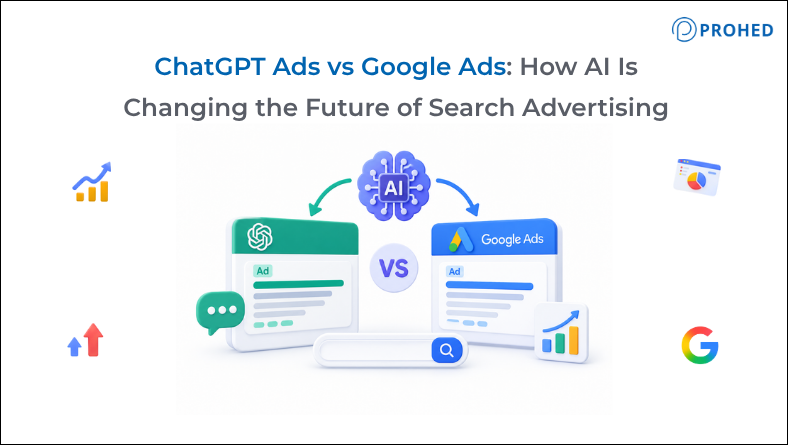
Marketing teams have spent two decades building their search strategy entirely around Google. That assumption is now genuinely up for debate. ChatGPT ads are live, buyable, and growing fast, which means brands are facing a real allocation question for the first time in years: does search budget stay with Google, move toward ChatGPT, or get split between the two? At PROHED, we’re not here to declare a winner. We’re here to help you think through where each platform actually earns its place in a media plan.
Two Different Moments in the Customer Journey
The most useful way to think about Google Ads versus ChatGPT ads isn’t “which platform is better.” It’s “which moment in the customer’s journey does each one own.”
Google Ads has always been strongest at capturing explicit intent. Someone types “best CRM for small teams” because they’ve already decided to compare options and act soon. That’s a high-intent, close-to-conversion moment, and Google’s two decades of auction refinement are built entirely around monetising it efficiently.
ChatGPT ads sit earlier. Someone asking ChatGPT “help me think through CRMs for a 15-person sales team” is still in a research and reasoning phase. They haven’t typed a comparison query yet, because they’re still working out what they even need to compare. That’s a moment Google Ads has never really been able to reach, since search ads only show up once someone knows what to search for.
This distinction matters more than any feature comparison. You’re not choosing a better search engine. You’re choosing which stage of decision-making you want to show up in.
Where Google Still Wins, Clearly
Google Ads remains the stronger channel for most performance marketing budgets today, and it’s worth being direct about why:
- Volume and reach. Billions of daily searches globally still dwarf ChatGPT’s ad-eligible audience, which is currently limited to Free and Go tier users only.
- Measurement maturity. Real-time, granular conversion data, attribution modelling, and two decades of optimisation tooling exist for Google. ChatGPT’s reporting is still closer to connected TV measurement, aggregated rather than granular.
- Bottom-of-funnel reliability. If most of your revenue depends on someone actively searching and buying within days, Google Ads is still where that behaviour concentrates.
For most Indian brands, especially those without large digital budgets, Google Ads should stay the backbone of search spend for now. That’s not a hedge, it’s just where the evidence currently points.
Where ChatGPT Search Is Genuinely Changing Behaviour
The part that shouldn’t be dismissed is how chatgpt search is quietly rerouting research behaviour, even for people who never see or click a ChatGPT ad.
Queries that used to start as a typed Google search (“is X ingredient safe,” “compare Y vs Z,” “best option for my situation”) increasingly start as a conversation instead. The output isn’t a list of ten blue links. It’s one synthesized answer, sometimes with a brand mentioned inside it, sometimes with a sponsored card underneath it.
For brands, this creates a visibility question that sits alongside, not instead of, traditional SEO: does ChatGPT even mention you when someone asks about your category? That’s a separate and increasingly important battle from ranking on a search engine results page, and it’s one that paid ChatGPT ads only partly solve, since the organic answer above the ad still shapes the decision.
Related Read: AI SEO Optimization for D2C Brands: How to Get Found on ChatGPT Shopping in 2026
A Practical Framework for Splitting Budget
Rather than treating this as an either-or decision, here’s a more useful way to frame it.
If your business looks like this… | Lean toward… |
Revenue depends on high-intent, ready-to-buy search traffic | Google Ads as the primary channel |
You need daily, granular performance data to optimise spend | Google Ads |
Your audience skews tech-forward, B2B, or younger consumer segments | A small ChatGPT ads test budget alongside Google |
You have budget to experiment beyond your core, proven channels | Test ChatGPT ads in parallel with Google, not instead of it |
Your category involves genuine research and comparison before buying | Prioritise organic visibility in AI answers, paid or not |
For almost every brand we work with right now, the uncompromising recommendation is the same thing: keep Google Ads as your primary engine and experiment with ChatGPT ads in a structured and budgeted way, not as a channel shift. If you want the crunchy details on ad formats, bid ranges, and which buying curve (Criteo, StackAdapt, or directly with OpenAI) is the best fit for your budget, we cover that in our ChatGPT Ads guide.
What This Means for Your Broader Ads Marketing Strategy
A few principles hold up regardless of which platform gets the bigger share of budget.
- Don’t treat this as a replacement decision: The brands making the biggest mistake right now are the ones either ignoring ChatGPT ads entirely or shifting too much budget away from a proven channel too fast. Diversification here should be additive.
- Invest in organic AI visibility alongside any paid spend: An organic growth agency in India approach, strong SEO and genuinely useful, well-structured content, increasingly determines whether your brand gets mentioned inside an AI-generated answer at all, paid placement or not.
- Match creative tone to the moment: Ads inside a conversational, research-driven experience read very differently from a search ad. Content that feels like a helpful next step tends to outperform anything that reads like an interruption.
- Track brand mentions, not just clicks: Whether or not you’re running paid ChatGPT campaigns, it’s worth periodically checking how your brand comes up when people ask AI tools questions in your category.
At PROHED, our performance marketing team runs Google Ads and Meta Ads across D2C, FMCG, EdTech, and B2B clients, and we’re building structured ChatGPT ads test frameworks as the platform’s presence in India grows. The goal isn’t chasing every new online ads platform that launches. It’s understanding which one actually moves revenue for your specific business, at your specific stage.
Conclusion
Google Ads and ChatGPT ads aren’t really competing for the same job. Google still owns the moment someone knows exactly what they want and is ready to act. ChatGPT is starting to own the moment before that, when someone’s still figuring out what they even need. The smartest search strategy right now doesn’t pick a side. It keeps Google Ads as the reliable core, tests ChatGPT ads deliberately where the audience and budget justify it, and pays close attention to organic visibility in AI answers either way.
FAQs
1. Is ChatGPT a replacement for Google Ads?
No, not currently. Google Ads still reaches a far larger volume of high-intent, ready-to-buy traffic. ChatGPT ads are better suited to reaching people earlier in their research process.
2. Which platform gives better ROI right now, Google Ads or ChatGPT ads?
For most businesses, Google Ads still delivers more predictable ROI due to mature measurement and a larger addressable audience. ChatGPT ads are still an early-stage channel with less granular attribution data.
3. Do I need a separate ad agency to manage ChatGPT ads versus Google Ads?
Not necessarily separate teams, but the strategic thinking does differ. Many performance marketing and Google Ads agencies are extending their capabilities to include ChatGPT ads as the platform matures.
4. How is targeting different between the two platforms?
Google Ads targets based on explicit searched keywords. ChatGPT ads match based on the context of a conversation, which behaves more like topic matching than keyword matching.
5. Should Indian brands prioritise ChatGPT ads or Google Ads first?
For most Indian brands, Google Ads should remain the priority given its scale and measurement maturity. ChatGPT ads are worth testing as a smaller, parallel budget, particularly for research-heavy or consideration-phase categories.
6. Can a brand appear in an answer from ChatGPT without paying for ads?
Yes. Organic mentions inside ChatGPT answers are possible purely from having good SEO and useful, well-structured content, unrelated to any paid ad placement.
7. What’s the biggest risk of shifting too much of a budget into ChatGPT ads too quickly?
Ditching the sure high-intent conversions from Google Ads in favour of a channel with less mature measurement and a smaller addressable audience at the moment.
8. Where can I find the technical details on how ChatGPT ads actually work?
Our detailed guide, How ChatGPT Ads Actually Work, breaks down ad formats, bidding ranges, targeting mechanics, and buying routes for Indian marketers.
Not sure how to split your search budget between Google and emerging AI platforms like ChatGPT?
Schedule a Free Strategy Call with PROHED Today