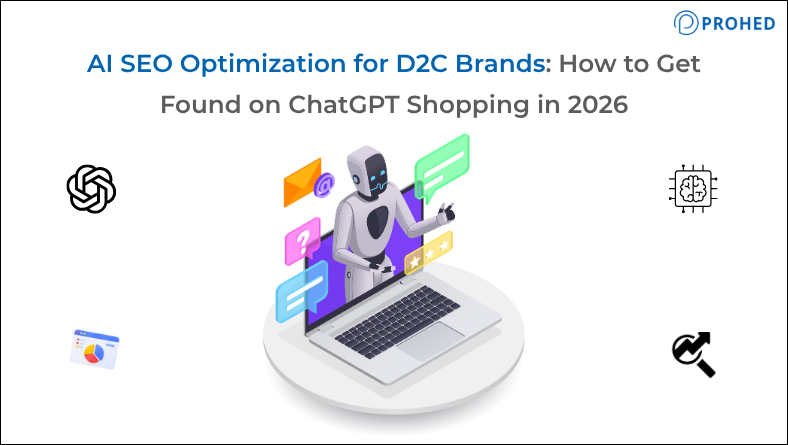
What is AI SEO optimization for D2C brands? AI SEO optimization is the practice of structuring your product data, content, and brand presence so that AI-powered engines like ChatGPT Shopping, Google AI Overviews, and Perplexity can find, understand, and recommend your products. Prohed helps D2C brands build this visibility layer alongside their existing paid and organic strategy, so they show up where their customers are actually searching in 2026.
Most D2C brands are still optimizing for a version of search their customers have quietly moved on from. The budget is going into Google Ads. The SEO team is chasing keyword rankings. Meanwhile, a growing share of purchase decisions are being made inside ChatGPT, where someone typed “best natural moisturizer for sensitive skin” and bought whatever the AI recommended, without clicking a single search result.
61% of consumers now use AI tools for shopping research, and AI-referred visitors convert up to 23 times higher than traditional organic search traffic. That gap is not a small difference. It’s the difference between showing up in the consideration set and not existing in the conversation at all.
At Prohed, we’ve seen this pattern repeat across every D2C vertical we work in, beauty, wellness, apparel, baby care. The brands winning AI visibility aren’t necessarily the ones with the biggest budgets. They’re the ones whose product data is structured in a way AI can actually read.
The Real Problem Is Structural, Not Strategic
91% of online stores remain invisible to AI shoppers, despite many having decent SEO on traditional search. The reason is that AI for SEO and traditional search engine optimization are not the same discipline. They require different inputs, different structures, and a different understanding of how AI engines source product recommendations.
Traditional SEO strategies are built around ranking pages for keywords. Google AI search and ChatGPT Shopping work differently. Instead of presenting a list of links, they generate a recommendation built from structured product data, brand authority signals, and contextual relevance.
A March 2026 analysis of 43,000 ChatGPT carousel products found that 83% of recommendations matched Google Shopping’s top 40 organic listings. So your Google Merchant Center feed is no longer just for Shopping ads. It’s the primary input determining whether ChatGPT recommends your products at all.
Furthermore, the defining shift in 2026 is that the primary consumer of product data is increasingly a machine, not a human. Retailers whose product feeds, schema, and pricing data are not machine-readable become invisible to AI shopping agents.
This changes the brief for any search engine optimization company working with D2C brands. The question is no longer just “how do we rank?” It’s “how do we get recommended?”
The 3 AI Visibility Gaps Costing D2C Brands Sales
- Gap 1: Treating Google SEO and AI SEO as the Same Thing: They share a foundation but diverge at execution. A brand ranking well on Google can still be completely invisible on ChatGPT Shopping if the product feed is incomplete or schema is missing.
- Gap 2: Accidentally Blocking AI Crawlers: More common than it should be. A developer blocks all bots including OAI-SearchBot, and the brand disappears from AI shopping results entirely. Check the robots.txt file, allow OAI-SearchBot specifically, and the channel opens immediately.
- Gap 3: Neglecting the Google Merchant Center Feed: Since 83% of ChatGPT shopping recommendations trace back to Google Shopping data, an outdated or incomplete Merchant Center feed is the single biggest barrier to AI shopping visibility for most D2C brands. Feed quality is not just a Google Ads problem anymore. It’s now an AI visibility problem too.
Full-Funnel AI SEO vs. Channel-First SEO: What the Data Shows
Most D2C brands default to channel-first SEO. One team handles Google Ads, another manages organic rankings, and nobody is thinking about AI visibility. Each team optimises for their own metric. None of them are sharing data.
The result is a brand that ranks reasonably on Google but doesn’t exist inside AI shopping conversations. Full-funnel AI optimization addresses this by treating AI visibility as a connected layer. Product schema, feed quality, brand mention signals, and review presence all feed into AI recommendation engines simultaneously. When one layer improves, the others benefit too.
Across D2C clients managed by Prohed in 2025-26, brands that implemented a connected AI visibility strategy alongside their paid campaigns saw measurably stronger performance on AI-referred traffic within 60 days. Paid campaigns drive brand familiarity signals that AI engines use as trust markers, while structured product data ensures the brand is actually findable when AI shopping queries occur.
Getting your products surfaced in AI search is step one. Building a profitable growth engine is step two – here’s how to scale D2C brands profitably in 2026
How Prohed Approaches AI SEO for D2C Brands
At Prohed, AI for SEO isn’t bolted onto a traditional SEO engagement as an afterthought. It’s built into how paid and organic strategy is connected from the beginning.
Paid campaign data feeds directly into AI visibility work. When paid search data shows that a specific long-tail product query converts at three times the rate of a broader category keyword, that insight shapes the product page content, the FAQ schema, and the Merchant Center feed attributes simultaneously. As a result, the brand becomes findable by AI engines for the exact queries that are already converting in paid.
Brand mention signals, built through earned media, community engagement, and review platform presence, are developed alongside technical AI optimization work. The reason is simple. AI engines use brand familiarity as a trust signal. A brand appearing in multiple credible sources, not just its own website, gets recommended more consistently.
Beyond AI SEO, Prohed’s full service mix covers Performance Marketing, SEM, Social Media Marketing, B2C Lead Generation, E-commerce Marketing, and App Install campaigns, all structured to work together rather than run as separate activities.
Final Word
$180 billion in e-commerce revenue is projected to flow through AI-powered discovery channels in 2026. The D2C brands getting a share of that revenue understood early that showing up in AI conversations requires a different approach than showing up in search results.
The foundation, clean product data, structured schema, a well-maintained Google Merchant Center feed, is achievable without a massive budget. What it requires is a connected strategy where AI visibility, paid performance, and organic SEO are all informed by the same data and pointed at the same goal.
Whether you’re based in Delhi, Mumbai, or looking for a SEO Agency in India that connects AI SEO, paid media, and D2C growth strategy under one roof, Prohed is the conversation worth starting.
FAQs
1. What is ChatGPT Shopping and how does it work for D2C brands?
Think of it as a personal shopper rather than a search engine. Instead of giving users a list of blue links, ChatGPT recommends products directly within a conversation. It pulls most of its info from Google Shopping data, so the better your Merchant Center feed looks, the better your chances are of being the product ChatGPT suggests.
2. Is AI SEO different from regular SEO for e-commerce?
They’re built on the same foundation, but the goal is different. Traditional SEO is about ranking on a page; AI SEO is about getting mentioned in a conversation. To win here, you need more than just keywords, you need rock-solid structured data, perfect product feeds, and clear brand authority signals that tell the AI you’re a trusted source.
3. How quickly can a D2C brand become visible on ChatGPT Shopping?
Technical fixes like allowing OAI-SearchBot and implementing product schema can unlock initial visibility within days. Consistent recommendation frequency typically builds over four to eight weeks.
4. Does running Google Shopping ads help with ChatGPT visibility?
It does, but in a “behind-the-scenes” kind of way. Since a huge chunk of ChatGPT’s shopping data (about 83%) comes from Google Shopping, having an active, optimized presence there naturally boosts your AI visibility. Plus, the discipline it takes to run a good paid campaign forces you to keep your data feed clean, which the AI loves.
5. What schema markup does a D2C brand need for AI shopping?
At minimum, Product schema with complete attributes including name, price, availability, images, description, and GTIN. Review schema adds trust signals. FAQ schema on category pages helps AI engines surface the brand in conversational responses beyond shopping carousels.
6. Can small D2C brands compete with large brands in AI shopping?
Absolutely. AI doesn’t care as much about how big your budget is or how long your domain has existed. It prioritizes data quality and relevance. If a small brand has better-structured data and a more detailed product feed than a giant competitor, the AI will likely recommend the smaller brand because it understands the product better.
7. What should a D2C brand do first to improve AI SEO visibility?
Start with these three quick wins: First, make sure you aren’t accidentally blocking the “OAI-SearchBot” in your robots.txt file. Second, audit your Google Merchant Center feed to ensure every detail is filled out. Third, double-check that your “Product Schema” is working on your main pages. These steps alone can unlock visibility that many brands are currently missing out on.
Schedule a Free Strategy Call with PROHED Today