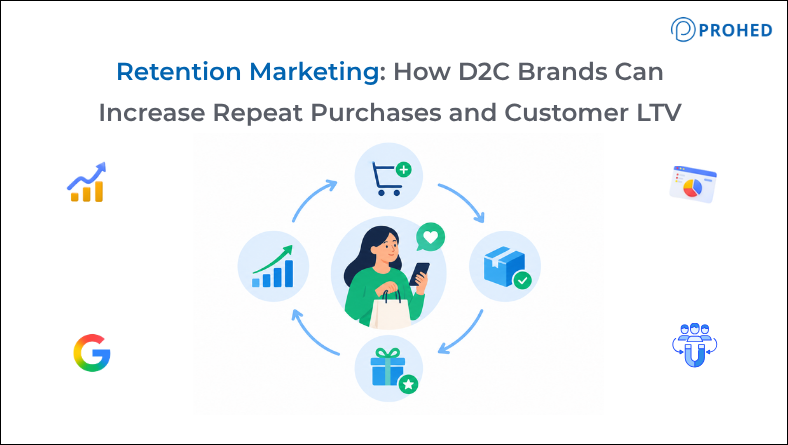
Most D2C founders can tell you their CAC to the rupee. Ask them what their 90-day repeat purchase rate is, and you’ll usually get a pause. Retention marketing is the practice of getting existing customers to buy again, more often, and for longer, which directly raises customer lifetime value without adding a single rupee to acquisition spend. At PROHED, an ecommerce marketing agency working with D2C brands across categories, we’ve found that retention is usually where the real margin problem hides, not in the ad account everyone’s busy staring at.
This piece looks specifically at the economics and mechanics of repeat purchase behaviour, not the personalisation or data tooling side, which we’ve covered separately on this blog.
The Math Problem Most D2C Brands Are Actually Solving
Here’s the uncomfortable version of the situation. If your CAC is ₹800 and your average order value is ₹1,200 at a 40% contribution margin, you’re making ₹480 per order and losing ₹320 on every first purchase. That business only works if a meaningful share of those customers come back.
So the question isn’t really “how do we improve retention.” It’s “how many repeat orders does a customer need to make before this brand is actually profitable?”
Repeat purchases | Contribution earned (at ₹480/order) | Net after ₹800 CAC |
1 (first order only) | ₹480 | -₹320 |
2 | ₹960 | +₹160 |
3 | ₹1,440 | +₹640 |
5 | ₹2,400 | +₹1,600 |
The jump from one order to two is what flips the business from losing money to making it. Everything after that is compounding. This is why customer retention marketing deserves a budget line of its own rather than being treated as something the email intern handles between campaigns.
Why Repeat Purchase Rate Beats Most Other Retention Metrics
Plenty of D2C brands track retention through churn or subscriber counts. For most non-subscription categories, repeat purchase rate is the more honest number.
Specifically, track these three:
- Repeat purchase rate: what percentage of customers have bought more than once
- Time to second purchase: the median gap between order one and order two
- Purchase frequency by cohort: how the January cohort behaves at month three versus the June cohort
That second metric is the one most brands ignore, and it’s arguably the most actionable. If your median time to second purchase is 65 days, your entire ecommerce retention strategy needs to be concentrated in that window, not spread evenly across the year. Sending a win-back campaign at day 120 to someone who already went elsewhere at day 70 is wasted spend.
The Second-Purchase Window Is Where Everything Happens
Across most D2C categories, the probability of a customer ever coming back drops sharply after a certain point. If they haven’t repurchased by then, they usually won’t.
That makes the period right after the first order the highest-leverage moment in the entire customer lifecycle. A few things that work here:
- Get the first delivery experience right: Nothing kills a second purchase faster than a late delivery or a damaged package. This isn’t strictly marketing, but marketing owns the consequences, so it’s worth pushing on internally.
- Send a genuinely useful post-purchase sequence: Not a discount. Something that helps them actually use the product well, care instructions, usage tips, what to expect in week two. Brands that discount immediately after purchase train customers to wait for discounts.
- Time your first repurchase nudge to consumption, not the calendar: If a product lasts roughly 45 days, the nudge goes out around day 35, not day 30 because that’s when the monthly campaign runs.
- Make reordering stupidly easy: A one-tap reorder link in WhatsApp or email removes more friction than any offer you could attach to it.
Building a Customer Lifecycle Marketing System
Customer lifecycle marketing means treating a customer differently depending on where they are in their relationship with your brand, rather than blasting the same campaign to everyone on the list.
A workable structure looks something like this:
Stage | Who’s in it | What they should receive |
New (0–30 days) | First-time buyers | Onboarding, product education, brand story |
Active repeat | 2+ orders, recent activity | Cross-sell, bundles, early access to launches |
At risk | Past expected repurchase window | Reminder, restock nudge, low-friction reorder |
Lapsed | No purchase in 2+ cycles | Win-back, feedback request, targeted offer |
VIP | Top 10–20% by spend | Loyalty perks, referral asks, community access |
Two practical notes on this. First, discounting should mostly live in the lapsed stage, not the active ones. Discounting people who were going to buy anyway is just margin donation. Second, VIP customers are your most underused asset for acquisition, since referral and UGC requests land far better with them than with a general list.
The Channels That Actually Drive D2C Retention in India
Not every channel earns its place. Here’s where the effort usually pays off:
- WhatsApp has become the strongest retention channel for Indian D2C brands, with open rates that email can’t match. It works best for reorder reminders, order updates, and restock alerts. It stops working the moment it becomes a broadcast promo channel, so restrict it to genuinely useful, timely messages.
- Email still does the heavy lifting for longer-form lifecycle sequences, product education, and win-back flows. Lower open rates, but more room to actually say something.
- Meta Ads retargeting for existing customers is underrated. Most brands exclude past purchasers from retargeting entirely. For consumable categories, retargeting them near their repurchase window often produces cheaper conversions than any cold audience.
- Loyalty and subscription mechanics work well in consumables (food, personal care, supplements) and poorly in categories where purchase frequency is naturally low. Don’t force it because a competitor launched one.
- Organic social and community builds the brand affinity that makes the other channels work better, but it’s slow and hard to attribute. Worth doing, hard to justify on a quarterly report.
How PROHED Approaches D2C Retention
We treat retention and acquisition as one system rather than separate departments, mostly because they directly affect each other. A brand with a strong repeat purchase rate can afford a higher CAC, which means it can outbid competitors on Meta and Google for the same customer. That’s a real competitive advantage, not a soft one.
For D2C clients, that usually involves cohort-level analysis to find where the drop-off actually sits, CRO work on the repurchase and checkout flow rather than just the acquisition landing page, and lifecycle campaign structures built around observed repurchase timing instead of a fixed monthly calendar. We also look at whether paid spend is being wasted re-acquiring customers the brand already had.
As a digital marketing agency in Gurgaon working across D2C and ecommerce, the pattern we see most often is simple: brands scaling ad spend hard while their repeat purchase rate quietly sits under 20%. Fixing the second number makes the first one far more affordable.
Conclusion
Retention isn’t a loyalty programme or an email calendar. It’s the thing that determines whether your acquisition spend is an investment or a leak. Start by finding your actual repeat purchase rate and median time to second purchase, then build everything around that window rather than a generic monthly campaign schedule. Get customers from one order to two consistently, and the unit economics of the entire business change. Most brands don’t need to spend more on ads. They need the customers they’ve already paid for to come back.
FAQs
1. What is retention marketing?
Retention marketing covers the strategies used to keep existing customers buying rather than focusing purely on acquiring new ones. It includes lifecycle campaigns, reorder nudges, loyalty mechanics, and win-back flows aimed at increasing purchase frequency and lifetime value.
2. Why is retention marketing important for D2C brands?
Most D2C brands lose money on a customer’s first order because CAC often exceeds first-purchase contribution margin. Retention is what turns that loss into profit, which is why a brand with weak repeat rates struggles to scale profitably regardless of how good its ads are.
3. What are the best customer retention strategies?
The highest-impact ones are usually well-timed reorder reminders based on actual consumption cycles, a useful post-purchase onboarding sequence that doesn’t lead with a discount, and frictionless reordering. Loyalty programmes and subscriptions help too, but mainly in consumable categories with natural repeat frequency.
4. How does retention marketing increase LTV?
Lifetime value is essentially purchase frequency multiplied by average order value and margin, over a customer’s active lifespan. Retention marketing increases frequency and extends that lifespan, which raises LTV without any additional acquisition cost.
5. What is the difference between acquisition and retention marketing?
Acquisition marketing pays to bring new customers in, usually through paid channels like Google Ads and Meta Ads. Retention marketing works with customers you’ve already paid for, which makes it significantly cheaper per rupee of revenue generated.
6. What’s a good repeat purchase rate for a D2C brand?
It varies heavily by category, but consumable brands should generally target above 30% while considered-purchase categories will naturally sit lower. The more useful benchmark is your own trend over time rather than an industry average.
7. Should retention campaigns always include a discount?
No, and over-discounting is one of the more common mistakes here. Discounting customers who were already going to repurchase erodes margin, so offers are better reserved for genuinely lapsed customers rather than active ones.
8. How do I know when to send a repurchase reminder?
Look at your median time to second purchase and send the nudge slightly before that window closes. For consumables, aligning the reminder to when the product is likely running out works better than any fixed monthly schedule.
Want to know where your repeat purchase rate is actually breaking down?
Schedule a Free Strategy Call with PROHED Today