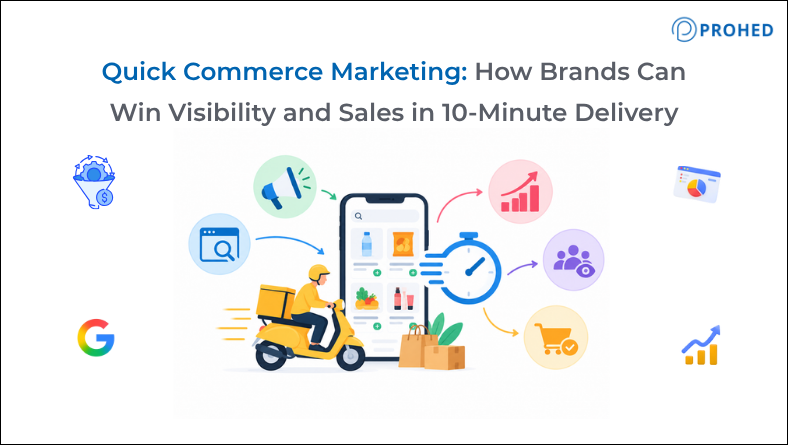
Quick commerce marketing is the work of getting a product ranked, stocked, and bought on 10-minute delivery apps like Blinkit, Zepto, Swiggy Instamart, and BigBasket Now, where the entire buying decision happens in the time it takes to open the app and scroll twice. PROHED, a performance marketing agency working with D2C and ecommerce brands, treats this as a separate discipline from regular ecommerce marketing, since the two rarely respond to the same playbook.
Most brands already run solid campaigns on Meta and Google. Almost none of them have a real plan for what happens the second someone opens Blinkit and types a category name. That’s a different visibility problem entirely, one that runs on in-app search ranking and local stock rather than ad creative alone. This piece is about closing that specific gap.
Quick commerce isn’t a niche experiment anymore either. GMV on these apps touched roughly ₹11,000 crore in a single month in early 2026, nearly double what it was a year before, with daily order volumes climbing past 7.8 million (Redseer). That kind of growth is exactly why “we’ll figure it out later” isn’t really an option for most consumer brands now.
Why Quick Commerce Changed the Visibility Game
Search results inside these apps work a lot like a mini search engine, though most brands still don’t treat them that way. Screen space is tight, attention spans are short, and the first few products a shopper sees get the bulk of the clicks. Brands are now fighting for shelf space, not just brand loyalty.
Discovery happens three ways here: in-app search ranking, sponsored ads, and category browsing. That’s genuinely not too different from SEO and PPC on a website, which is exactly why quick commerce SEO and quick commerce advertising work best planned together, not as separate line items. A brand that only runs ads without fixing its listing content usually ends up paying more per sale than it should.
There’s a habit factor too. Once a shopper finds a brand that consistently shows up and delivers fast, they tend to stop comparing. That habit becomes genuinely hard for a competitor to break later, which is part of why early visibility matters more here than in slower-moving categories.
Traditional Ecommerce vs Quick Commerce Marketing
| Factor | Traditional Ecommerce | Quick Commerce |
|---|---|---|
| Decision time | Minutes to days | Seconds to minutes |
| Discovery driver | Search engines, social ads | In-app search, local stock |
| Delivery time | 2–7 days | 10–30 minutes |
| What converts | Detailed descriptions, reviews | Clear visuals, price, trust signals |
| Repeat buys | Email, retargeting | App reminders, habit buying |
| Stock model | Central warehouse | Local dark stores |
This table makes one thing obvious: brands can’t just copy their ecommerce playbook here. Quick commerce needs a plan built for speed and local stock availability, and honestly, it needs its own budget line rather than leftover spend from a bigger campaign.
What Actually Wins on the Quick Commerce Shelf
A handful of things consistently separate brands that grow fast from ones that stay buried on page two.
- In-app search ranking matters more than most people think: Shoppers usually search first before they browse categories, so a product invisible in search results is effectively invisible, full stop.
- Local stock decides whether your product shows up nearby at all: Distribution has quietly become part of marketing now, not just a supply chain concern.
- Pack visuals need to sell the product in one glance: There’s no time to read three lines of text on a small phone screen mid-scroll.
- Reviews and ratings build trust fast: A new buyer decides in seconds, so early reviews carry disproportionate weight compared to a slower-considered purchase.
- Sponsored placements buy visibility while organic ranking is still building: This is particularly useful for newer brands entering a crowded category with no ranking history yet.
More brands are now planning marketing around these apps first, with the website coming second, and for some categories, barely factoring in at all.
Building a Quick Commerce Marketing Strategy
A working plan usually has a few moving parts, and each one needs ongoing attention rather than a one-time setup.
- In-app SEO and keywords: Product titles, backend tags, and category placement all affect ranking, much like on-site SEO for a website. Small changes, like adding the right search term to a title, can shift ranking within days.
- Sponsored ads: Quick commerce advertising runs on an auction system where bids and budgets decide who shows up first. Competition is high enough that these campaigns need regular checks rather than a set-and-forget approach, since costs can shift daily depending on how many other brands are bidding in the same category.
- Hyperlocal targeting: Spend often needs planning pincode by pincode, matching ad budget to where stock actually sits, so money isn’t wasted showing ads to shoppers who can’t even get the product delivered.
- Smart pricing: Combos and starter offers tend to perform well here, nudging a shopper who’s already buying to add one more item, which lifts average order value without much extra effort.
- Cross-channel support: Meta and Google ads that send people to search for your brand on these apps can lift in-app ranking too. More searches and more sales both feed the app’s ranking system, creating a loop that keeps compounding.
Mistakes Brands Keep Making
A few habits quietly hold brands back here, and most are easy to fix once spotted.
- Treating quick commerce as a side channel instead of giving it its own budget and dedicated focus
- Ignoring stock-outs at the local level, which kills visibility even with a full ad spend running in the background
- Reusing old Amazon or website copy instead of writing for a faster shopping moment where attention lasts only a few seconds
- Skipping reviews early on, which slows trust with new buyers who have no other quick way to judge the product
- Running one creative across every app without adjusting for how each platform actually looks and behaves
Case Study: Reaching Shoppers at the Right Moment
The Mom Store, a D2C mother and baby brand, had a common problem. Parents often need baby products fast, but the brand’s visibility hadn’t kept up with that urgency. PROHED rebuilt the brand’s digital approach around this gap, lining up content, targeting, and campaign structure with how parents actually search when they need something now, rather than relying solely on a slower, traditional ecommerce funnel.
How Quick Commerce SEO Fits the Bigger Picture
Even though buying happens inside an app, your website still matters. Many shoppers search your brand name on Google before adding it to cart, just to check if the brand is real and trusted. Quick commerce SEO and regular website SEO end up supporting each other rather than competing for the same budget, and treating them as connected usually produces better results than running them apart.
This is where an experienced SEO company in Gurgaon or ad agency in Gurgaon can help. Lining up in-app visibility with website authority usually needs more than one specialist working in isolation.
Where PROHED Fits Into This
PROHED helps quick commerce and D2C brands connect in-app ads, hyperlocal targeting, and performance marketing into one plan. As a performance marketing agency and one of the digital marketing agencies Gurgaon brands often turn to, the team pairs quick commerce advertising with search marketing and social campaigns, so visibility on the app also builds visibility everywhere else instead of each channel working in its own silo.
If you’re comparing options for the best D2C marketing agency to grow your quick commerce presence, check whether they actually understand both the in-app auction system and the wider digital funnel behind it. Most agencies only know one side, and that gap usually shows up later as wasted ad spend. (If you’re at that comparison stage specifically, our roundup of quick commerce marketing agencies in India is a better starting point than this piece.
Conclusion
Quick commerce rewards brands that give it its own strategy, not a smaller copy of their ecommerce plan. In-app ranking, local stock, and a few seconds of shelf space decide most outcomes here, and none of those three show up automatically just because a brand is already good at Meta or Google Ads. Brands that build around these factors deliberately tend to win more often than ones reusing an old website playbook and hoping it translates.
FAQs
1. What is quick commerce marketing?
It’s how a brand gets noticed on apps like Blinkit, Zepto, or Instamart, where delivery lands in 10 to 30 minutes. Listing quality, stock, and pricing all have to click together fast, because there’s no time for a slow pitch here.
2. How is it different from regular ecommerce marketing?
On Amazon, people compare, read reviews, maybe wait a day before deciding. On a quick commerce app, that patience just doesn’t exist, so the usual playbook of long descriptions and slow trust-building falls flat.
3. Why does local stock matter so much?
A listing might look great, but if it’s out of stock at the nearest dark store, it simply won’t show up in results. Ranking here leans heavily on real inventory, which means stock planning is effectively part of marketing now.
4. What role does SEO play here?
Titles, backend keywords, and category tags all decide how high a product ranks in the app’s own search bar, similar in principle to website SEO. Even a small tweak, like fixing a missing keyword, can move the needle within days.
5. How much should a brand spend on quick commerce ads?
There’s no fixed number, since it depends heavily on the category and how many dark stores cover an area. Most brands test a small budget across a few pincodes first, then push more spend where it’s actually converting.
6. Do all quick commerce apps work the same way?
Not quite. The basics, search ranking and sponsored slots, are similar across platforms, but each app has its own quirks and shopper habits, so creative and bidding usually need some platform-specific tweaking.
7. Can a small D2C brand compete with bigger players here?
Yes, actually, and that’s the encouraging part. Visibility rides more on listing quality and consistent stock than on brand size, so a smaller brand doing the details right can outrank a bigger name in specific pincodes.
8. How should a brand start improving its quick commerce presence?
Start small: audit listings for missing keywords, check whether stock is consistent across dark stores, then run a modest ad test. That last step tells you which search terms actually convert before committing real budget.
Want your brand to show up first the moment someone opens the app?
Schedule a Free Strategy Call with PROHED Today