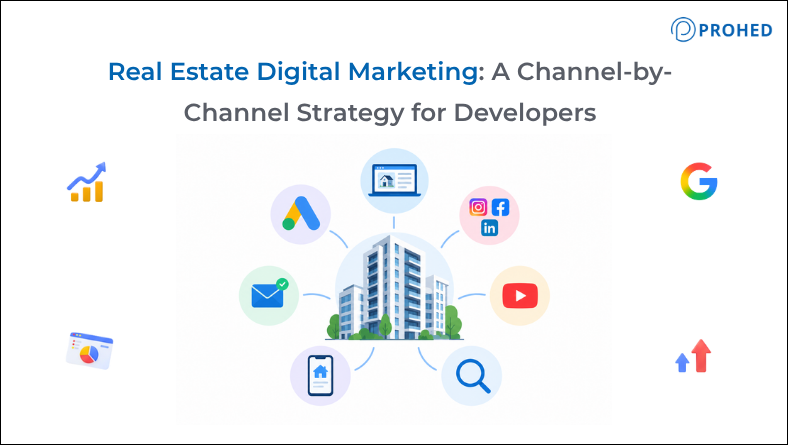
Ask ten developers where their leads come from and most will say “portals and Google.” Ask what each channel actually costs them per booking, and the answers get vague fast. Real estate digital marketing works best when each channel is given a specific job rather than being treated as interchangeable sources of leads. At PROHED, a lead generation marketing agency working with developers, we’ve seen budgets shift dramatically once a brand can see which channel produces site visits versus which one just produces form fills. This is a channel-by-channel breakdown of what each one is actually good for.
We’ve covered lead generation strategy and agency selection elsewhere on the blog. This piece stays focused on the channels themselves.
Mapping Channels to the Buyer’s Actual Journey
A homebuyer moves through roughly three phases, and each channel performs very differently depending on which phase someone’s in.
Phase | What the buyer is doing | Channels that work here |
Exploration | Browsing localities, budgets, configurations | Meta Ads, YouTube, organic social, SEO content |
Comparison | Shortlisting 3–5 specific projects | Property portals, real estate SEO, Google Search Ads |
Decision | Booking site visits, negotiating | Google Search Ads (brand terms), remarketing, WhatsApp |
Running the same message across all three phases is the most common and most expensive mistake in digital marketing for real estate. An exploration-phase buyer isn’t ready for a “book your site visit today” ad, and a decision-phase buyer doesn’t need another locality guide.
Google Ads: Your Highest-Intent Channel
Google Search is where the strongest leads come from, because someone typing “3 BHK Sohna Road under 2 crore” has already done the hard thinking.
Real estate PPC campaigns for developers generally break into three campaign types:
- Brand terms (your project name, developer name): cheapest clicks, highest conversion, and essential because competitors will bid on your project name if you don’t
- Category and locality terms (“flats in Golf Course Extension,” “new launch projects Gurgaon”): more expensive, mid-to-high intent, this is where most budget should sit
- Competitor terms: viable but costly, and conversion rates depend heavily on how differentiated your project genuinely is
A few practical notes on running these well:
- Use location extensions and call extensions aggressively, since a meaningful share of real estate searches happen on mobile with immediate call intent
- Set up separate campaigns per micro-market rather than one Gurgaon-wide campaign, because CPCs and buyer profiles differ significantly between them
- Feed offline conversion data (site visits, bookings) back into Google, otherwise the algorithm optimises toward cheap form fills rather than actual buyers
That last point is where most developer accounts fall short. Without offline conversion tracking, Google is optimising for the wrong outcome entirely.
Meta Ads: Awareness and Early Interest
Meta does a genuinely different job. Nobody’s scrolling Instagram intending to buy an apartment, which means Meta works best for building familiarity before a buyer starts searching.
Where it performs:
- New launch announcements, where reach matters more than immediate intent
- Video walkthroughs and construction progress, which build credibility over time
- Lookalike audiences built from actual booked customers, not just all form fills
- Retargeting anyone who visited your project page but didn’t convert
Meta lead form ads generate volume cheaply, which is exactly why they need a qualification layer. Raw Meta leads at a low cost per lead often convert far worse than a more expensive Google lead, and comparing the two on CPL alone will lead you to the wrong conclusion.
Real Estate SEO: The Slow Channel That Lowers Everything Else
Real estate SEO is the channel developers underinvest in most, usually because portals and paid ads deliver faster.
What actually works here:
- Locality and micro-market content: Pages targeting “best residential projects in [locality]” or “[locality] property price trends” capture buyers in exploration and comparison phases, often months before they’re ready to enquire.
- Project pages built to rank: Your own project pages should rank for your project name, not just your portal listings. If a buyer searches your project and lands on a portal first, you’ve handed a warm lead to a platform that will sell it to three competitors too.
- Google Business Profile for the site office: Underused, and increasingly important as more local search happens through map results and AI-generated answers.
The payoff on SEO is slow, typically six months or more, but it compounds and it reduces dependence on rising CPCs over time. For developers with multiple projects in one city, the content built for one launch keeps working for the next.
Property Portals: Useful, But Not a Strategy
Portals deliver volume and buyers in active comparison mode. They also sell the same lead to your competitors, and the lead quality varies widely.
Treat portals as one channel in the mix rather than the backbone of your real estate online marketing. Developers who rely on portals exclusively end up with no owned audience, no organic visibility, and no control over lead cost when portal pricing changes.
WhatsApp and Remarketing: Where Leads Get Recovered
Most enquiries don’t convert on first contact, which makes the recovery layer as important as the generation layer.
- WhatsApp works for follow-up, sharing floor plans and price sheets, and site visit coordination, with far better response rates than email in the Indian market
- Display and Meta remarketing keeps a project visible during the weeks a buyer spends deliberating
- Email works better for longer nurture content like construction updates and payment plan explanations
How PROHED Approaches Channel Planning for Developers
We start by assigning each channel a role and a metric, rather than judging everything on cost per lead. Google Search carries decision-phase intent and gets measured on cost per site visit. Meta carries exploration and gets measured on assisted conversions and lead quality after qualification. SEO gets measured on organic enquiry volume and its effect on blended acquisition cost over quarters, not weeks.
Alongside that, we run CRO on project landing pages, because a page that loads slowly or buries the site visit booking form undercuts every channel feeding into it. As a digital marketing agency in Gurgaon working with developers, we’ve found most budget reallocation decisions become obvious once offline conversion data flows back into the ad platforms properly.
Conclusion
Every channel in real estate marketing does a different job, and the brands wasting the most money are usually the ones judging all of them by the same metric. Google Search buys intent. Meta buys attention. SEO buys long-term independence from rising ad costs. Portals buy volume you don’t control. Getting the allocation right starts with connecting your CRM back to your ad platforms, so you can finally see which channel produces bookings rather than just leads.
FAQs
1. What is digital marketing in real estate?
It covers the online channels developers use to reach and convert buyers, including search ads, social media, SEO, property portals, and CRM-driven follow-up. Unlike traditional advertising, it allows spend to be tracked from first click through to site visit and booking.
2. Which digital marketing channels work best for real estate?
Google Search Ads usually produce the highest-intent enquiries, while Meta Ads work better for building awareness earlier in the journey. Most developers get the best results from a mix, with SEO running underneath to reduce long-term dependence on paid channels.
3. How does SEO help real estate companies?
Real estate SEO captures buyers researching localities, price trends, and projects before they’re ready to enquire, often months ahead of a purchase. It also ensures your own project pages rank for your project name rather than ceding that traffic to portals.
4. How does Google Ads work for real estate?
Campaigns bid on search terms related to your project, locality, or configuration, showing ads to people actively searching. The key to making it work is feeding offline conversion data back in, so Google optimises toward site visits and bookings rather than cheap form fills.
5. How much does real estate digital marketing cost?
Budgets vary widely by city, project size, and competition, with most developers allocating a meaningful share of overall marketing spend to digital. Rather than benchmarking total spend, it’s more useful to track cost per qualified site visit, since that connects directly to sales outcomes.
6. Are property portals still worth the investment?
They still deliver volume from buyers in active comparison mode, so most developers keep them in the mix. The limitation is that portals sell the same lead to competitors, which is why they work better as one channel among several rather than the primary one.
7. Why do Meta leads often cost less but convert worse than Google leads?
Meta reaches people who weren’t actively searching, so intent is naturally lower even though the lead itself is cheap. Comparing the two channels on cost per lead alone is misleading; cost per site visit gives a much fairer picture.
8. How long does it take to see results from real estate digital marketing?
Paid channels can generate enquiries within days of launch, though stable conversion patterns usually take six to eight weeks to emerge. SEO operates on a longer timeline, typically six months or more before it contributes meaningfully to enquiry volume.
Want to see which of your channels is actually producing bookings?
Schedule a Free Strategy Call with PROHED Today