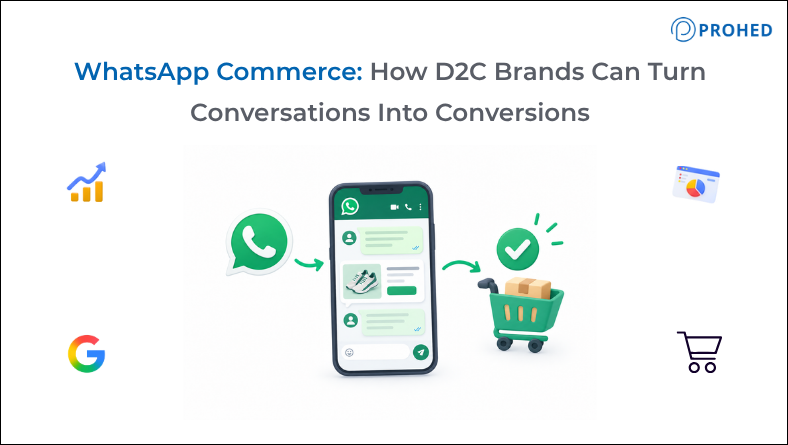
A customer messages a D2C brand on WhatsApp about a product, and by the end of that conversation, they’ve paid for it, without opening a browser tab or downloading an app. That’s WhatsApp Commerce, quietly becoming one of the shortest paths to a sale Indian D2C brands have access to. PROHED, a d2c marketing agency working across categories, has watched this shift from a nice-to-have feature into something brands actively build storefronts around.
What Is WhatsApp Commerce, Exactly?
This refers to the product catalog, cart, checkout, and payment tools built directly into WhatsApp Business, letting a customer browse, select, and pay for products inside a single chat thread. It’s different from using WhatsApp purely for marketing messages or support, since the transaction itself happens in the app, not just the conversation leading up to it.
For D2C brands, this matters because it removes almost every friction point standard ecommerce carries: no separate app to download, no account to create, no unfamiliar checkout page. The purchase happens inside an app most Indian shoppers already have open several times a day.
How WhatsApp Commerce Actually Works
Stage | What Happens |
Discovery | A customer messages the brand or taps a Click-to-WhatsApp ad, opening a chat |
Browsing | The product catalog appears inside the chat, with images, prices, descriptions |
Selection | Items get added to a cart directly within WhatsApp, no separate page needed |
Checkout | Payment happens via UPI, a payment link, or an in-chat payment flow |
Confirmation | Order confirmation and tracking arrive as WhatsApp messages, not emails |
Every stage happens without the customer leaving the conversation. That single detail is what separates this from ordinary WhatsApp marketing, where the chat usually still redirects to a website for the actual purchase.
Setting Up a Product Catalog on WhatsApp
Getting a working catalog running takes a few concrete steps, most of which sit inside WhatsApp Business Manager:
- Build a catalog with clear images, accurate pricing, and short descriptions, since this is what customers browse directly inside the chat.
- Connect it to a WhatsApp Business API account, since the free Business App supports only a limited version.
- Set up automated replies surfacing relevant catalog items based on what’s asked, rather than the full catalog every time.
- Enable cart functionality so customers can select multiple items, instead of buying one product per conversation.
- Test the full purchase flow end to end before launching, since a broken link at this stage loses the sale entirely.
In-Chat Checkout: Cart, Payments, and Order Confirmation
This is where most of the actual transaction happens, and it’s also where brands most often get it wrong. A full cart means nothing if the payment step sends a customer somewhere unfamiliar or slow.
- UPI-based payment links tend to convert best for Indian shoppers, since the flow feels identical to something already used daily.
- Third-party checkout integrations, connected through the API, can pull cart contents directly into a payment page without re-entering details.
- Cash on delivery still needs a place in the flow for many D2C categories, since it remains a default preference for a meaningful share of Indian shoppers.
- Order confirmation sent immediately after payment, inside the same thread, closes the loop without a separate email or SMS.
Why WhatsApp Commerce Works So Well for D2C Brands in India
A few things about the Indian ecommerce market make this approach a particularly good fit, more so than in markets where app-based shopping already dominates.
In-Chat Shopping vs a Standard Ecommerce Checkout
Step | Standard Checkout | WhatsApp Commerce |
App or site required | Yes, usually a separate app or website | No, happens inside an app already installed |
Account creation | Often required before purchase | Not required, chat identity carries through |
Screens to purchase | Typically 4-6 screens | Usually 1-2 within the same thread |
Trust signal | Depends on site design and reviews | Personal chat context, closer to a known contact |
Fewer screens and less friction tend to translate directly into fewer drop-offs at checkout, which is usually where a standard ecommerce funnel loses the most volume.
A Retention Channel, Not Just a First-Sale Tool
Most of the attention here focuses on the first sale, but the bigger value often shows up afterward. A customer who’s already bought once has a saved conversation thread with the brand, no re-marketing needed to remind them it exists. A follow-up message with a restock alert, a reorder link, or an early-access offer lands directly in a thread the customer already trusts, rather than competing with dozens of other emails.
Common Mistakes Brands Make Setting This Up
A handful of patterns come up repeatedly when D2C brands build this without enough planning:
- Sending the full catalog regardless of what was asked, which overwhelms rather than helps.
- Skipping cart functionality and forcing one product per conversation, capping average order value unnecessarily.
- Leaving payment pointing to a generic website checkout instead of an integrated in-chat flow.
- No clear handoff between an automated response and a human agent for specific questions.
- Treating it as a one-time setup rather than something needing the catalog kept current.
Where PROHED Fits Into This
As an ecommerce marketing agency in India, PROHED builds these setups alongside the broader D2C growth strategy, catalog structure, checkout flow, and the marketing that drives customers into that chat in the first place. It isn’t a bolt-on feature; it works best planned as part of the same system as paid acquisition and retention. For brands searching for the best digital marketing agency for D2C brands, or the best performance marketing agency for D2C brands in India, this is a fair question to raise directly, since not every agency has actually built and tested a live catalog-to-checkout flow rather than just running WhatsApp broadcasts.
Conclusion
WhatsApp Commerce works because it removes almost every reason a customer has to abandon a purchase halfway through. No app to download, no account to create, no unfamiliar checkout page, just a conversation that ends in a completed order. For D2C brands still sending customers off to a separate website mid-chat, that’s real revenue sitting in a channel already open on nearly every Indian phone.
FAQs
1. What is WhatsApp Commerce?
WhatsApp Commerce is the set of catalog, cart, checkout, and payment tools built into WhatsApp Business that let customers browse and buy products entirely inside a chat. It’s different from general WhatsApp marketing, since the actual transaction happens in the app rather than redirecting to a website.
2. How does WhatsApp Commerce work?
A customer browses a brand’s product catalog inside the chat, adds items to a cart, and completes payment through a UPI link or an integrated checkout, all without leaving the conversation. Order confirmation and tracking then arrive as WhatsApp messages instead of emails.
3. How can businesses sell products through WhatsApp?
Businesses need a WhatsApp Business API account connected to a structured product catalog, along with a checkout flow that supports UPI or another integrated payment method. Most brands set this up through a WhatsApp Business Solution Provider rather than building the integration from scratch.
4. How can WhatsApp increase ecommerce sales?
By removing friction at the exact point most sales get lost: checkout. Fewer screens, no account creation, and a payment method shoppers already trust tend to reduce drop-off compared to a standard multi-page ecommerce checkout.
5. Is WhatsApp good for customer retention?
Yes, often more so than for first-time acquisition. A saved conversation thread means follow-up messages, restock alerts, reorder links, personalized offers, land somewhere the customer already checks daily, rather than competing with an inbox full of unread promotional emails.
6. Does WhatsApp Commerce work for cash on delivery orders?
It can, though the flow needs to account for it specifically. Many D2C brands keep a COD option available even within a WhatsApp-first purchase journey, since a meaningful share of Indian shoppers still prefer it over prepaid, particularly for first-time purchases from a new brand.
7. What’s the difference between WhatsApp marketing and WhatsApp Commerce?
WhatsApp marketing covers the messaging, broadcasts, and nurture sequences that build a relationship with a customer. WhatsApp Commerce specifically refers to completing the actual purchase, catalog browsing, cart, and payment, inside the same chat thread.
8. Do I need the WhatsApp Business API to set up commerce features?
For anything beyond a very basic catalog, yes. The free WhatsApp Business App supports a limited catalog view, but cart functionality, integrated checkout, and automated catalog responses generally require the API, accessed through a Business Solution Provider.
Ready to Turn Your WhatsApp Chats Into a Storefront?
A product catalog that customers still have to leave WhatsApp to actually buy from is leaving revenue on the table. Talk to PROHED’s team about building a WhatsApp Commerce setup that takes a customer from question to completed order without ever opening a browser.
PROHED is a d2c marketing agency and ecommerce marketing agency in India, recognized as one of the best digital marketing agencies for D2C brands building revenue channels beyond standard paid acquisition.
Schedule a Free Strategy Call with PROHED Today