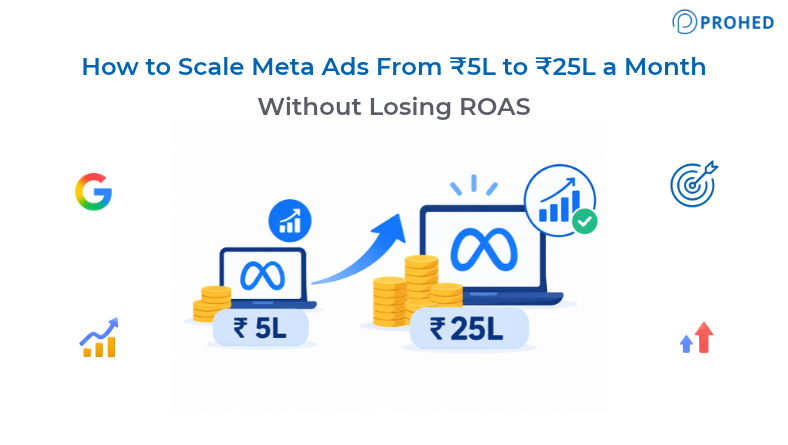
To scale Meta ads from ₹5L to ₹25L a month without wrecking ROAS, raise budgets in steps of about 20% every three or four days, add new campaigns and audiences alongside those steps, and grow your creative output faster than your spend. Judge every increase on marginal ROAS and new-customer ROAS, not the blended number in Meta Ads Manager. At PROHED, this is the order we follow when D2C brands ask us to 5x their spend: creative supply first, budget second, reporting third.
Ask any D2C founder who’s tried this. They doubled the budget on a Monday, CPA jumped sharply by Wednesday, and by Friday the budget was back where it started. Two weeks later, same experiment, same result.
Meta wasn’t the problem. The plan was.
Why ROAS Drops When You Scale Meta Ads?
Three things happen as spend goes up, and they tend to show up together.
First, audience saturation. At ₹5L, Meta is mostly finding people who were nearly ready to buy anyway. Push to ₹10L and it has to go after colder people, the sort who need convincing, and convincing costs money. Don’t read that as failure. It’s just what scaling does.
Frequency comes next. Same people, same four ads, again and again. In our experience, once 7-day frequency on cold audiences moves past roughly 2 to 2.5, click-through rates often start to slide. Treat that as a rule of thumb and go find your own account’s tipping point. Our guide on creative fatigue in D2C ads covers the warning signs.
Then the learning phase. Meta wants around 50 optimisation events in a week to exit learning, and a big budget increase counts as a significant edit. So an ad set that was perfectly stable can slide back into learning and wobble for days.
Vertical vs Horizontal Scaling: Which One and When
There are really only two ways to scale a Meta account.
Vertical scaling | Horizontal scaling | |
What it means | Raising the budget on campaigns that already work | Adding new campaigns, audiences, offers or creatives |
Best for | Proven campaigns with stable CPA | When vertical increases start hurting ROAS |
Main risk | Learning resets and rising CPA | Spreading budget too thin across weak tests |
Speed | Fast | Slower, but builds more room to grow |
Go vertical first. When a 20% bump stops holding its CPA for a week, go horizontal, then push vertical again on whichever new campaign wins. Expect to flip back and forth many times before you reach ₹25L.
How Much Can You Increase a Meta Ads Budget at a Time?
If you want to scale Facebook ads budget without the wobble, around 20% every three to four days is a sensible starting point for most accounts. It isn’t an official Meta rule. It’s simply a step big enough to matter and small enough that Meta usually doesn’t throw the ad set back into learning. Watch how your own account reacts and adjust.
Here’s a rough path for a brand going from ₹5L to ₹25L:
Phase | Monthly spend | Main move | What to watch |
Weeks 1–4 | ₹5L to ₹8L | 20% vertical steps on top campaigns | CPA holding within 10–15% of target |
Weeks 5–8 | ₹8L to ₹13L | Launch Advantage+ sales and a new offer angle | NC-ROAS, frequency |
Weeks 9–14 | ₹13L to ₹19L | New audiences, new formats, broader geos | Marginal ROAS on each step |
Weeks 15–20 | ₹19L to ₹25L | Mostly creative volume and budget pacing | Blended MER from your own backend |
On paper, 20% steps get you to 5x in about a month. In real life, creative runs out long before that, so plan for four to five months and you’ll actually hold your numbers.
A quick word on Advantage+ shopping. Meta has since renamed it Advantage+ sales, and it does a lot of the heavy lifting at higher spend. One thing changed with the switch: the old existing-customer budget cap is gone. So keep retargeting separate yourself, in its own campaign or ad set, and judge prospecting on NC-ROAS so past buyers don’t flatter the results. Check your own Ads Manager, since Meta rolls these changes out in stages. Our Meta Advantage+ guide covers the setup.
CBO, ABO and Budget Pacing at Higher Spend
CBO, now labelled Advantage+ campaign budget in Ads Manager, lets Meta move money to whichever ad sets convert best. Once you’re past ₹20L a month, run your main campaigns this way, but keep a small ABO campaign alongside, maybe 10 to 15% of spend, just for testing. Without it, one proven ad hogs the CBO pool and new creatives never get a fair shot.
Pacing matters more than people expect. Indian D2C sales spike around paydays, festive sales and end-of-season drops, so spreading spend evenly across 30 days often wastes money in the slow weeks. Move 15 to 20% of the monthly budget toward the windows where your conversion rate is strongest.
How Many Creatives Do You Need to Scale Spend?
Many more than feels sensible. Creative volume is the real engine here.
As a rough planning guide, a brand at ₹5L can often get by with 8 to 10 fresh ads a month. At ₹25L, plan for something closer to 25 to 40, and not just colour swaps on the same video. You need different hooks, different faces, different formats. A founder talking to camera. A customer unboxing a ₹1,499 serum in her kitchen. A blunt comparison carousel.
A few ways to keep up with that appetite:
- Brief UGC creators in batches of ten, not one at a time
- Reuse winning hooks with new middles and endings
- Turn your best customer reviews into static ads
- Test one new “concept” a week, not just new versions of the old one
Measure Marginal ROAS and NC-ROAS, Not Just Blended ROAS
Most scaling plans fall apart quietly right here.
Let’s do the sums. Spend ₹5L, make ₹16L: ROAS is 3.2. Scale to ₹8L and revenue reaches ₹22L, so blended ROAS slips to 2.75. Not bad, right? Except the extra ₹3L of spend only brought in ₹6L. That’s a marginal ROAS of 2.0.
Break-even ROAS is the point where an order’s revenue just covers product, shipping and other variable costs, with no profit left. At a 45% contribution margin, it works out to about 2.2 (1 ÷ 0.45). If your break-even is 2.2, every extra rupee is losing money even though the dashboard still looks healthy.
So track these next to Meta’s own numbers:
- Marginal ROAS: extra revenue divided by extra spend, checked after every budget step
- NC-ROAS: revenue from new customers only, divided by spend, so retargeting can’t flatter the picture
- MER: total revenue from Shopify or your backend, divided by total ad spend
- Contribution margin per order: a 3x ROAS on a 30% margin product can still lose money
We go deeper into this in our post on how D2C brands scale while protecting ROAS.
When Should You Stop Scaling and Fix the Funnel Instead?
Sometimes the right move is to stop. Pause the increases if click-through rate looks fine but conversion rate keeps dropping, or if add-to-cart is healthy while checkout drop-off climbs well above your brand’s usual rate. Same if marginal ROAS has sat below break-even for two steps in a row, or if new creatives win on CTR but not on purchases.
None of that is an ad problem. It’s a page, price or offer problem, and more spend will only make it more expensive. Fix the landing page, the checkout or the offer first, then scale again.
How PROHED Approaches Meta Ads Scaling?
For us, scaling is a weekly routine, not a big launch. Every Monday, the team looks at marginal ROAS, NC-ROAS and frequency for each campaign, then decides which ones get a 20% step, which get new creative and which get paused. Our performance marketing service pairs Meta ads with Google Ads and CRO, so a funnel problem gets fixed instead of funded.
Scaling only pays off on a funnel that already converts, and that groundwork is what our work for Dorabi, a sustainable womenswear brand, was about. We built a full-funnel Meta setup around their bestsellers, testimonial ads and sale-focused remarketing. In the first months, ROAS rose 45%, revenue grew 110% and orders went up 79%, with average order value climbing 27% too. It’s an efficiency story more than a spend-growth one, but it’s the kind of base you want in place before pushing budgets.
If you’re comparing options for the best performance marketing agency for D2C brands in India, ask each one how they measure the next ₹1L of spend. The answer tells you a lot.
Conclusion
Going from ₹5L to ₹25L on Meta is a series of small, boring, well-measured steps. Raise budgets gradually. Add new campaigns when the old ones flatten. Feed the account far more creative than feels comfortable, and judge each step on what the extra rupee actually earned. Do that, and ROAS bends a little instead of breaking.
FAQs
1. How much can you increase a Meta ads budget at a time?
Around 20% every three to four days is a common rule of thumb, and it isn’t a Meta rule. Bigger jumps often push ad sets back into learning and raise CPA for several days.
2. Why does ROAS drop when you scale Meta ads?
Meta has to reach colder audiences who cost more to convert, frequency climbs, and budget jumps can reset learning. A small dip is normal. A steep one usually means you’re short on creative.
3. What is the difference between vertical and horizontal scaling?
Vertical scaling raises the budget on campaigns that already work. Horizontal scaling adds new campaigns, audiences, offers or creatives. Most brands end up using both, taking turns.
4. How many creatives do you need to scale spend?
As a rough guide, 8 to 10 new ads a month at ₹5L and 25 to 40 at ₹25L. Your own numbers depend on how fast your ads fatigue. Variety in hooks and formats matters more than small edits to one ad.
5. When should you stop scaling and fix the funnel instead?
When marginal ROAS stays below break-even, or when clicks are healthy but conversions keep falling. Both point to the landing page, checkout or offer.
6. Is Advantage+ sales (formerly Advantage+ shopping) good for scaling Meta ads?
For most D2C brands with steady conversion volume, yes. The existing-customer budget cap went away with the rename, so run retargeting separately and track NC-ROAS to make sure it isn’t just reselling to past buyers.
7. Should I use CBO or ABO when scaling?
CBO for proven campaigns at higher spend. Keep a small ABO campaign running so new creatives get tested fairly.
8. What is NC-ROAS and why does it matter?
NC-ROAS is revenue from new customers divided by ad spend. It shows whether your Meta ad account is winning new customers or just reselling to people who’d have bought anyway.
Planning to 5x your Meta spend? Talk to PROHED, a performance marketing agency in India that helps D2C brands scale Meta ads with profit intact.
Schedule a Free Strategy Call with PROHED Today