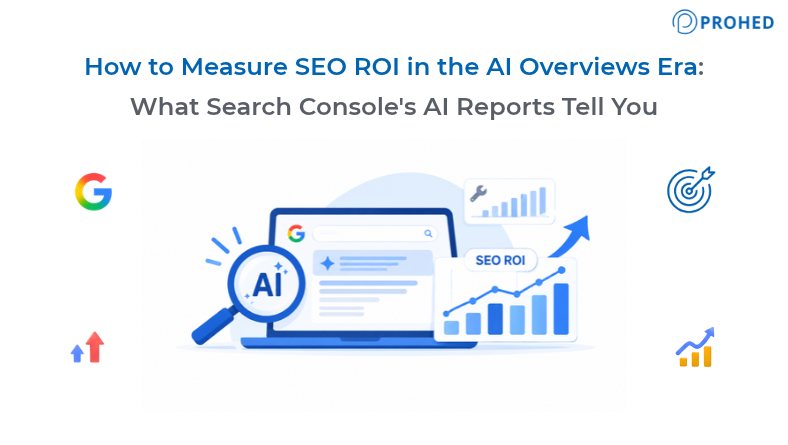
SEO ROI is the revenue and pipeline organic search brings in, set against what you spent to get it. Clicks and rankings used to be good enough proxies. They aren’t now. AI Overviews and AI Mode answer plenty of questions before anyone visits a site, so a dip in clicks doesn’t always mean lost value, and a jump in impressions doesn’t always mean growth. At PROHED, we measure SEO ROI in four layers: visibility, branded demand, assisted conversions and closed revenue.
You’ve probably lived this meeting. Impressions are up, clicks are flat, and somebody in finance asks what the SEO budget is actually buying. “It’s complicated” won’t cut it. Here’s a better answer.
What Search Console’s AI Reports Actually Show
On 3 June 2026, Google added generative AI performance reports to Search Console. One covers Search, which includes AI Overviews and AI Mode, and another covers Discover. The data begins on 18 May 2026. Nothing before that date was backfilled.
Here’s the bit people miss: it isn’t new data. Those AI impressions were already sitting inside your main Performance totals. The report just pulls them apart. Google rolled it out gradually, starting with a subset of sites, and it now reaches sites worldwide, so if it wasn’t there in June, check again.
Data point | Included at launch? |
|---|---|
Impressions in AI Overviews and AI Mode | Yes |
Pages earning those impressions | Yes |
Countries, devices and dates | Yes |
Separate Discover view | Yes |
Clicks and click-through rate | No |
Query-level data | No |
Without clicks or queries, this is a visibility signal, not a traffic source. Google may add more, so look at what your own report includes before you build anything on top of it.
Why Clicks Alone Mislead
Zero click searches have been around for years. Generative AI answers made them more common. Someone reads a summary, gets what they came for and leaves. Your page may have helped shape that answer, yet you never saw the visit.
That said, don’t pin every dip on AI. Rankings slip. Pages break. Tracking goes missing. Rule those out first, and our guide on why your organic traffic is down shows how. After that, read Search Console next to your other data, something we’ve written about in Google Search Console and social performance.
How to Calculate SEO ROI in 2026
The hard part is deciding what goes in.
Input | What goes in |
|---|---|
Revenue | Closed deals or orders where organic search was a first, last or assisted touch |
Cost | Agency or in-house fees, content production, tools and developer time |
Time window | A full sales cycle, not one month |
Two habits make these numbers far easier to defend. Pass the source and landing page into your CRM, so pipeline attribution can be traced back to organic sessions. And add a “How did you hear about us?” field to your forms, with choices like search, AI assistant and social media. Plenty of buyers now find brands inside AI answers, and standard analytics barely notices.
Build a Four-Layer View
One number can’t describe organic performance any more. Four can.
Layer | Metrics | Where to find them | Question it answers |
|---|---|---|---|
Visibility | AI impressions, standard impressions, share of search | Search Console, trend tools | Are we being seen? |
Demand | Branded search, direct visits | Search Console, GA4 | Do people remember us? |
Engagement | Assisted conversions, engaged sessions | GA4 | Does organic help the journey? |
Revenue | Pipeline attribution, closed-won revenue | CRM | Did it make money? |
Branded Search and Share of Search
When branded search grows, visibility is turning into recall. Split branded and non-branded queries in Search Console, then watch both each month.
Share of search goes a step further. It compares how often people look for you against your competitors, and it tends to move before market share does. Our post on share of search as a marketing metric for CMOs explains the method.
Assisted Conversions
Organic often introduces a buyer who converts later through another channel. GA4’s assisted conversion reports capture that early nudge. Skip them and SEO looks weaker than it is, particularly in long B2B sales cycles.
Impressions or Clicks: Which Should Lead?
Neither, really. Impressions, AI impressions included, show reach. Clicks show response. Pipeline shows value. Put pipeline first, then use the other two to explain it. When they disagree, that gap is the story to chase.
Reporting to a CFO When Clicks Fall
Finance cares about return and risk. Build the report around both.
- Start with organic revenue and pipeline, not traffic.
- Put total cost right next to it so ROI is obvious.
- Explain the click drop using AI impressions, zero click searches and ranking data.
- Show branded search growth as proof that awareness is building.
- Bring in assisted conversions to show organic’s wider influence.
- End with next quarter’s priorities, each tied to one metric.
Be straight about bad news too. If clicks fell because rankings dropped, say so and show the fix. A flattering chart costs you credibility the moment someone checks it.
Metrics That Show AI Search Visibility
No single tool covers it yet, so mix a few sources:
- AI impressions by page in Search Console
- Branded query growth after content updates
- Share of search against named competitors
- Manual checks of how your brand appears in AI Mode and other generative AI tools
- Self-reported discovery sources on lead forms
Pages that answer a question in their first few lines, under a clear heading, usually have a better shot at earning those impressions. These SEO tips help AI for SEO work and classic ranking work alike.
A 30-Day Setup Plan
- Week one: mark 18 May 2026 as your AI reporting baseline and separate branded from non-branded queries.
- Week two: confirm GA4 conversions and check that CRM records carry source and landing page.
- Week three: add a self-reported source field to every lead form.
- Week four: build a one-page monthly dashboard covering all four layers.
How PROHED Approaches SEO ROI
Traffic only counts when it reaches revenue. In our case study for A Box Of Stories, the brand reported 20% month-on-month organic traffic growth, 35% more subscriptions and 40% lower acquisition costs. Traffic, conversions and cost together: that’s what a believable SEO ROI picture needs.
Our SEO, Performance Marketing and CRO teams share reporting, so organic results sit next to paid and conversion data. Comparing SEO companies in India? Ask each one how they report revenue, not just rankings. Their answer tells you a lot.
Conclusion
Proving SEO ROI today means widening the lens. Search Console’s AI reports give you a useful view of impressions across AI Overviews and AI Mode, but they don’t replace revenue tracking. Combine visibility, branded demand, assisted conversions and pipeline data, and the conversation with leadership changes. It stops being about why clicks are down and starts being about what organic is contributing.
FAQs
1. How do you calculate SEO ROI in 2026?
Take the revenue attributed to organic search, subtract total SEO cost, divide by that cost and multiply by 100. Count assisted conversions, and measure across a full sales cycle.
2. Does Search Console show AI Overviews and AI Mode data?
Yes. The generative AI performance reports show impressions by page, country, device and date. At launch they didn’t include clicks or queries.
3. Should impressions or clicks be the main SEO KPI now?
Neither on its own. Use impressions for visibility, clicks for engagement and pipeline for the headline number.
4. How do you report SEO performance to a CFO when clicks fall?
Lead with revenue and cost. Then explain the click shift with AI impressions, branded demand and assisted conversions.
5. Which metrics show AI search visibility?
AI impressions in Search Console, branded query growth, share of search, manual checks in AI tools and self-reported discovery sources.
6. What is share of search and how is it calculated?
It’s your brand’s slice of search interest among a group of competitors. Divide your branded search volume by the combined volume for every brand in that group.
7. How long does it take to see SEO ROI?
Usually several months, and longer for complex B2B sales. Until then, watch leading signals like branded search and rankings.
8. What should SEO companies in India report each month?
Organic revenue or pipeline, cost, branded and non-branded performance, assisted conversions and AI visibility signals, plus what’s planned for next month.
Need an SEO ROI report finance will trust? Talk to PROHED’s SEO team about a measurement framework built for AI search.
Schedule a Free Strategy Call with PROHED Today