Most marketing teams can tell you exactly where leads enter their funnel. Ask where those same leads quietly vanish, and you’ll get a lot of shrugging. A lead generation funnel is the path a prospect walks, from first hearing about you to actually becoming a customer, and honestly, the real value of mapping it isn’t the pretty diagram. It’s finding the one stage where people are bleeding out. At PROHED, a lead generation marketing agency working across B2B, D2C, and high-ticket categories, we keep running into the same pattern: most “lead generation problems” turn out to be one weak stage in an otherwise decent funnel, not a system that’s broken top to bottom.
This one’s specifically about funnel architecture, building and fixing each stage. If you want the broader picture on channels, budgets, and B2B versus B2C strategy, our full lead generation guide covers that in more depth.
What a Lead Generation Funnel Actually Looks Like
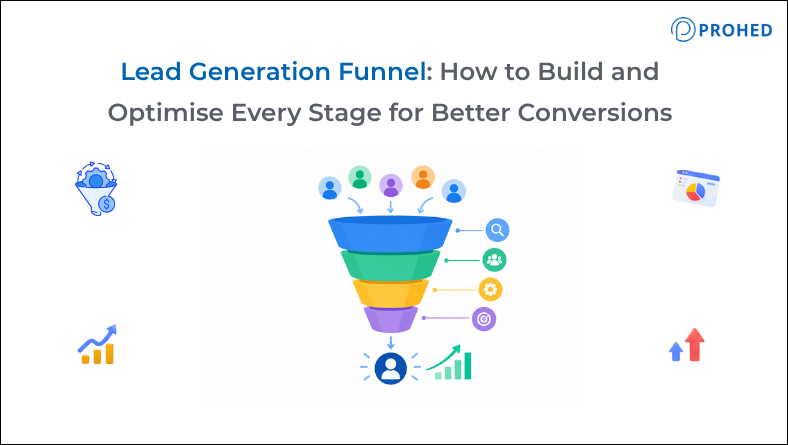
A funnel narrows on purpose. Not everyone who hears about your brand is going to buy, and that’s fine, actually. The funnel’s job is to filter and guide people along, not to convert every single person who wanders in.
A fairly standard structure:
| Stage | What’s Happening | Prospect’s Mindset |
|---|---|---|
| Awareness (TOFU) | First exposure to the brand or problem | “I didn’t know this was even an option” |
| Interest (MOFU) | Actively researching solutions | “Let me see what’s out there” |
| Consideration (MOFU) | Evaluating specific vendors | “Is this actually right for me?” |
| Intent (BOFU) | Ready to act, sorting final details | “What do I need to do next?” |
| Conversion (BOFU) | Completes the action | “Okay, I’m in” |
| Retention/Advocacy | Life after conversion | “Would I even recommend this?” |
TOFU, MOFU, and BOFU, top, middle, bottom of funnel, need genuinely different content and messaging at each stage, with different ways of measuring success too. Running the same pitch across all three is one of the most common reasons a lead conversion funnel quietly underperforms, even while individual campaigns look perfectly fine sitting on their own.
Building the Top: Awareness
Conversion isn’t the goal here. The goal is making sure the right people know you exist and actually understand the problem you’re solving for them.
What tends to work:
- Educational content answering questions people are already typing into Google, not a pitch dressed up as an article
- Broad-reach paid social for visibility, without expecting an immediate spike in conversions
- SEO-driven blog content aimed at informational search intent, which pays off slowly but keeps paying
- An organic social presence that builds familiarity long before anyone visits your website
A mistake we see constantly: judging TOFU content against conversion rate. Wrong yardstick entirely. Awareness content should be measured on reach, engagement, and whether it’s pulling in the right kind of audience, not on how many people bought something the same week.
Building the Middle: Interest and Consideration
This is where a lead generation strategy either earns real trust or quietly loses the prospect to whoever explained things better.
People at this stage are comparing, so your content needs to help them evaluate, not just sell to them louder. That means:
Comparison and educational content that’s honest about how you’re different, not the vague “why choose us” copy that could belong to literally any competitor in the category.
Case studies and real proof points. A B2B or high-ticket buyer especially needs evidence before spending more of their time on you, since a wrong choice feels riskier the more expensive or complicated the decision gets.
Lead magnets that genuinely help, a detailed guide, a calculator, a template, rather than a “download our brochure” button that gives nothing back for someone’s contact info.
Retargeting built around what someone actually did, not the same blanket message for everyone. Someone who read your pricing page needs a different follow-up than someone who skimmed one blog post once.
Building the Bottom: Intent and Conversion
By this point, the prospect knows who you are and is deciding whether to commit. The job now is clearing out friction and doubt, not generating more awareness they don’t need.
Simplify the final step. Every extra form field, every unnecessary click, every unclear next move costs you more here than anywhere earlier in the journey.
Answer the specific objections that stall a purchase. Pricing clarity, real guarantees, and social proof placed right at the decision point carry more weight here than they ever did earlier on.
Make the handoff to sales genuinely seamless, especially for B2B and high-ticket categories where a human conversation is what actually closes things. Someone who’s already engaged with three pieces of your content shouldn’t have to start from zero the moment a salesperson calls.
The Stage Most Funnels Just Skip: Nurturing
A lead nurturing funnel is what keeps prospects moving instead of quietly going cold after that first interaction. A big chunk of leads captured at any given moment just aren’t ready to buy yet, and without a real nurture sequence, they sit in the CRM until someone finally gives up and deletes them.
Effective nurture usually involves:
- Behaviour-triggered email or WhatsApp sequences that respond to what someone actually did, not a generic drip that fires off regardless of engagement
- Content that progresses gradually, moving someone from problem-awareness toward genuinely evaluating a solution over a series of touches
- Sales-ready signals baked into the sequence itself, so marketing knows exactly when to hand off a lead instead of guessing based on how many days have passed
Pearson, an EdTech and higher education client, is a decent example of what happens when nurture actually works alongside a properly built funnel. Working with PROHED, Pearson managed enrolments from 10 new countries while pulling in 45% higher qualified leads and 2.5X registrations, and that came from every stage of the funnel working together, not just from more traffic hitting the top.
Measuring the Funnel: Actually Finding Where It Breaks
You can’t fix a stage you’re not measuring on its own. Blended metrics are great at hiding exactly where the real problem sits.
| Metric | What It Reveals |
|---|---|
| Stage-to-stage conversion rate | Where prospects drop off between specific stages |
| Time in stage | Whether a stage is moving too fast or too slow for the buying cycle |
| Lead-to-opportunity rate | Whether TOFU and MOFU content is attracting the right people at all |
| MOFU-to-BOFU conversion | Whether nurture content is actually building real intent |
| Overall funnel velocity | How long the whole journey takes, first touch to close |
If leads are converting fine from TOFU to MOFU but stalling before BOFU, that’s a trust or proof-point problem, not a traffic problem at the top. Teams respond to a stalled funnel by throwing more budget at the top constantly, which just makes the existing bottleneck worse by feeding even more prospects into a stage that’s already leaking.
How to Actually Improve Lead Funnel Conversion Rates
A few fixes that consistently move the needle more than a full rebuild would:
Audit each stage transition on its own. Find the single weakest link first instead of trying to fix everything at the same time.
Match content specificity to the actual stage. Generic content at BOFU and overly salesy content at TOFU both flop, since each stage genuinely needs a different level of detail and a different kind of proof.
Shorten the path wherever you honestly can, without cutting the steps that build trust. Removing genuinely unnecessary friction helps a lot. Removing the steps that build confidence for a big-ticket purchase usually backfires badly.
Build nurture before you scale acquisition spend further. More traffic into a funnel with no nurture layer just means more leads going cold, faster, and more expensively.
How PROHED Approaches This
We map each client’s funnel stage by stage before we touch anything about campaign structure, because a channel problem and a funnel-stage problem look identical from the outside but need completely different fixes. That usually means auditing exactly where drop-off is worst between stages, building nurture sequences tied to what leads actually do rather than a fixed calendar, and setting up tracking that ties each stage back to revenue, so budget decisions follow where the funnel is genuinely leaking, not guesswork.
As a B2B digital marketing agency and lead generation partner across categories, we’ve found that fixing the single weakest stage in an existing funnel usually gets results faster than tearing the whole thing down and starting over.
Conclusion
A lead generation funnel isn’t something you build once and walk away from. It’s a working system, and each stage needs its own content, its own metrics, and its own fix when something breaks. Most funnels don’t fail everywhere at once. They fail at one specific point that’s quietly leaking prospects while the rest of the dashboard looks fine. Find that point, fix it specifically, and you’ll usually see improvement faster than any broad strategy overhaul would ever give you.
FAQs
1. What is a lead generation funnel?
It’s the path a prospect walks from first becoming aware of your brand to actually converting, typically split into awareness, consideration, and decision stages. Each stage needs its own content and messaging, which is exactly why one generic campaign rarely performs well across the whole journey.
2. What are the stages of a lead generation funnel?
Most funnels run through awareness (top), interest and consideration (middle), and intent and conversion (bottom), often followed by a retention stage. TOFU, MOFU, BOFU is the shorthand people use, and each one needs its own content strategy and success metric rather than one blended approach for everything.
3. How do you build a lead generation funnel?
Start by figuring out what a prospect needs to know or feel confident about at each stage, then build content and offers specifically for that, not the same message reused everywhere. Add a nurture layer between stages so people who aren’t ready to convert yet stay warm instead of quietly going cold.
4. How do you measure a lead generation funnel?
Track stage-to-stage conversion rates rather than just total lead volume, since a blended number hides exactly where prospects are actually dropping off. Time in stage and lead-to-opportunity rate are both useful for spotting whether one specific stage is underperforming relative to the rest.
5. How can you improve lead funnel conversion rates?
Find the single weakest stage transition first instead of trying to fix the whole funnel at once, since most conversion problems concentrate in one bottleneck. A proper nurture sequence between stages, plus matching content specificity to where the prospect actually is, usually beats just adding more top-of-funnel traffic.
6. What’s the difference between a lead generation funnel and a sales funnel?
A lead generation funnel is mostly the marketing side, attracting, nurturing, and qualifying prospects before handoff. A sales funnel typically picks up from there, covering what a sales team manages once a lead is considered qualified, though in practice the two overlap constantly, especially for high-ticket categories.
7. Why do leads stall in the middle of the funnel?
Usually it’s because middle-of-funnel content doesn’t give enough proof or comparison detail to actually move someone toward a decision, so they’re stuck evaluating with nowhere to go. It also happens when there’s no real nurture sequence in place, so someone genuinely interested just loses momentum and drifts off.
8. How long should a lead generation funnel take from first touch to conversion?
This varies wildly by category and ticket size, days for low-consideration B2C purchases, months or quarters for enterprise B2B deals. Rather than chasing some fixed benchmark, it’s more useful to track your own funnel velocity over time and dig into any stage that’s taking noticeably longer than it used to.
Want to find out exactly where your funnel is losing prospects? Talk to PROHED, a b2b digital marketing agency and lead generation partner that builds funnel strategy around your actual drop-off data, not a generic template.
Schedule a Free Strategy Call with PROHED Today