What is a full-funnel content strategy for D2C brands using AI? A full-funnel content strategy uses AI to connect awareness, consideration, and conversion content into one system, where performance data from each stage informs the next. Prohed builds these systems for D2C brands by integrating paid campaign data with organic content planning.
Most D2C brands have a content problem they don’t fully recognize yet. They’re producing more content than ever, reels, blogs, emails, ads, landing pages, and yet the conversion numbers aren’t moving the way the output would suggest they should. The top of the funnel is busy. The bottom of the funnel is leaking.
More often than not, the problem is that brands fail to connect their content. Teams create each piece in isolation, optimize it for a single platform, and hand it off to a channel team that lacks any visibility into what other channels are doing. There’s no thread running from awareness to purchase. Just a collection of assets that happen to feature the same logo. At Prohed, we’ve seen this pattern repeat across every D2C vertical we work in, beauty, Ayurveda, baby care, apparel. The content exists. The connection between it doesn’t.
Why AI Changes the Full-Funnel Equation for D2C
This is exactly where AI marketing strategy is shifting things in a meaningful way. Not because AI writes better content than humans, it doesn’t, not consistently, but because AI makes it possible to connect content across the funnel in ways that were previously too time-consuming or too data-intensive to execute at scale.
Furthermore, according to a 2024 McKinsey report, companies that use AI in their marketing operations see productivity gains of 20 to 30 percent in content workflows. For D2C brands where speed and relevance are competitive advantages, that efficiency gap compounds quickly.
Additionally, India’s D2C market is projected to reach USD 60 billion by 2027, according to IBEF and NASSCOM industry data, making it one of the fastest-growing consumer commerce categories in the world. Furthermore, HubSpot’s State of Marketing 2025 report found that 64% of marketers are already using AI tools in their content workflows, with adoption accelerating fastest in the D2C and e-commerce segment.
Across D2C clients managed by Prohed in 2025-26, brands that implemented a connected full-funnel content strategy saw three times the retention rate of those running isolated channel strategies. That pattern has repeated across every vertical we work in, beauty, Ayurveda, baby care, and apparel.
The brands winning at D2C marketing in 2026 aren’t the ones producing the most content. They’re the ones producing the most connected content, and AI is the infrastructure making that connection possible.
What a Full-Funnel Content Strategy Actually Means
The phrase “full-funnel content strategy” gets thrown around a lot. Most of the time it’s used to mean “we post on multiple channels” which isn’t the same thing at all. So before getting into where AI fits, it’s worth being honest about what the term actually means in practice.
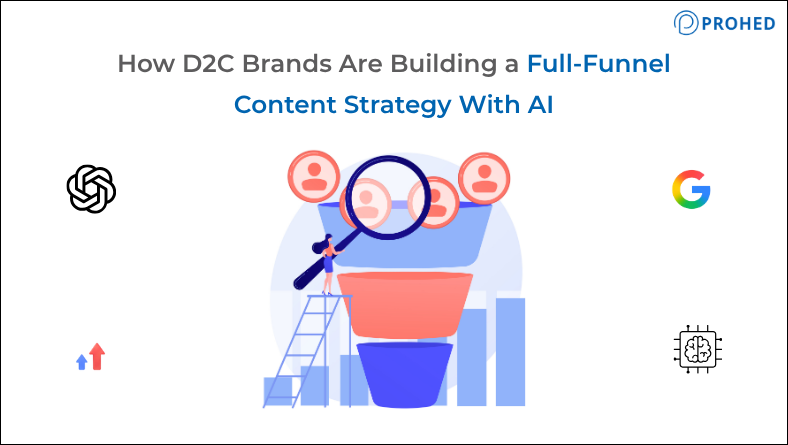
A proper marketing funnel has three stages. Each one needs content that does a completely different job, and mixing them up is one of the most common reasons D2C content spend doesn’t convert.
- Top of Funnel (Awareness): This is your first handshake. The goal isn’t a sale, it’s a lasting impression. Use short-form videos, blogs, and social content to build reach and brand recall. For example, a D2C skincare brand used AI to identify a content gap around “ingredients to avoid in moisturizers” a high-search, low-competition topic their competitors had ignored entirely. Within three months, that single content cluster was driving 4,000 monthly visitors who had never heard of the brand before.
- Middle of Funnel (Consideration): Here, prospects are deciding if you’re the right fit. Don’t go silent, this is where comparison guides, customer testimonials, and product deep dives do the work. A D2C food brand, for instance, used AI-powered email personalization to send recipe suggestions based on the flavour profiles each subscriber had previously browsed. Open rates on those sequences ran 34% above their standard newsletter. The content felt personal because it was.
- Bottom of Funnel (Conversion): Your audience is at the finish line. Skip the storytelling and focus on closing with direct content like retargeting ads, abandoned cart reminders, and specific offers. A D2C apparel brand used AI to rotate creative across abandoned cart sequences, automatically testing different product images, headline variations, and discount thresholds against different audience segments. Cart recovery improved by over 20% within the first campaign month.
Most D2C brands are reasonably good at bottom-of-funnel content. The gap is almost always in the middle, where consideration lives and where the brand either builds enough trust to earn the sale or loses the customer to a competitor that did.
How AI Is Being Used Across Each Funnel Stage
Top of Funnel: Producing at the Speed the Algorithm Demands
Social platforms in 2026 reward volume as much as quality, particularly for short-form video. Consequently, D2C brands that can produce ten variations of a creative concept in the time it used to take to produce two are at a structural advantage. AI tools like generative video editors, script assistants, and image generation platforms make that volume possible without proportionally scaling the creative team.
Instead of guessing what your audience might want to read, we use AI-powered SEO tools to pinpoint the exact questions people are asking when they first start their search. This allows us to build out “content clusters” that address those specific needs before your competitors even realize there’s a gap.
Essentially, we stop the guesswork. By generating content briefs based on real-time search intent, we ensure your top-of-funnel articles and videos reach people who are already looking for something closely related to what you offer. It’s about being helpful exactly when and where your future customers are looking for answers.
Middle of Funnel: Personalisation at Scale
This is where marketing with AI has arguably the biggest impact on a full-funnel content strategy. Personalised content, emails that reference a specific product viewed, retargeting ads that speak to the exact category a user browsed, landing pages that adapt based on the traffic source, has always outperformed generic content. The problem is that building personalised content manually doesn’t scale.
AI changes that equation. Dynamic content tools can generate personalised email sequences, ad copy variations, and landing page headlines at scale, based on behavioural signals, purchase history, and audience segment. Therefore, a brand with 50,000 customers on an email list can effectively deliver 50,000 slightly different versions of the same message, each one more relevant to its recipient than a single broadcast would be.
Moreover, AI is being used at this stage to analyse which content formats are moving people forward in the funnel and which ones are creating drop-off. That feedback loop, content performance feeding back into content strategy, is something that previously required a dedicated analyst and weeks of reporting. Now it’s available in near real-time.
Bottom of Funnel: Closing the Gap Between Content and Conversion
Funnel marketing strategy at the bottom of the funnel has always been about timing and relevance. The right message, to the right person, at the right moment. AI makes that precision achievable at a scale that human-only execution can’t match.
Specifically, AI optimizes ad creative rotation by automatically pausing underperforming variants and scaling those gaining traction. Similarly, brands personalize abandoned cart email sequences with AI-generated copy that references specific products, moving beyond generic “you forgot something” templates.
The conversion impact of these optimisations compounds. A two percent improvement in cart recovery rate, sustained across every campaign, adds up to significant revenue over a quarter.
The 3 AI Content Mistakes Killing D2C ROAS (And What to Do Instead)
Understanding how to use AI in a content strategy is valuable. Knowing what not to do is equally important, because the mistakes are common enough to be worth naming directly.
- Mistake 1: Using AI for production without using it for strategy AI can write a blog post faster than a human. That’s useful. But if the blog post is written around the wrong keyword, aimed at the wrong stage of the funnel, and published without a distribution plan, it doesn’t matter how fast it was produced. AI should inform strategy first, then accelerate production.
- Mistake 2: Treating AI-generated content as finished content Every piece of AI-generated content needs human editing before it goes live. Not because AI produces bad content, but because it produces generic content. The brand voice, the specific product knowledge, the cultural nuance, the insight that only comes from actually knowing the customer, none of that comes from the model. It has to be added by a human who understands the brand.
- Mistake 3: Optimising each funnel stage in isolation AI tools that optimise top-of-funnel content separately from middle-of-funnel content, with no data sharing between stages, replicate the same disconnected approach that caused the problem in the first place. AI adds value to a full-funnel content strategy by connecting the stages: what works at the top informs what you produce in the middle, and what converts at the bottom feeds back up to improve your targeting at the top.
What This Looks Like in Practice for a D2C Brand
A practical AI marketing strategy for a D2C brand doesn’t require a large technology budget or a dedicated AI team. In fact, most of what’s described in this article is achievable with tools that are already widely available.
The starting point is always audience intelligence. Before we brief a single piece of content, we use AI tools to identify what the target audience actually searches for, which questions keep surfacing, which formats drive engagement at each funnel stage, and where the biggest gaps in coverage exist.
From there, the content calendar gets built around funnel stages rather than around how often the team wants to post. Each piece gets assigned a specific job. Awareness, consideration, or conversion. The distribution plan is built around that job, not the other way around.
Then, as content goes live, performance data starts feeding back. What’s getting traction at the top of funnel gets amplified. What isn’t moving people further along gets pulled or reworked. The next round of content briefs is informed by what the data is showing, not by what the team thinks should work.
Over time, this loop gets tighter. Brief, produce, distribute, measure, refine, repeat. That cycle is the difference between a content strategy that builds momentum quarter over quarter and one that resets every month with no retained learning.
How Prohed Connects AI Content Strategy to Performance Marketing
At Prohed, we don’t build full-funnel content strategies in isolation from performance marketing. We design the two together, because content disconnected from campaign performance data is essentially flying blind.
Here’s what that looks like in practice. For a D2C wellness brand, our paid search data showed “ashwagandha sleep benefits” converting at three times the rate of the broader “ashwagandha benefits” keyword. That single insight moved the entire content calendar toward sleep-specific formats for two months. Organic traffic to those pages now supports the paid campaign rather than competing with it, which means the same audience intent is being captured at a fraction of the cost.
The same keyword and audience data driving our paid campaigns informs our top-of-funnel SEO and content work. We build middle-of-funnel content around the actual objections and questions surfacing in ad comments, chat conversations, and support tickets. Finally, we test, iterate, and optimize bottom-of-funnel creative using the same performance dashboard that governs our paid media decisions.
As a result, D2C brands working with Prohed don’t have a content team and a performance team operating separately. They have one connected growth system where every piece of content has a measurable role to play.
Beyond content strategy, Prohed’s full service mix covers Performance Marketing, SEO, Search Engine Marketing (SEM), Social Media Marketing, B2C Lead Generation, E-commerce Marketing, and App Install campaigns, all built to reinforce each other rather than run in parallel.
Full-Funnel AI Content vs. Channel-First Content
| Feature | Channel-First Content | Full-Funnel AI Content (Prohed) |
| Strategy | Siloed teams (Social, Email, Ads) creating content for their own platforms. | A unified intelligence layer where SEO, paid, and social data inform all content. |
| Team Focus | Optimizing for platform-specific metrics like “likes” or “open rates.” | Optimizing for the entire journey, from awareness to final conversion. |
| Consistency | Messaging often feels disconnected across different touchpoints. | Every channel reinforces the same core message, building deeper brand trust. |
| Efficiency | High waste; teams often repeat work or miss cross-channel insights. | High efficiency; AI spots gaps and scales winning ideas across the whole funnel. |
| Business Impact | Busy teams, poor conversion. High activity that doesn’t lead to sales. | Growing business. Lower acquisition costs and higher average order values. |
Channel-first content keeps teams busy. Full-funnel AI content keeps the business growing.
Final Word
AI isn’t replacing content strategy. It’s making it possible to execute the kind of full-funnel content strategy that most D2C brands have always known they should be building but never had the resources to sustain.
The brands moving fastest right now are the ones that have stopped treating content as a creative exercise and started treating it as a performance system. AI is the infrastructure. The strategy still requires human judgment, brand understanding, and a clear picture of what the funnel is actually supposed to do.
FAQs
1. What is a full-funnel content strategy?
Think of it as giving every piece of content a specific job to do, rather than just posting to fill up a calendar. Awareness content is like a handshake with new people who don’t know you yet. Consideration content is where you sit down and build real trust by showing your value. Conversion content is that final nudge that helps close the sale. Because each stage has a different goal, they all need their own unique tone, format, and way of measuring success.
2. How is AI used in D2C marketing content strategy?
We use it for three big wins: we spot “content gaps” your competitors haven’t noticed, whip up creative variations to test ideas quickly, and analyze the data to see which posts actually drive sales versus those just getting “empty” views. We move away from guesswork and use data to drive the creative process.
3. Does AI replace human content creators in D2C marketing?
Not at all. In fact, brands that try to go “all-AI” usually end up with robotic, generic content that sounds like everyone else. Think of it this way: AI handles the heavy lifting, the high volume, and the data crunching, but humans provide the soul. You still need people for the brand voice, the creative judgment calls, and that final polish that turns a rough output into something people actually enjoy reading.
4. What is the most underserved stage of the funnel for most D2C brands?
It’s the middle of the funnel, hands down. Most brands obsess over viral social posts at the top to get attention and “buy now” ads at the bottom to get the sale. But they often ignore the middle, the consideration stage, where trust is actually earned and the decision to buy is made. When you neglect this, you end up with a “leaky” funnel where potential customers lose interest right before they were ready to commit.
5. How does performance marketing connect to content strategy?
They should be best friends. The data from your paid ads, like which keywords actually make people buy or which videos hold their attention the longest, should be the blueprint for your next batch of content. When these two teams share notes, everything gets better. When they work in silos, you’re basically paying two different teams to pull a rope in opposite directions.
6. How long before a full-funnel content strategy shows results?
It’s a mix of quick wins and the long game. Paid content at the bottom of the funnel can move the needle in just a few weeks. However, the organic SEO and top-of-funnel work usually takes three to six months to really find its rhythm. You’ll see the true “compounding effect” where every stage of the funnel is feeding the next, show up clearly around the six-to-twelve-month mark.
7. What AI tools are commonly used for D2C content strategy, and what actually works?
At Prohed, we’ve learned what actually works. Jasper and Copy.ai are great for quick drafts, but they need human editing to avoid sounding robotic. For the Indian D2C market, Semrush beats Ahrefs for spotting real search intent. On the ad side, Meta and Google’s AI tools are powerful, but only if you feed them high-quality creative and solid customer data. Everyone has these tools; the real edge is knowing exactly how to use them to get results.
Schedule a Free Strategy Call with PROHED Today