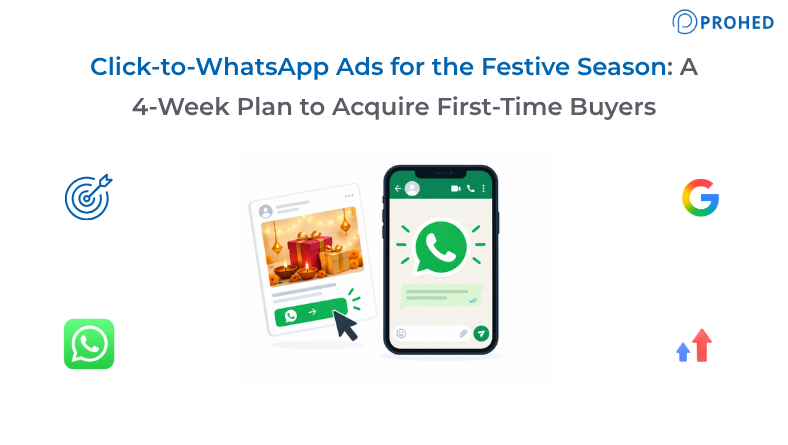
Someone clicks your Meta ad and lands in a WhatsApp chat with your business. For the next 72 hours, every message you send them is free, marketing templates included. That’s what Click to WhatsApp ads actually give you. PROHED builds festive acquisition plans around that window specifically, because turning cold traffic into a first-time buyer without the usual per-message cost is the whole point of this format.
Most brands don’t use it that way. They run the campaign, collect the chat, move on, and never think about the clock running on that free window. Which is a shame, because marketing messages in India now cost around ₹0.86 each once you’re outside it. A real 4-week festive plan looks nothing like a lazy always-on broadcast. Worth laying out why before your festive spend actually goes live.
Click-to-WhatsApp Isn’t Regular WhatsApp Marketing
A broadcast to your existing list, that’s WhatsApp marketing India in its simplest form. You’ve got the number. You’ve got consent. You hit send. Click-to-WhatsApp is a different animal entirely. It’s acquisition. It opens a chat with a total stranger, and everything about the economics changes in that first 72 hours.
Here’s Meta’s current India rate card, roughly:
| Message Type | Inside 72-Hour Window | Outside the Window |
|---|---|---|
| Marketing template | Free | ₹0.8631 per message |
| Utility (order updates, confirmations) | Free | ₹0.1150 per message |
| Service (free-form replies) | Free | Free up to 1,000/number/month, then ₹0.1150 |
Convert inside the window and your cost is basically just the ad spend. Drag past 72 hours and now you’re paying per template on top of whatever you already spent to get them there.
Why This Season, Specifically
Festive shoppers click through and ask questions before they buy. Always have. Gold, gifting, anything D2C and high-consideration, same pattern every year. A landing page can’t answer “is this the right size” or “what’s today’s gold rate.” WhatsApp can.
Three reasons this channel is worth the effort right now:
WhatsApp open rates for Indian audiences regularly cross 70%, which email just doesn’t touch, and during a short festive window you genuinely don’t have time to wait on someone checking their inbox.
A first-time buyer gets to ask something real before committing. Delivery timeline, sizing, whatever’s actually stopping them. A static ad can’t do that.
Your abandoned cart recovery lives in the same chat. Someone browses your catalogue, drops off mid-conversation, you nudge them back without sending them anywhere else.
The 4-Week Plan
Week 1: Build First, Launch Second
Don’t run ads before the backend’s ready. You need a real opt-in flow, and DPDP means genuine, purpose-specific consent at the moment someone starts chatting with you, not an assumed yes because they clicked.
Before any media spend:
- WhatsApp Business API connected, with a product catalogue that’s actually synced to real stock
- A welcome message that tells people what they signed up for and how to leave
- DPDP consent language in the first automated reply, not buried in terms nobody opens
- Auto-responses for the obvious stuff, pricing, delivery, sizing, so the window doesn’t burn waiting on a human
Week 2: Keep It Narrow
Don’t open the whole budget on day one. Two or three tight audiences is plenty, lookalikes off your best customers, interest targeting for the category, a retargeting slice of people who engaged on Meta but never bought.
Watch one number closely. Not clicks. How many of those clicks turn into an actual started conversation. A gap between the two, clicks up, conversations flat, usually means the ad’s promising something the first message doesn’t deliver on.
Week 3: Fix the Conversation
By now there’s enough data to see where people stall out inside the 72 hours. This is where the advantage quietly disappears for most brands.
Same three questions keep coming up? Build the answers into the auto-flow. Don’t make people wait for a human. Catalogue browse not turning into purchase? Nudge them inside the free window, not with a paid template two days later when the moment’s passed. And move budget toward whatever audience is actually converting in the window, not whichever one’s just generating clicks.
Week 4: Switch Gears
You’ve got a real list now, first-time buyers who opted in through the festive push. Time to move WhatsApp Business API campaigns out of acquisition and into something that looks more like care, post-purchase instructions, reorder nudges if it’s a consumable, maybe a loyalty push if it’s not.
Be straight with yourself about messaging tiers here. Everyone outside that original 72 hours costs you per message now. Segment by actual intent before you broadcast the same thing at your whole list.
How PROHED Approaches Festive WhatsApp Campaigns
The 72-hour window is the planning unit, not an afterthought bolted on. That means pairing Meta targeting with a conversational flow that actually responds, watching conversation-start rate as hard as click-through, and getting consent capture right the first time, which matters a lot more with DPDP enforcement rolling out through 2026 and 2027.
For ecommerce and D2C clients, this sits inside the broader full-funnel digital marketing work we do year-round. The WhatsApp data feeds back into retargeting and retention everywhere else.
Conclusion
Plan around the free 72 hours, or don’t bother treating WhatsApp as anything more than a broadcast list. Build the opt-in flow and catalogue before you spend a rupee, keep the first audiences narrow, fix the stalls before scaling, then switch cleanly to retention once the push is over. The brands actually getting something from this channel are watching conversation starts, not clicks.
FAQs
1. What are Click-to-WhatsApp ads, and how are they different from regular WhatsApp Business messaging?
A Click-to-WhatsApp ad opens a chat when someone clicks it, and that starts a 72-hour window where every message is free. A regular broadcast to your existing list doesn’t get that free window unless the conversation itself started through an ad or Page CTA.
2. How much do WhatsApp marketing messages cost in India after the free window closes?
On Meta’s October 2026 rate card, marketing template messages run ₹0.8631 per delivered message in India, with no volume discount at any scale. Utility and authentication messages are cheaper at ₹0.1150 each and do get volume discounts, but only once you’re sending a genuinely high monthly volume.
3. Is consent required before messaging someone through Click-to-WhatsApp ads?
Yes. A click isn’t ongoing consent under DPDP, so your welcome sequence needs real, purpose-specific opt-in. Build this properly now, DPDP enforcement is phasing in through 2026 and 2027, and rebuilding it later under pressure is worse.
4. How long is the free messaging window after someone clicks a Click-to-WhatsApp ad?
72 hours from when the chat starts. Every message type is free in that window. After it closes, standard rates apply by category.
5. What’s a good conversation-start rate to aim for from Click-to-WhatsApp ads?
No universal number, it depends on category and targeting. What matters is tracking it separately from click-through rate. A big gap between the two usually means the ad and the first message aren’t saying the same thing.
6. Can Click-to-WhatsApp ads work for high-ticket or considered-purchase categories, not just D2C impulse buys?
Yes, often better. The conversational format lets someone ask a real question before committing, which a landing page can’t offer. Jewellery, real estate, premium services tend to see stronger engagement here than low-consideration impulse categories.
7. How should brands handle first-time buyers after the 72-hour free window ends?
Segment by actual intent before sending more templates, since every message now costs something. A structured sequence, order updates, reorder nudges, loyalty pushes, beats broadcasting the same promo to everyone equally.
8. Do Click-to-WhatsApp ads work better than a standard landing page for festive campaigns?
When buyers typically have questions before purchasing, yes, the conversation resolves hesitation in real time instead of losing them to an unanswered question. For a simple, single-offer purchase, a plain landing page still holds up fine.
Want a festive WhatsApp plan built around converting inside the free window? Bring your Click-to-WhatsApp campaign to PROHED and we’ll map the 4 weeks against your catalogue.
Schedule a Free Strategy Call with PROHED Today