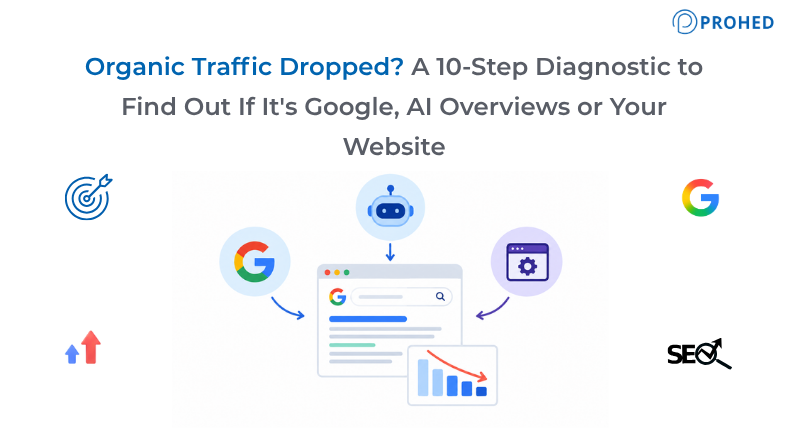
Organic traffic falls for three genuinely different reasons. Google changed something. AI Overviews grabbed the click before it reached you. Or your own site broke somewhere. Each needs a completely different response, and PROHED built this 10-step diagnostic to figure out which one you’re actually looking at before anyone touches anything.
Here’s where most teams go wrong. Traffic drops, and the first instinct is “we got hit” or “rankings fell,” without ever checking which of the three it is. We’ve already written the deep-dives, on recovering from a Google Core Update, on unconfirmed ranking volatility, on technical SEO fixes. This is the step before any of those. Ten checks, then you’ll know where to go.
Step 1: Check Search Console Before Anything Else
Pull up the Performance report. Look at impressions next to clicks, not clicks alone. This one check splits the whole problem in two.
Both dropped together? Something shifted in how Google ranks or indexes you. Impressions steady, clicks down? The ranking’s probably fine. Something else is eating the click.
Step 2: Separate Impressions vs Clicks Properly
Impressions vs clicks is the single most useful comparison here, and almost nobody actually does it.
Both down together: visibility problem, likely Google-side. Impressions flat, clicks down: something’s intercepting the click, almost certainly AI Overviews traffic loss. Impressions down, clicks flat or even up: you’re ranking for fewer queries but converting what’s left. Often not a crisis at all.
Step 3: Check Whether a Confirmed Google Update Lines Up With the Timing
Check your drop date against Google’s confirmed rollout dates. A close match means you’re probably looking at a recover from Google core update scenario, and our breakdown covers what to actually do about it.
No confirmed update near your date? Don’t relax yet. Keep going.
Step 4: Look at Query-Level Changes, Not Just Overall Traffic
Pull your top 20-30 queries and check whether they’re still showing similar impression volumes. A broad drop across unrelated queries points to a site-wide signal problem. A drop concentrated in informational, definition-style queries points toward AI Overviews eating that particular intent specifically.
Step 5: Check Which SERP Features Now Appear on Your Key Queries
Manually search your 10 most important queries. Note what’s sitting above the organic results that wasn’t there before. AI Overviews, a bigger featured snippet, an expanded “People Also Ask,” any of these mean your position probably hasn’t moved. The real estate above it got more crowded instead.
Step 6: Audit Indexation Status
Indexation issues are quick to rule out and constantly ignored anyway. Run URL Inspection on your important pages and look for:
Pages that say “Crawled, not indexed” but used to rank fine. A sudden jump in “Discovered, not indexed.” Sitemap errors nobody’s caught yet.
A deindexing problem looks exactly like a ranking drop on the surface. The fix is nothing alike.
Step 7: Check for Technical Regressions Since the Drop
Compare Core Web Vitals and site speed before and after the drop. A deployment, a plugin update, a hosting switch around that window, these get missed constantly because they feel too boring to be the actual cause. They’re usually the easiest fix on this whole list.
Step 8: Review GA4 Channel Grouping for Misattribution
GA4 channel grouping changes can make traffic look gone when it’s just being counted somewhere else now. Check whether a config change reclassified organic search, whether AI tool referrals (ChatGPT, Perplexity) are landing in Direct or Unassigned instead of being tracked properly, or whether cross-domain tracking broke somewhere in a checkout flow.
Step 9: Check Competitor Movement on the Same Queries
Rankings are relative, always have been. Run your key queries and see if a competitor moved into spots you used to hold. If so, this might not be a penalty against you at all. Someone else just moved faster. That’s a different fix entirely, out-execute them, not recover from a hit.
Step 10: Decide Which Deep-Dive You Actually Need
| If You Found… | The Actual Problem | Where to Go Next |
|---|---|---|
| Impressions and clicks both down, timing matches an update | Algorithmic ranking change | Core Update recovery framework |
| Impressions flat, clicks down, AI Overviews visible on your queries | Zero-click absorption | AI Overviews-specific diagnosis |
| No confirmed update, no clear pattern | Likely ranking volatility or data refresh | Ranking volatility framework |
| Pages not indexing, Core Web Vitals regressed | Technical issue | Technical SEO checklist |
How PROHED Approaches Organic Traffic Diagnosis
We run this exact sequence before recommending anything, because treating every drop the same way wastes time and sometimes makes things worse. Khoya Mithai and Motozite both started here, diagnosis first, work second, which is partly why the growth that followed, 115% and a doubled traffic number respectively, actually stuck instead of sliding back.
As one of the digital marketing agencies in Gurugram that treats SEO as diagnosis before it’s creative work, we rule out the boring, fixable stuff first. A technical fix is almost always faster than waiting out an algorithm.
Conclusion
There’s rarely one cause behind a traffic drop, and guessing wrong burns weeks on a fix that was never going to work. Start with impressions versus clicks in Search Console, work through indexation and technical checks, then decide whether you’re actually dealing with Google, AI Overviews, or your own site. Once you know which, the right deep-dive has the real steps.
FAQs
1. Why is my website traffic dropping even though my rankings look the same?
Probably AI Overviews or another SERP feature now sitting above your result for that query, grabbing the click first. Check Search Console. Flat impressions, falling clicks, that’s the pattern.
2. How do I know if a Google core update caused my traffic drop?
Line up your drop date against Google’s confirmed rollout dates. Close match, drop across many pages at once, that’s your update.
3. What’s the difference between an SEO traffic decline and normal seasonal fluctuation?
Seasonal dips follow a pattern you’ve seen before and bounce back within weeks on their own. A real decline hits sharper, doesn’t match any known seasonal shape, and sticks around.
4. Can indexation issues cause a sudden traffic drop without any ranking change?
Yes. Pages that get deindexed stop showing up at all, no matter how well they’d otherwise rank. Looks identical to a ranking drop until you actually check Search Console directly.
5. How much organic traffic loss is typically attributed to AI Overviews?
Varies a lot by query type. Informational, definition-style queries lose the most clicks. Transactional, specific queries hold up better since people still need to visit a site to finish whatever they’re doing.
6. Should I change my content strategy if AI Overviews are taking my clicks?
Often, yes. Content built to earn citation inside AI answers matters more as this grows. Not instead of SEO, alongside it.
7. How long does it typically take to recover from a confirmed Google core update?
Weeks to a few months, depending how thoroughly you fix the underlying issue. Partial bounces during the rollout itself happen and don’t always predict the final result.
8. Can a GA4 configuration issue make organic traffic look like it dropped when it actually didn’t?
Yes. A channel grouping change or broken cross-domain tracking can make traffic look gone when it’s just sitting under Direct or Unassigned instead. Check recent GA4 changes against your drop date before assuming the worst.
Not sure why your organic traffic dropped? Get a diagnostic audit from PROHED, a digital marketing agency in India for growth, and we’ll tell you whether it’s Google, AI Overviews, or something on your own site.
Schedule a Free Strategy Call with PROHED Today