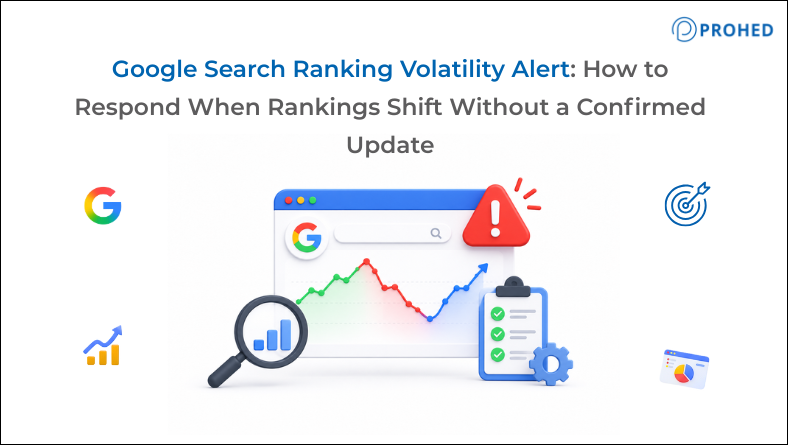
Google search ranking volatility refers to unexplained drops or shifts in your website’s positions without a confirmed algorithm update. It is one of SEO’s most frustrating challenges because you face sudden traffic dips without a clear announcement from Google. As a performance marketing agency in Gurgaon, Prohed helps brands navigate these shifts by diagnosing the root cause first, ensuring you don’t waste time on panic-driven fixes.
Rankings dropped. Nobody announced anything.
You’ve checked Search Engine Roundtable. You’ve searched for a google search update. Nothing confirmed. No chatter from Google. And yet the data clearly shows something has changed.
This is the scenario that trips up even experienced SEO teams. Confirmed updates come with context. Unconfirmed volatility comes with almost none. And the instinct to do something, anything, quickly is precisely what tends to make things worse.
The first and most important decision is whether this volatility is your problem to fix, or Google’s fluctuation to wait out.
Why Unconfirmed Volatility Happens More Than Most Teams Realize
Google makes thousands of changes to its ranking systems every year. The vast majority are never publicly announced. Only the larger, clearly significant updates receive formal confirmation through channels like the Google Search Status Dashboard or statements from Google’s Search Liaison.
Everything else happens quietly.
Google search ranking fluctuations that aren’t tied to a confirmed update typically fall into one of four categories:
- Infrastructure-side changes: Google runs unknown ranking changes to portions of its index before making them general. You could experience a ranking change because you’re in a test group, not because your site is in trouble, and the change will often fix itself.
- Data refreshes: Search engine ranking changes that occur during data refreshes are not a new algorithmic insight; they are more accurately a re-assessment of existing signals such as backlinks, Core Web Vitals and content quality evaluation.
- Competitor movement: Rankings are relative. If a competitor has published stronger content, earned new backlinks, or improved their technical setup recently, your seo ranking can drop even if nothing on your site has changed. This is one of the most underdiagnosed causes of apparent volatility.
- SERP feature expansion: Google’s tendency to feature AI Overviews, featured snippets, People Also Ask etc more often is pushing organized results further down the SERP page. A classic rank 3 can be getting significantly less traffic now than it was 6-months-ago (or even 1-year-ago) if a new SERP feature shows up above it). This looks like a ranking problem but it is really a visibility problem with a different solution.
Understanding which category applies before taking any action is the difference between a measured response and a reactive one that creates new problems.
The PROHED Volatility Diagnosis Framework
At PROHED, we run every instance of unexplained google search ranking movement through a structured diagnosis before recommending any response. The PROHED Volatility Diagnosis Framework covers four questions in sequence.
Question 1: Is the Volatility Site-Wide or Isolated?
Pull Google Search Console data at the URL level and filter by the affected time period.
If impressions and clicks have fallen during a period across many of your pages, the drop is more likely algorithmic or data refresh or infrastructure test. If impressions and clicks have fallen during a period on a few URLs or a topic cluster, the drop is more likely content or competitor upgrade or technology issue against those few URLs.
Also cross-reference via third-party volatility trackers such as Semrush Sensor, MozCast, or Algoroo. If google is highly volatile in google rankings at an industry level in that period of time, the movement is more likely Google side and not a site issue.
Question 2: Did Anything Change on the Site?
Check what changed on the site in the 2 to 4 weeks before the volatility emerged. Any content changes, URL structure changes, redirects added, CMS updates, plugin changes, robots.txt changes all deserve a look.
It can be a simple change to content that causes a google ranking check recalculation on certain pages. In addition, technical changes that may look unrelated to SEO such as a site speed optimisation that causes JavaScript to load asynchronously can impact how Google crawls and indexes certain pages.
If no changes were made to the site and there is broad industry volatility in the same time period, the diagnosis is almost certainly the Google-side. To wait and watch is usually the answer.
Question 3: Who Has Taken Your Positions?
Search the keywords where rankings have dropped and note which URLs are now occupying the positions your site held previously.
If a direct competitor has moved up, assess what changed on their site recently. New content? Stronger internal linking? Recent backlink gains visible in Ahrefs or Semrush? This diagnosis points toward a competitive response strategy rather than a site fix.
If a SERP feature has appeared where organic results previously sat, the response is structural: optimise affected pages for featured snippet eligibility, structured FAQ content, and schema markup that increases the chance of appearing within the feature rather than below it.
If a completely unrelated domain has taken the position, that points more toward an algorithmic re-evaluation of topical relevance or content quality on the affected pages.
Question 4: Is the Drop in Impressions, Clicks, or Both?
The distinction matters significantly for diagnosis.
Impressions falling alongside clicks indicates the pages are being seen less frequently, pointing toward a ranking drop or index coverage issue. Impressions holding steady while clicks fall indicates the pages are still ranking but generating less engagement, which often signals a SERP feature absorbing clicks or ad placements consuming more visible real estate.
Improve your google search ranking strategy differs depending on which of these is true. A click-through rate problem and a ranking problem have different root causes and different fixes.
Related Read: Why Your Organic Traffic Is Down But Your Revenue From Search Is Up: The New SEO Paradox
What to Actually Do When Rankings Drop
Once the diagnosis is clear, the response becomes much more specific.
- If the cause is Google-side volatility: Give it 10-14 days before you touch anything. Stripping apart your content or site structure during an algorithmic test is usually a recipe for disaster that kills your recovery. Just log the dip, keep up your publishing schedule, and don’t panic-tweak temporary fluctuations.
- If the cause is a competitor moving up: Run a quick content gap analysis on the pages that fell. Look for gaps where competitor’s page is newer, well-structured, exhaustive, or internally well-optimized. Just close the gaps with targeted updates, don’t waste time brown-patching a full page rewrite.
- If the cause is a SERP feature expanding: Restructure your page so Google views it as the perfect source for that feature. Add clean FAQ schema, optimize your text for direct answer blocks, and sharpen your heading hierarchy so you can claim the feature position instead of sitting beneath it.
- If a recent site update broke something: Roll back the technical change immediately to see if your rankings bounce back. Should the update be permanent and mandatory, audit the implementation with a fine-tooth comb to catch and fix any unintended SEO side effects before pushing it live again.
- If the cause is a content quality issue flagged by a quiet refresh: Audit your sliding pages against Google’s helpful content guidelines. Look for thin copy, high bounce rates, or pages that attract the wrong search intent. To fix them, inject real depth, like original data or unique insights, and format the layout to give users fast, direct answers.
The Google AI Search Layer That’s Changing Volatility Patterns
There’s a newer dimension to google search ranking volatility that didn’t exist two years ago.
Google AI search features, particularly AI Overviews, have introduced a new source of impression and click movement that isn’t always reflected in traditional ranking data. A page can hold its position in standard organic results while simultaneously losing significant traffic because an AI Overview is now appearing for the same query and resolving it without a click.
This pattern looks like a ranking problem in traffic reports but doesn’t show up as a position change in Search Console. Consequently, teams diagnose it incorrectly and look for a ranking fix when the actual issue is AI visibility.
The right response here is not to chase the website ranking number but to optimise content for AI citation eligibility through direct answer blocks, named frameworks, original data, and structured FAQ sections with schema markup. Content that earns citation within AI Overviews recovers brand visibility even on queries where the organic click is no longer happening at the same rate.
At Prohed, this kind of layered diagnosis, separating traditional search engine ranking movement from AI Overview absorption, is now standard in every client performance review. It connects directly to our SEO, Performance Marketing, Content Strategy, and E-commerce Marketing work because a google search ranking problem that’s actually an AI visibility problem requires a content solution, not a technical one.
Conclusion
Unconfirmed google search ranking volatility is genuinely harder to navigate than a confirmed algorithm update. With a confirmed google core update, there’s at least a framework for response. Without one, the risk is reacting to noise, making changes that aren’t warranted, and creating instability in a site that might have recovered on its own.
The right sequence is always: diagnose first, identify whether the problem is Google-side or site-side, understand who has taken positions and why, separate ranking drops from AI Overview absorption, and then respond specifically to the actual cause.
Brands that build this diagnostic discipline into their regular SEO workflow handle volatility significantly better than those who respond to every movement with site-wide changes.
If your team needs support diagnosing a sudden ranking drop or building a monitoring process, Prohed can help. As an experienced provider of SEO services in Gurgaon, we treat every ranking movement as a diagnostic question before a strategic one. Our team works alongside brands as one of the proactive digital marketing agencies in Gurugram, building search strategies around long-term stability rather than reactive, volatile fixes.
Frequently Asked Questions
1. What is Google search ranking volatility?
Volatility in Google search ranking refers to a meaningful, unexplained move in the position of a website in search results without an identified algorithm update. This could be caused by Google-side infrastructure or data refreshes, competitor movement, SERP feature expansion, or site-side change. Identifying the cause informs how to react.
2. How do I know if a ranking drop is caused by a Google update or a site issue?
Consider 3rd party volatility trackers such as Semrush Sensor, MozCast, or Algoroo. If these indicate broad industry-wide volatility in the same period, it’s likely Google-side. If rankings have fallen on only specific URLs and volatility tools exhibit no broad volatility, try to identify recent site changes, competitor movement or technical issues.
3. Should I make changes to my site immediately when rankings drop?
Not always. If the cause appears to be Google-side volatility or an algorithm test, waiting 10 to 14 days before making significant changes is often the right approach. Reactive changes during a volatility period can interfere with natural recovery and create additional instability.
4. Why have my impressions stayed the same but my clicks dropped?
This pattern typically indicates a SERP feature, such as an AI Overview, featured snippet, or People Also Ask box, has appeared for the query and is absorbing clicks before users reach organic results. It’s a visibility problem rather than a ranking problem and requires optimising for the feature itself rather than chasing position improvements.
5. How do Google AI Overviews affect search ranking volatility?
AI Overviews can remove clicks from a page but not affect its ranking. This means a page can drop in clicks but stay in the same organic position; the AI Answer that resolves the query shows at the top of the results page. A page can be optimised to be AI-cited by adding a direct answer block, schema structured FAQ, or some other data optimisation.
6. What tools should I use to monitor Google search ranking fluctuations?
Search Console is the first required to see URL-level impression and click data. Semrush, Ahrefs, and Moz are good for keyword position and backlink monitoring. Semrush Sensor, MozCast, and Algoroo are great for market volatility. Communications from Google Search Liaison and the Search Status Dashboard are definitive signals of major changes.
7. How long does it take to recover from a Google ranking drop?
Recovery time depends on the cause. Site-side issues, once fixed, often show improvement in Search Console within 2 to 4 weeks. Algorithm-related drops tied to content quality can take 1 to 3 months after improvements are made. Drops caused by competitor movement require ongoing content and authority improvements rather than a single fix.
8. How does Prohed help brands respond to unexplained ranking volatility?
Prohed runs the Prohed Volatility Diagnosis Framework on any significant ranking movement, determining if the root cause is Google-side, competitor-driven, technical, or AI Overview-related, prior to making any recommendation to act. By diagnosing first, Prohed keeps us from making reactive changes that exacerbate instability, and helps us address the underlying cause instead of merely treating the symptom.
Are your Google search rankings shifting without a clear explanation? Prohed can run a structured volatility diagnosis and identify exactly what’s causing the movement before recommending any changes.
Schedule a Free Strategy Call with PROHED Today