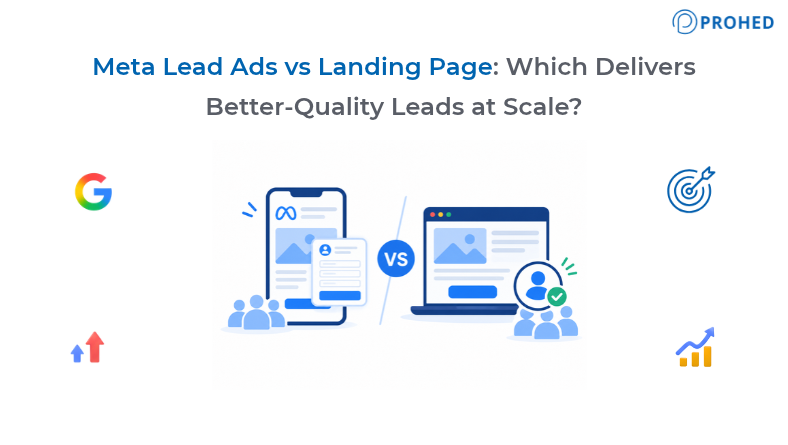
Meta lead ads tend to deliver more leads at a lower cost, while landing pages tend to deliver better-qualified ones. PROHED, a performance marketing agency in Gurgaon, explains how to choose, and how to get quality from either format.
Your Meta dashboard shows 400 leads at a record-low cost. Your sales team says half the phone numbers are dead. That’s the lead ad trap, and it’s why the question isn’t only which format to pick. It’s what you tell Meta to chase.
Key takeaways
- Instant forms win on volume, speed and cost per lead. Landing pages win on intent and context.
- Low quality is usually a setup problem you can fix, not a format flaw.
- The biggest lever is sending CRM outcomes back to Meta.
- Judge both formats on cost per qualified lead and cost per sale, never cost per lead alone.
Meta Lead Ads vs Landing Page: The Short Answer
| Factor | Meta lead ads (instant forms) | Landing page |
|---|---|---|
| Cost per lead | Usually lower | Usually higher |
| Lead volume | Higher | Lower |
| Intent | Mixed, one-tap submissions | Higher, people choose to click through |
| Friction | Very low | Higher |
| Context before the form | Limited | Full page, proof and price |
| Tracking | Inside Meta | Pixel and Conversions API on your site |
| Best for | Quick enquiries, local services, events | High-ticket, B2B, complex offers |
Neither wins every time. A low-ticket offer with fast follow-up often does better with instant forms. A complex or expensive offer usually needs a page that explains it.
Why Instant Form Leads Often Have Lower Quality?
- Pre-filled details: Meta fills in name, email and phone from the profile, so a stray tap becomes a lead.
- Little context: People often haven’t seen your price, proof or terms before they submit.
- The default goal: Standard lead campaigns optimise for submitted forms, regardless of quality.
- Dead or wrong numbers: Without verification, some contact details never connect.
- Slow follow-up: A lead that waits hours has often forgotten the ad.
How to Improve Lead Quality on Meta Lead Ads?
- Use the Higher Intent form type: It adds a review step before submission. Expect fewer leads and judge it on cost per qualified lead.
- Add one or two qualifying questions: Budget, timeline or service type work well as multiple-choice.
- Use conditional logic: Send answers that clearly don’t fit to a closing screen.
- Verify phone numbers: Meta’s form settings offer one-time passcode verification, which helps catch fake numbers.
- Be upfront about price: A price or range in the ad filters out browsers.
- Follow up in minutes: Our guide on why leads don’t convert into sales shows how much speed matters, and a quick WhatsApp message works well in India.
How to Make Landing Pages Deliver Better Leads?
A landing page only wins if it’s good. Load fast on mobile, match the ad’s promise, ask for the minimum, and show proof near the form. Offer a call or WhatsApp option for people who dislike forms. Our conversion rate benchmarks show what to aim for.
Also check the tracking. Pixel and Conversions API events should fire once per lead, or Meta learns from bad data.
How to Send CRM Outcomes Back to Meta to Improve Lead Quality?
Meta’s Conversion Leads goal optimises for leads that reach a stage in your CRM, such as qualified or appointment booked, not just form submissions. It’s the same idea as our guide on connecting your CRM to Google Ads, applied to Meta.
- Define stages: For example: new, qualified, appointment, won.
- Store the lead ID: Save Meta’s lead ID with each record in your CRM.
- Send stage changes: Pass updates to Meta through the Conversions API for CRM, via a CRM connector or integration tool.
- Choose the goal: Pick Conversion Leads when you set up the campaign in Meta Ads Manager.
- Give it time: Reports of Meta’s requirements say it works with instant forms, needs around 200 leads a month, and takes about a month to learn. Confirm current rules in Meta’s Help Center.
Should You Run Both in One Campaign?
Run both formats, but keep them in separate campaigns or ad sets with the same audience and creative. Mixing them inside one ad set muddies the data.
Compare after three to four weeks on cost per qualified lead and cost per sale. A hybrid also works well: a Higher Intent instant form, a qualifying question, then a thank-you screen that offers a call or WhatsApp chat.
| Choose lead ads when | Choose a landing page when |
|---|---|
| The offer is simple or low-ticket | The offer is expensive or complex |
| You can call back within minutes | Buyers need proof and detail first |
| You serve a local area | You sell B2B or high-consideration products |
| You have CRM data to feed back | Instant form quality stays poor after fixes |
How to Measure Whether Your Leads Are Actually Better?
| Metric | What it tells you |
|---|---|
| Cost per lead | How cheaply you collect contacts |
| Cost per qualified lead | How cheaply you find real prospects |
| Lead-to-sale rate | Whether leads convert |
| Time to first contact | Whether your team acts fast |
| Cost per sale | Whether the channel pays off |
Each metric belongs to a stage in your funnel, which our guide on lead generation funnel optimisation walks through.
How PROHED Runs Meta Lead Generation Campaigns?
Our co-founder is a Facebook Blueprint Lead Ads Trainer, and Meta lead generation is core to how we work. We build campaigns around qualified leads and sales, connect the CRM before scaling spend, and test lead ads against landing pages in separate ad sets. Our EdTech work for Pearson, for example, delivered 45% higher qualified leads and 2.5x registrations. That’s a lead-quality-first result across channels, not a Meta lead ads number alone.
Conclusion
Neither format wins on its own. Instant forms give you volume, landing pages give you intent, and the real gains come from verification, qualifying questions and CRM feedback. Test both, measure cost per sale, and let Meta learn from the leads that actually buy.
If you’re looking for a digital marketing agency in Gurgaon to fix lead quality on Meta, PROHED is built for this brief. As a performance marketing agency in Gurgaon, we run Meta Ads, Google Ads, landing pages and CRM tracking together for D2C, ecommerce and B2B brands, with digital marketing services reported against sales, not cost per lead.
FAQs
1. Do Meta lead ads or landing pages produce better leads?
Landing pages usually produce better-qualified leads, and lead ads usually produce more of them at a lower cost. With Higher Intent forms and CRM feedback, instant forms can close much of the quality gap.
2. Why do instant form leads often have lower quality?
Forms pre-fill details and take one tap, so accidental and low-intent submissions get through. The default goal also rewards submissions, not buyers.
3. How can you improve lead quality on Meta lead ads?
Use the Higher Intent form type, add qualifying questions, verify phone numbers and call back within minutes. Then optimise toward CRM outcomes instead of raw form submissions.
4. Should you run both formats in one campaign?
Run both, but in separate campaigns or ad sets with matching audiences and creative. Compare them on cost per qualified lead and cost per sale after three to four weeks.
5. How do you send CRM outcomes back to Meta to improve lead quality?
Store Meta’s lead ID in your CRM, then send stage changes such as qualified or booked back through the Conversions API for CRM. Choose the Conversion Leads goal so Meta learns which leads progress.
6. How many leads do I need before Meta can optimise for CRM outcomes?
Reports of Meta’s documentation suggest around 200 leads a month, with your chosen stage reached by a share of leads within 28 days. Rules change, so check Meta’s Help Center.
Getting plenty of Meta leads that never buy? Book a lead quality review with PROHED and we’ll show you where your funnel leaks.
Schedule a Free Strategy Call with PROHED Today