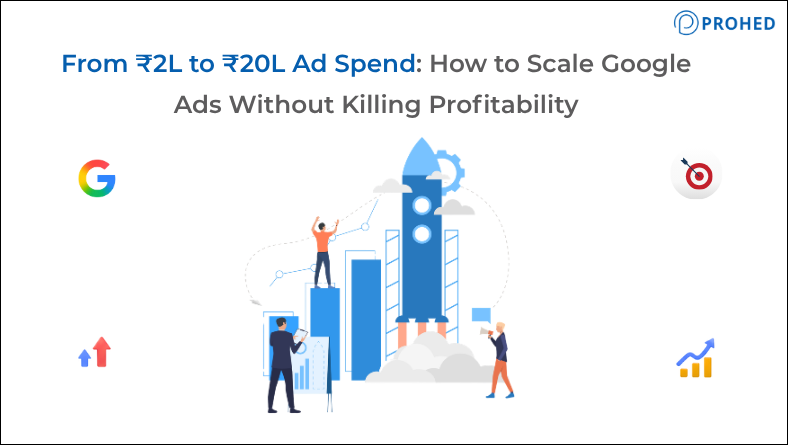
Scaling Google Ads feels straightforward on paper. More budget in, more results out. If ₹2 lakhs is generating decent returns, surely ₹20 lakhs will generate ten times the results.
It rarely works that way.
What actually happens is this. The budget goes up, the campaigns start spending faster, and somewhere between ₹5L and ₹8L of monthly ad spend, the numbers start looking different. CPCs climb. Conversion rates dip. The ROAS that looked comfortable at ₹2L starts compressing at ₹10L, and by ₹20L the whole account feels like it’s working harder for worse results.
This isn’t a Google Ads problem. It’s a scaling strategy problem. And it’s one of the most common places growing brands lose money, not because they’re doing something obviously wrong, but because they’re doing the right things in the wrong order at the wrong pace.
Here’s how to scale Google ad spend from ₹2L to ₹20L without handing profitability back to the platform in the process.
The Scale Trap: Why “More Money” Often Means “Less Profit”
Spending Tier | The Symptom | The Brutal Reality |
₹2L – ₹5L | CPCs start creeping up. | You’ve exhausted the “cheap” clicks. To spend more, the algorithm has to bid more aggressively to win the same eyeballs. |
₹5L – ₹8L | Conversion rate takes a hit. | You’re moving from “hot” audiences to “lukewarm” ones. You’re reaching more people, but they don’t know you as well yet. |
₹8L – ₹12L | ROAS starts to shrink. | Your current setup is officially “maxed out.” The structure that worked at ₹2L is now leaking cash because it wasn’t built for this volume. |
₹12L+ | Profitability falls off a cliff. | You’re now paying for “impressions” rather than “intent.” The budget is moving faster than the algorithm can find actual buyers. |
Understanding why scaling breaks things is the first step to scaling without breaking them.
Step 1: Audit the Foundation Before Touching the Budget
The single biggest mistake made when scaling a Google Ads account is increasing ad spend before verifying that the foundation is solid enough to support it.
A Google ads account running on a ₹2L monthly budget can hide a lot of structural problems. Keyword overlap between campaigns. Broad match terms eating into budget without converting. Landing pages with friction that doesn’t show up at low volume. Conversion tracking set up correctly in theory but firing inaccurately in practice.
At ₹2L, these problems exist but their impact is manageable. At ₹15L, the same problems get amplified proportionally. Every structural inefficiency costs ten times more simply because ten times more budget is flowing through it.
Therefore, before scaling ad spend, a proper account audit is necessary. Specifically, this means checking conversion tracking accuracy first, not last. If the data Google’s algorithm is learning from is wrong, every scaling decision made from that point forward is built on a false foundation. Bidding strategies, audience signals, campaign optimisation, all of it depends on clean conversion data.
Additionally, keyword structure needs reviewing. Campaigns that worked efficiently at lower budgets often have underlying keyword conflicts that only become expensive at scale. Broad match terms that were converting at low volume may start pulling irrelevant traffic when daily budgets increase. Consequently, negative keyword lists need to be thorough before the budget goes up, not after the wasted spend shows up in reports.
Step 2: Scale in Stages, Not in One Move
Doubling or tripling a Google ads account budget in one step is one of the most reliable ways to trigger the learning phase across multiple campaigns simultaneously. When that happens, performance becomes unpredictable for two to three weeks while the algorithm readjusts. During that readjustment period, ad spend is being consumed at the new higher rate while results remain uncertain.
The recommended approach is incremental scaling: increasing ad spend by 15 to 20 percent every seven to ten days rather than making large jumps. This keeps most campaigns out of the learning phase while still moving the overall budget meaningfully upward over a four to six week period.
Furthermore, not all campaigns should be scaled at the same rate. The scaling order matters significantly. Campaigns with the strongest conversion data and the most stable ROAS should receive budget increases first. These are the campaigns where the algorithm has the most information to work with and is therefore least likely to become inefficient when given more to spend.
Conversely, campaigns that are still in early learning stages, testing new audience approaches, or showing inconsistent conversion patterns should be held at their current budgets until the stronger campaigns demonstrate sustainable performance at the higher spend level.
Also Read: How Enterprise Brands Use Agentic AI Workflows to Run Full Marketing Campaigns Autonomously
Step 3: Expand Reach Deliberately, Not Accidentally
One of the hidden drivers of ROAS compression during Google ads scaling is unintentional audience expansion. As daily budgets increase, Google’s bidding systems naturally seek more inventory to spend against. Without deliberate structural controls in place, that often means the account starts reaching lower-intent users simply because the higher-intent inventory has been exhausted.
There are specific ways to manage this.
- Layered audience targeting keeps campaigns anchored to higher-intent signals even as budgets grow. Adding audience observations for in-market segments, customer match lists, and similar audiences to existing campaigns gives the algorithm stronger signals about who to prioritise, rather than letting it default to reach maximisation.
- Campaign segmentation by intent level becomes more important at higher ad spend levels. Separating brand campaigns from non-brand. Separating high-intent exact match terms from broader discovery campaigns. Giving each segment its own budget and its own performance benchmarks rather than blending everything into shared campaigns where the efficient terms end up subsidising the inefficient ones.
- Geographical expansion as a scaling lever is often underused. Rather than increasing bids and budgets in existing markets, expanding into new cities or regions can deliver incremental volume at comparable efficiency. For brands targeting metro markets, tier 2 cities often represent meaningful untapped intent at lower CPCs.
Step 4: Protect Profitability With the Right Bidding Strategy
The wrong bidding strategy is the fastest way to turn a profitable account into a money pit. Here’s how to handle it as you grow:
Respect the Data Threshold: Don’t rush into automated bidding. If a campaign isn’t hitting 30–50 conversions a month, the algorithm is just guessing. It’ll either blow your budget on junk or stop spending entirely.
Be Real with ROAS Targets: Your Target ROAS should be based on actual data, not what you wish your margins were. Set it too high, and your ads won’t show; set it too low, and the AI will chase cheap, useless clicks just to hit your volume.
Use Portfolio Strategies: Once you’re at a higher spend, stop managing campaigns in silos. Group them under a Portfolio Bid Strategy. This pools all your conversion data together, giving the AI a bigger “brain” to figure out where the next sale is coming from.
Step 5: Build the Creative and Landing Page Infrastructure for Scale
Most people obsess over bids and keywords but completely ignore where the traffic is landing. If your site isn’t built for volume, scaling will fail.
The “Message Match” Problem: A landing page that works at ₹2L might fail at ₹20L. Why? Because as you spend more, you’re reaching a wider, “colder” audience. You need specific pages that speak to different levels of intent, you can’t treat a “just browsing” click like a “buy now” click.
Plug the Leaks: High volume exposes every tiny friction point in your checkout process. A 1% drop in conversion rate is annoying at a small budget; at ₹20L, it’s a financial disaster. Fix the UX before you crank up the heat.
Feed the P-Max Beast: If you’re scaling Performance Max, you need a massive library of videos and images. If you only give the algorithm two photos and a headline, it’ll hit a performance ceiling in days. Give it enough variety to test what actually clicks with different audiences.
Planning to scale your Google Ads budget in 2026 but not sure if the account structure can support it?
A Google Ads scaling audit can identify exactly what needs to be fixed before the budget goes up, and build a clear stage-by-stage plan for reaching ₹20L monthly ad spend without compressing margins.
Schedule a Free Google Ads Scaling Consultation with PROHED Today
How Prohed Approaches Google Ads Scaling
Scaling Google ad spend profitably is one of the most technically demanding things in performance marketing. It requires clean data infrastructure, deliberate campaign architecture, the right bidding strategy at each stage, and enough creative variety to maintain message relevance as reach expands.
At Prohed, the scaling process starts before the budget increases. Account audits, conversion tracking verification, campaign structure reviews, and landing page assessments are all completed before a single additional rupee of ad spend goes into the account. This is because fixing structural problems after scaling is significantly more expensive than fixing them before.
Beyond Google Ads, Prohed manages Meta Ads, LinkedIn campaigns, SEO, content marketing, and conversion rate optimisation for growth-stage and enterprise brands. The paid channels and organic channels are planned together, because sustainable growth at ₹20L monthly ad spend requires more than just Google performing efficiently. The full acquisition funnel needs to be built to convert the volume that scaled ad spend generates.
Real Results: Scaling That Actually Held Up
Some brands scale their ad spend and watch ROAS hold. Others watch it compress. The difference is almost always in what was done before the budget went up, not during.
The brands that scale from ₹2L to ₹20L without destroying profitability share a few consistent characteristics. Their conversion tracking is accurate. Their campaign structures are clean and deliberately segmented. Their landing pages match the intent of the traffic being sent to them. And their budget increases happen in stages, with each stage validated before the next one begins.
That’s not a complicated formula. It’s just a disciplined one, and discipline in Google ads scaling is what separates the accounts that compound returns at higher spend from the ones that compound waste.
The Bottom Line
Scaling Google ad spend from ₹2L to ₹20L is entirely achievable without sacrificing profitability. However, it requires treating the scaling process as a structured programme rather than a budget increase.
Fix the foundation first. Scale in deliberate stages. Expand reach with intent controls in place. Match bidding strategy to the data available at each stage. Build landing page infrastructure that supports the volume before the volume arrives.
Done in that order, scaling Google ads becomes a compounding growth lever. Done out of that order, it becomes an expensive lesson in why bigger budgets don’t automatically produce better results.
Prohed is a specialist Growth Marketing Agency in India, helping brands scale Google Ads profitably from early growth stages through to enterprise-level ad spend. From campaign architecture to full-funnel strategy, the work is built around sustainable returns.
FAQs
Q1. How quickly should Google Ads budget be scaled up?
Increasing ad spend by 15 to 20 percent every seven to ten days is the recommended approach for most Google ads accounts. Larger jumps trigger the learning phase across multiple campaigns simultaneously, which creates a period of unpredictable performance while the algorithm readjusts, at the new, higher spend rate.
Q2. Why does ROAS drop when Google Ads budget is increased?
Think of it like fishing in a small pond. At a low budget, you’re catching the easiest, “hungriest” fish (the high-intent buyers). When you pump in more money, you’re basically forced to move to the middle of the ocean where the fish are harder to find and less interested. Plus, if your account has small “leaks” like a messy keyword list, scaling the budget just turns those tiny drips into a flood of wasted cash.
Q3. What should be fixed in a Google Ads account before scaling budget?
Don’t throw more fuel on a broken engine. First, make sure your tracking is 100% accurate; otherwise, you’re flying blind. Clean up your keyword lists (add those negatives!), make sure your landing pages actually convert, and check that your bidding strategy matches your real-world goals. If you don’t fix the foundation now, scaling will just make your mistakes more expensive.
Q4. How does Performance Max fit into a scaled Google Ads account?
Performance Max is like a high-performance car, it’s fast, but it’s only as good as the fuel you give it. For it to work at scale, you need to feed it clean conversion data, a rock-solid product feed, and plenty of fresh videos and images. If your signals are weak, the algorithm will eventually “hit a wall” because it doesn’t know who else to target, and your performance will just flatline.
Schedule a Free Strategy Call with PROHED Today