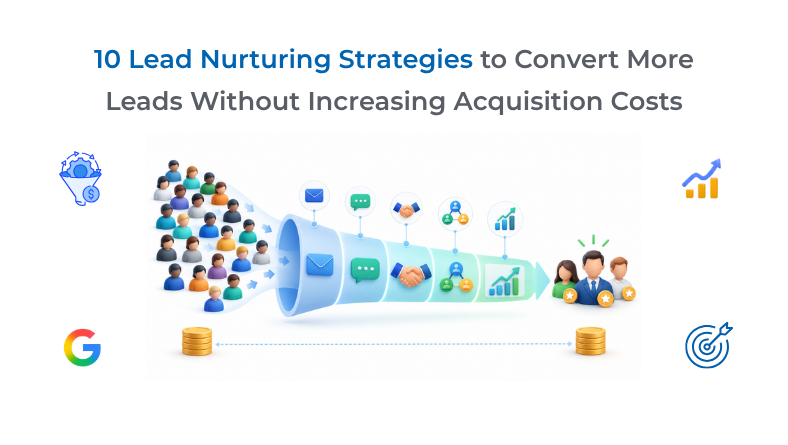
Most brands treat an unconverted lead like it’s dead. It isn’t, not even close. It’s just someone who wasn’t ready yet, and going out and buying more traffic to replace them is usually the most expensive way to solve a problem that nurturing fixes for free. Lead nurturing strategies are the structured follow-up touches, email, WhatsApp, retargeting, that move a prospect from “interested but not ready” to actually ready to buy, without spending another rupee on acquisition. At PROHED, a lead generation agency working across B2B, D2C, and high-ticket categories, we run into this gap constantly: decent ad spend, solid lead volume, and almost nothing set up for what happens once that first message goes unanswered.
We’ve covered the bigger picture elsewhere, how the lead generation funnel breaks down stage by stage, and how lead scoring tells you which leads deserve a call first. This one’s narrower, ten specific nurturing moves that actually get a stalled lead moving again.
Why the Lead Nurturing Process Beats Chasing More Traffic
Acquisition cost only really moves in one direction lately, across nearly every paid channel worth mentioning. Meanwhile, most CRMs are sitting on a pile of leads that already cost real money to bring in and are now just… sitting there, untouched since the first follow-up attempt fizzled out.
A working lead nurturing process recovers that spend without adding a single rupee to it. It’s genuinely the cheaper lever here, and yet it’s the one most teams under-invest in, mostly because acquisition feels urgent in the moment and nurture always feels like something you’ll get around to eventually.
Here are ten worth actually building.
1. Segment Leads Before You Start Any Nurture Sequence
Sending the exact same follow-up to everyone in your CRM is basically the same as sending nothing at all. A lead who downloaded a pricing guide and one who skimmed a single blog post are not the same person, and treating them like they are wastes the attention of the one who’s genuinely closer.
A few basic ways to split things from day one:
- By source (organic, paid, referral), since intent tends to differ a lot by channel
- By engagement level (high, medium, low), so your strongest leads actually get the most attention
- By stage in the buying journey (early research vs actively comparing vs ready to decide)
- By product or category interest, especially useful for brands with a wide catalogue
Nail this first. Pretty much every strategy after this one leans on it working properly.
2. Build an Actual Multi-Touch Email Lead Nurturing Sequence
One follow-up email isn’t a nurture sequence, honestly. It’s just a reminder. Email lead nurturing works because it’s a series, usually five to seven emails spread across two to four weeks, each one building on the last instead of repeating the same pitch with a slightly different subject line.
A structure that tends to hold up:
| Timing | Purpose | |
|---|---|---|
| 1 | Day 0-1 | Acknowledge interest, set expectations |
| 2 | Day 3 | Educational content addressing a common question |
| 3 | Day 6 | Social proof, case study, or testimonial |
| 4 | Day 10 | Address a specific objection (price, timing, fit) |
| 5 | Day 15 | Soft offer or incentive to act |
| 6 | Day 22 | Final direct ask, with urgency if genuine |
Not every lead needs to run through all six. Someone engaging heavily by emails 3 should get pulled into a faster, sales-ready track instead of just finishing out the sequence on autopilot because that’s how it’s scheduled.
3. Layer WhatsApp and SMS Into Your Lead Nurturing Campaigns
Email open rates in India, especially for D2C and consumer brands, don’t really tell the whole story anymore. WhatsApp keeps outperforming email on open and response rates here, which makes it one of the highest-leverage channels still missing from most lead nurturing campaigns.
Save it for genuinely time-sensitive nudges, a restock alert, a price drop, a limited slot for a consultation call. Keep email for the longer, more detailed stuff, guides, comparisons, deeper proof, that just doesn’t fit a WhatsApp message’s format. Running both together, rather than betting on one, tends to beat either channel running alone.
4. Match Content to Where the Lead Actually Is
A lead three days into their research doesn’t need a discount code shoved at them. A lead who’s already compared three competitors doesn’t need another educational blog post either. And yet plenty of nurture sequences send the exact same content no matter where someone actually sits in their own decision.
A simple way to think about mapping this:
- Early stage: educational content, answering the questions they’re still working out
- Middle stage: comparison content, proof points, case studies
- Late stage: objection handling, pricing clarity, a clear, low-friction next step
If you’ve already got a lead scoring model running, this gets a lot easier, since the score more or less tells you where someone sits without you having to guess.
5. Trigger Nurture Based on Behaviour, Not Just a Fixed Calendar
A drip that fires on day 1, day 5, day 10 no matter what the lead actually does is a pretty blunt tool. Behaviour-triggered nurture responds instead. Someone opening three emails in a row and clicking through gets moved along faster. Someone who’s gone completely quiet gets a different track entirely, one built for re-engagement rather than pushing more content at them that they’re clearly not reading anyway.
This one shift, calendar-based to behaviour-triggered, is usually the single biggest jump in lead conversion most brands see from any change to their nurture setup.
6. Personalise Beyond Just Dropping in a First Name
Real personalisation means the actual content shifts based on what you know about someone. A lead who browsed a specific product category should be seeing nurture content about that category, not a generic overview of the whole brand. A returning lead who’s already engaged before shouldn’t get dropped into the same introductory sequence as someone brand new to you.
This doesn’t take a huge tech investment to start, either. Even basic dynamic content blocks in most email platforms, product recommendations, category-specific case studies, can lift response rates noticeably compared to firing off one static sequence to absolutely everyone.
7. Build a Real Win-Back Sequence for Cold Leads
Most nurture sequences quietly give up after three or four touches, and the lead just sits there indefinitely, forgotten. A deliberate win-back sequence, sent weeks or even months later, recovers a decent chunk of leads who genuinely just weren’t ready the first time, not leads who were never actually interested.
A Box Of Stories, a subscription commerce brand we’ve worked with, basically runs on this kind of re-engagement logic, since a subscription business lives or dies on bringing lapsed customers back rather than only chasing brand new ones. That focus on ongoing, structured re-engagement was part of what pushed subscriptions up 35% while cutting acquisition costs by 40% across the wider engagement with them.
8. Keep Sales in the Loop Without Handing Off Too Early
Marketing nurture and sales follow-up really shouldn’t run as two disconnected systems, though they often do. A lead who’s engaged deeply with a nurture sequence, opened every email, clicked through case studies, checked the pricing page twice, is telling you something a sales rep genuinely needs to know before they ever dial the number.
Build a simple signal into your CRM: once a lead crosses a defined engagement threshold, sales gets notified with actual context attached, not just a name and a phone number. That context alone tends to change how the first call goes, sometimes a lot.
9. Use Retargeting Ads as a Parallel Nurture Channel
Email and WhatsApp aren’t the only nurture channels around, and treating retargeting as its own separate “ads” workstream instead of part of the same nurture logic leaves real overlap sitting on the table. A lead who opened your last three emails but still hasn’t converted is a genuinely strong retargeting audience, arguably stronger than a cold lookalike audience built from scratch.
Sync your CRM segments into Meta Ads and Google Ads audiences so someone already being nurtured by email is also seeing consistent, complementary messaging while they’re scrolling elsewhere. The two channels reinforcing each other usually beats either one running by itself.
10. Automate the Process, But Don’t Let It Feel Robotic
Automation is what makes any of this actually scalable past a handful of leads a day. Platforms like HubSpot, LeadSquared, or WebEngage can run segmented, behaviour-triggered sequences without someone manually hitting send on every single email. That said, automating the process shouldn’t mean every touch reads like it came out of a template.
Build in at least one genuinely personal moment somewhere in the sequence, a real message from a sales rep, a reply-to address someone’s actually monitoring on the other end. Leads can usually tell the difference between a template and someone actually paying attention, and that difference shows up pretty clearly in response rates.
How PROHED Approaches Lead Nurturing
We build nurture sequences as an extension of whatever’s already working in the funnel and the scoring model, not as some separate thing bolted on afterward. That usually means setting up behaviour-triggered email and WhatsApp sequences tied to real CRM activity, syncing engaged-but-unconverted segments into retargeting audiences on Meta and Google, and building the sales handoff logic so a rep already knows how engaged a lead is before that first call even happens.
As a digital marketing agency in Gurgaon working across performance marketing, CRM integration, and lead generation, our take stays pretty consistent across clients: most brands don’t actually have a lead volume problem. They have a follow-up problem, and nurturing is almost always the cheaper fix for it.
Conclusion
Lead nurturing isn’t some nice-to-have you bolt onto acquisition once everything else is sorted. It’s often the fastest way to lift conversions without spending another rupee on ads, since the leads already sitting untouched in your CRM cost money to bring in the first time around. Start with segmentation, build sequences around actual behaviour instead of a fixed calendar, and bring sales in at the right moment, not too early, not too late. Get those basics right, and the same lead volume you’re already generating starts converting at a noticeably better rate, no extra spend required.
FAQs
1. What are lead nurturing strategies?
Lead nurturing strategies are the structured follow-up tactics, emails, WhatsApp messages, retargeting ads, used to move a prospect who isn’t ready to buy yet a little closer to actually deciding. They work by staying genuinely useful over time instead of repeating the same sales pitch until the lead just checks out entirely.
2. What is the best lead nurturing strategy?
There’s honestly no single best one, it depends a lot on your category and sales cycle, but segmenting leads before you even start nurturing tends to have the biggest impact regardless of industry. Behaviour-triggered sequences that adjust based on real engagement usually beat any fixed, one-size-fits-all drip campaign.
3. How long should you nurture a lead?
It varies a fair bit by ticket size and category, anywhere from a few days for low-consideration D2C purchases to several months for enterprise B2B deals. Rather than picking some arbitrary cutoff, it’s more useful to keep nurturing as long as a lead shows any engagement at all, and shift disengaged ones into a slower, less frequent re-engagement track instead of dropping them altogether.
4. How do you automate lead nurturing?
Most teams lean on a CRM or marketing automation platform, HubSpot, LeadSquared, or WebEngage are common picks, to trigger emails, WhatsApp messages, or retargeting audience updates based on what a lead actually does. The real key is building genuine behaviour triggers rather than just scheduling a fixed calendar of messages that fire off regardless of whether anyone’s actually engaging.
5. How does lead nurturing improve conversion rates?
It keeps prospects engaged during that gap between first showing interest and actually being ready to buy, a gap most brands just abandon after one or two follow-up attempts. Since nurtured leads convert at meaningfully higher rates than the ones left untouched, the same acquisition spend ends up generating more revenue without pulling in any extra traffic.
6. What’s the difference between lead nurturing and lead scoring?
Lead scoring ranks leads by how likely they are to convert, so it tells you who to prioritise first. Lead nurturing is what you actually do with that information, the specific sequences and touches that move a lead forward, and the two genuinely work best when they’re built to feed off each other rather than running as separate systems.
7. Should every lead go through the same nurture sequence?
No, and honestly this is one of the more common mistakes brands make without even realising it. Segmenting by engagement level, source, and buying stage lets high-intent leads move through a faster, more direct sequence while lower-intent ones get a longer, more educational track that actually fits where they are.
8. Can lead nurturing work without a large marketing team?
Yes, especially with automation platforms handling most of the sending and triggering once the sequences are actually built. The bulk of the effort is upfront, mapping out segments, writing content for each stage, setting up the triggers, after which the whole system runs with far less ongoing manual work than most teams expect going in.
Want help building a lead nurturing system that actually converts your existing pipeline? Talk to PROHED, a lead generation agency that builds nurture sequences around your real CRM data, not a generic template.
Schedule a Free Strategy Call with PROHED Today