The Strategic Benefits of an In-House Team
1. Profound Brand Knowledge
A unique synergy is created when marketers participate in internal product debates and absorb company history. This results in a level of nuance and context that is difficult to replicate through external onboarding.
2. Seamless Cross-Departmental Synergy
Barriers are removed when a marketer can simply walk over to the sales department to discuss customer objections. This real-time collaboration ensures that marketing efforts remain grounded in the daily realities of the business.
3. Absolute Strategic Command
Decisions are executed with speed. There is no reliance on agency timelines or external approval chains. This responsiveness is a critical asset when market conditions shift unexpectedly.
4. Long-Term Institutional Value
A permanent employee possesses a vested interest in the company’s success. Over time, valuable institutional knowledge is accumulated regarding past successes and failures, expertise that remains within the company indefinitely.
Also read: How AI-Based Marketing & Ad Optimization can Boost ROAS
The Limitations of the Internal Model
1. Substantial Financial Commitment
Beyond the obvious weight of base salaries, budgets are often strained by recruitment fees, onboarding time, and the extensive benefits packages required to retain top talent. When the expensive software stacks and specialized tools necessary for modern marketing are added to the mix, the annual capital requirement is rendered significant. For many growing brands, this represents a heavy, fixed financial burden that must be carried regardless of performance.
2. Specialized Talent Gaps
Even a highly talented team of generalists will eventually hit a wall. Fields like technical SEO, conversion rate optimization, and advanced data analytics are incredibly deep; they aren’t just “tasks” you can pick up on the fly. When a small internal team is forced to stretch across too many different disciplines, performance in these specialized areas is almost always compromised. It’s in those complex technical gaps where a brand’s momentum is most likely to falter.
3. Barriers to Rapid Scaling
When the time comes to ramp up, maybe for a massive product launch or a seasonal surge, an internal team is often held back by the slow reality of hiring and training. That lack of agility can be incredibly damaging during high-growth phases where timing is everything. Unlike an agency model, where specialized resources are deployed the moment they’re needed, an in-house setup is strictly limited by the physical bandwidth of the people already on your payroll.
What are the Advantages of Outsourced Marketing?
1. Access to Elite Specialization
By partnering with a reputable agency, generalists are replaced by specialists who have spent years mastering specific channels. This depth of focused experience is rarely found in a single internal hire.
2. Transparent and Predictable Costs
In an outsourced model, payment is rendered for output and results. The burden of training budgets, insurance, and tool subscriptions is carried by the agency, not your balance sheet.
3. Operational Flexibility
Resources can be aggressively deployed for a product launch and subsequently scaled back. This ability to adjust scope without managing headcount is one of the most practical benefits of outsource marketing services.
4. The Value of External Perspectives
One of the biggest wins you get with an agency is something that’s often totally overlooked: breadth of vision. Since agencies are constantly in the trenches across so many different industries, they have a vantage point that internal teams just don’t. They can spot a winning strategy or a shifting trend in one market and apply it to yours before your competitors even know what’s happening.
When a team is siloed inside the same company for too long, it’s easy to fall into a bit of a creative rut. That “outside-in” perspective is a massive safeguard against stagnation—it’s what actually keeps a brand sharp and at the cutting edge, rather than just recycling the same old internal ideas.
5. Premium Technology Access
Furthermore, Premium Technology Access is granted through these strategic partnerships. Enterprise-level tools for technical SEO and programmatic advertising are frequently cost-prohibitive for a single brand to own independently. By partnering with a premier digital marketing company in India, these high-end technologies are utilized on your behalf, allowing you to reap the rewards without requiring a massive, direct capital investment.
What are the Disadvantages of Outsourced Marketing?
It’s not all upside; handing the keys to an outside partner comes with its own set of headaches that you need to be ready for.
1. You lose that “instant” control
When a team is down the hall, you can pivot in ten minutes. With an agency, you’re working within their internal systems and sprint cycles. Even the most responsive agencies can’t match the immediate, day-to-day control of an in-house team, and sometimes that lag can feel frustrating when you need a “right now” adjustment.
2. The communication tax
Misalignment is a real risk. No matter how good the brief is, there’s always a chance an agency misses a subtle nuance in your brand’s tone or a shift in your internal priorities. You have to be willing to pay the “communication tax” meaning regular check-ins, feedback loops, and constant coordination, just to make sure everyone is still rowing in the same direction.
3. The “key man” risk
When you outsource, a huge chunk of your brand’s momentum sits in someone else’s hands. If that agency’s quality slips, or if the relationship sour, it doesn’t just hurt your ads, it can actually disrupt your entire growth trajectory. You’re effectively betting on their performance, and if they stumble, your brand feels the impact directly.
Cost Comparison: Outsourcing vs In-House
When the hard numbers are scrutinized, the disparity between these two models is often far more pronounced than most leaders expect.
The In-House Reality
To build a functional, mid-sized team, an investment of ₹30 to ₹60 lakhs annually is realistically required in base salaries alone. However, the true burden is often found in the “hidden” costs, recruitment fees, employee benefits, ongoing training, and software subscriptions, which typically increase the total expenditure by another 20-30%.
The Outsourced Reality
Conversely, professional agency retainers typically range from ₹1 to ₹5 lakhs per month. In this model, the infrastructure is already built, the talent is already seasoned, and the risk is mitigated; you are essentially investing in the execution and the results, rather than the overhead.
Making the Final Decision
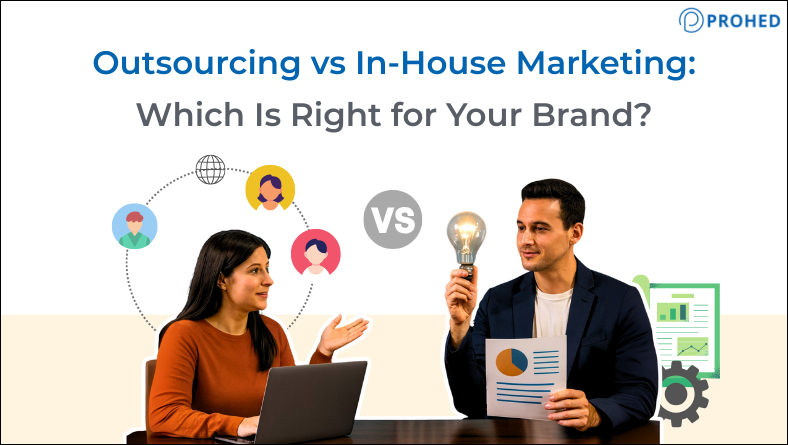
When does the in-house model actually make sense?
It’s usually the right move if you’re an established enterprise with a deep, multi-year budget to burn. It works best when your marketing is so tangled up with daily R&D and product updates that you need your team in the same room. Basically, if having absolute, minute-to-minute control over your brand voice is a non-negotiable priority, you keep it inside.
On the flip side, outsourcing is almost always the better bet if:
You’re a startup or an SME that needs senior-level expertise but doesn’t have the budget for a massive internal payroll. It’s the go-to choice when you need specialized skills, like Performance Marketing or technical SEO, ready to roll right now, not six months from now. Plus, if your business deals with seasonal peaks and valleys, an agency gives you the freedom to scale your resources up or down whenever you feel like it.
Conclusion
The truth is, there isn’t a single “correct” answer, only the one that actually fits your current resources and stage of growth. While an internal team brings depth and a certain long-term stability, outsourcing is what provides the velocity and specialized edge you need to really dominate a crowded market.
It is no accident that so many top-tier brands are moving toward a hybrid model. By keeping high-level strategy close to home with a core internal leader, and handing off the technical heavy lifting to a premier digital marketing agency in India, companies get the best of both worlds. It is a setup designed specifically for brands that need to stay deeply rooted in their own culture while remaining incredibly agile as the market shifts.
FAQs
1. Can a brand combine both in-house and outsourced marketing?
Definitely. In fact, most of the big players do exactly that. They usually keep a core strategist on staff to steer the ship but hire an agency to handle the specialized stuff like technical SEO, media buying, or heavy design work. It’s a smart way to stay in control of your vision without getting buried under the cost of a massive full-time payroll.
2. Can an agency really nail our specific brand voice?
Yes, but it isn’t magic, it’s a partnership. You have to give them a real foundation to work with. If you provide clear guidelines and actually talk to them, a good agency will treat your brand voice with just as much respect as they do your ROI. The best setups feel less like a “vendor” relationship and more like an extension of your own desk.
3. Should we build creative automation in-house or just hire a performance partner?
Honestly, it comes down to your scale. If you’re pushing out an insane volume of content and have the tech-savvy staff to manage complex software, building it yourself might be worth the investment. But for most brands, it’s just not worth the headache. Partnering with a solid digital marketing company in India is usually the faster, more flexible route. It gets you expert-level execution immediately without the trial-and-error of building it from scratch.
4. What’s the catch with outsourcing our data and analytics?
It’s a bit of a trade-off. If you outsource, you get instant access to better tools and people who live in spreadsheets, but you aren’t “owning” every single step of the process. Keeping it in-house gives you total control, but you’re stuck paying for expensive software and constant training. The sweet spot? Own your own data (the logins and the accounts), but let an agency handle the actual reporting and heavy lifting of the analysis.
5. How does full-service marketing management differ from partial outsourcing?
Full-service management means the agency owns the whole engine, strategy, execution, and reporting, across channels. Partial outsourcing is more like renting a specialist for one job, say SEO or paid ads, while you run everything else in-house. The trade-off is control versus coordination: full-service takes more off your plate, but partial outsourcing lets you keep tighter oversight on the channels you consider core to your brand.
6. When should a startup outsource content marketing vs doing it in-house?
If you’re pre-Series A and don’t have a dedicated content hire yet, outsourcing usually wins, you get consistent output without the six-month ramp-up of building a team from scratch. Once you’re publishing daily and content is core to your acquisition strategy, it often makes sense to bring a content lead in-house and keep an agency for overflow or specialized formats like video or technical SEO content.
7. What are the advantages of outsourcing growth marketing versus hiring in-house?
Outsourcing growth marketing gets you a team that’s already run hundreds of experiments across different brands, so you skip a lot of the trial-and-error phase. You also get access to premium tools and multi-channel expertise, paid, SEO, CRO, without the payroll weight of hiring for each skill separately. The trade-off, as covered above, is a bit less day-to-day control than an in-house hire would give you.