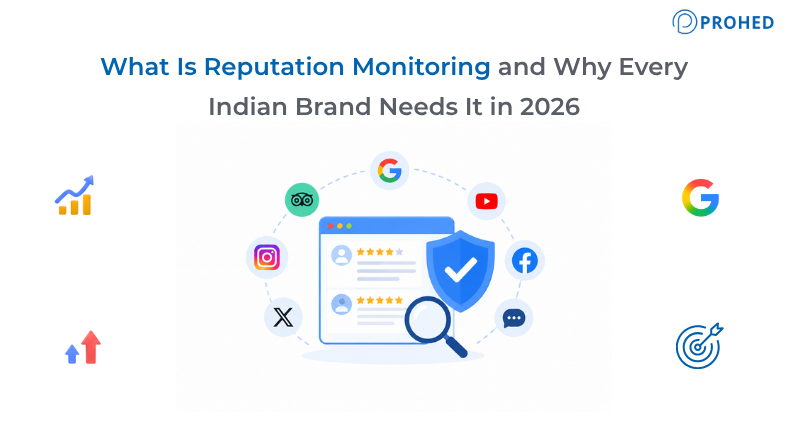
Reputation monitoring is the ongoing tracking of what people say about your brand across reviews, social platforms, news and search, so you catch problems early. PROHED, a performance marketing agency in Gurgaon, sets it up as an early-warning system.
Think about how most brands find out something has gone wrong. A support person pings the founder with a screenshot. Nobody spotted it earlier. The post has been up for two days and a few hundred people have shared it. Reputation monitoring exists to kill that lag, and these days it has to cover a lot more than a Google Alert on your company name.
Reputation Monitoring vs Online Reputation Management
The two get lumped together, but they do different jobs. Online reputation management is the doing part: answering reviews, pushing better pages up for your brand name, nudging happy customers to post. We’ve written about that in our online reputation management guide and compared agencies in a separate roundup of ORM providers.
Monitoring comes first. It’s how you learn there’s something to manage. Without it you react late, and with only monitoring you end up with a chart nobody acts on.
What Brand Reputation Monitoring Should Cover
| Where | What turns up | Why you care |
|---|---|---|
| Google reviews and Business Profile | Ratings, branch-level complaints | Sits next to your name in search |
| X and Instagram | Tags, quote posts, creator callouts | Moves fastest |
| Reddit and Quora | “Is this brand legit?” threads | Ranks on Google, feeds AI answers |
| YouTube | Reviews, rants, comment threads | Stays findable for years |
| News and blogs | Coverage, recalls, funding stories | Shapes what ranks for your name |
| App store reviews | Bugs, payment failures | Hits installs directly |
| Employer review sites | Ex-employee posts | Affects hiring and B2B trust |
Most teams watch Google reviews and Instagram, then call it done. But the posts that hurt tend to begin somewhere less obvious, like a Reddit thread or a YouTube comment section, and only reach search later.
Why Online Reputation Monitoring Is Harder in India
Language is the first headache. Customers write in English, in Hindi typed with Roman letters, and in a blend of both, so “bakwaas delivery” won’t match a keyword list built in English.
Then there’s WhatsApp. A lot of complaints travel as screenshots inside private groups, and no tool can see them. Your support tickets, sales calls and reseller chats are the only early signal you’ll get there, so pull them into the same weekly review.
Creators add another layer. One reel from a mid-sized creator can outweigh a month of your own posting, so track those mentions separately. And during festive sales, logistics get stretched and delivery complaints tend to bunch up. Watch harder when you’re spending harder.
Social Listening vs Social Media Monitoring
Social media monitoring covers what’s aimed at you: tags, replies, DMs, comments on your posts. It’s customer service with a radar attached.
Social listening covers what’s said about you and your category when nobody bothers to tag the brand. An untagged complaint in a forum. A thread comparing you with a rival. You need both, but listening is where early warnings come from, since the first angry posts rarely tag you.
Sentiment Analysis: Useful, With a Catch
Most tools tag each mention as positive, neutral or negative and roll it into a percentage. Mixed-language text trips them up. “Waah, kya service hai” could be praise or a dig, depending on the day, and sarcasm in general is a weak spot.
Treat that percentage as a rough guide. Once a month, read 30 to 50 mentions yourself and compare them with the tool’s labels. If it gets a third wrong, tune the rules, or tell leadership the number is directional. Don’t drop a sentiment score into a board deck without this check.
Reputation Management Tools: Start Cheaper Than You’d Think
| Tier | Examples | Good for |
|---|---|---|
| Free | Google Alerts, Business Profile notifications, X advanced search, Reddit search | The first 30 days, small teams |
| Mid-range | Brand24, Mention, Awario | Steady mention volume, alerts, basic sentiment |
| Enterprise | Sprinklr, Meltwater, Brandwatch, Talkwalker | Large brands, several markets, team workflows |
Before paying, run a two-week trial on your own brand. If the tool misses the last bad review you remember, skip it. Test Hinglish spellings too.
Setting Up Brand Mentions Tracking in One Afternoon
- List your terms: Brand name, misspellings, Hinglish spellings, product names, founder names, campaign hashtags, and two or three competitors.
- Set alert rules: Instant alerts for 1 and 2-star reviews and large accounts. A daily digest for the rest. A spike alert when negative mentions double your weekly average.
- Name an owner and a backup: Write down who replies, who escalates, and the time limit for each.
- Block 20 minutes weekly: Read the actual mentions, not just the chart.
- Report four numbers monthly: mention volume, share of negative mentions, time to first response, and share of voice against your two closest rivals.
Reputation Monitoring Now Includes AI Answers
Customers now ask ChatGPT and Gemini about brands before they search. If an answer describes you wrongly or leaves you out, that’s a reputation problem. Those answers lean on reviews, Reddit threads and news coverage, so everything above feeds into it. Our guide to tracking your brand in ChatGPT, Gemini and AI Overviews covers the checking side.
How PROHED Uses Reputation Signals
We don’t keep monitoring in its own corner. If delivery complaints cluster during a sale, we tighten the promise in the ad or slow spend in affected regions while support clears the backlog. If people grumble about a product claim, we pull the creative that makes it.
As a performance marketing agency in Gurgaon, we run listening next to paid, SEO and social, so whoever sees the spike can change the campaign the same day. That’s what reputation management online looks like when it’s wired into the work.
Conclusion
Monitoring won’t fix a bad product, but it stops small problems from becoming public ones. Start with free alerts, add a tool only after a trial, and review mentions weekly. The brands that look calm during a controversy usually saw it coming a day earlier.
FAQs
1. What is reputation monitoring?
It’s the ongoing tracking of brand mentions across reviews, social media, forums, news and search. The aim is to spot problems early and respond before they spread.
2. What’s the difference between reputation monitoring and online reputation management?
Monitoring is detection, meaning you find out what’s being said. Online reputation management is the response, like replying to reviews and rebuilding search results.
3. What’s the difference between social listening and social media monitoring?
Monitoring tracks activity aimed at your accounts, such as tags and comments. Listening tracks conversations about your brand and category even when nobody tags you.
4. Which reputation management tools work best for Indian brands?
It depends on your mention volume and languages. Trial any tool on your own brand for two weeks, Hinglish spellings included, before you pay.
5. How accurate is sentiment analysis for Hinglish?
It’s weaker than for plain English, especially with sarcasm. Read a sample of 30 to 50 mentions each month to check the labels.
6. How often should you monitor brand mentions?
Use instant alerts for low reviews and large accounts, plus a 20-minute weekly review. Look more often during sales and launches.
7. Can you monitor WhatsApp mentions?
No, because WhatsApp groups are private and no tool can see them. Use support tickets, sales calls and reseller feedback as your signal instead.
8. How much does reputation monitoring cost?
You can start free with Google Alerts and native platform search. Paid tools usually bill monthly based on how many mentions you track, so ask for a trial first.
Curious what people are saying about your brand that you haven’t seen yet? Ask PROHED for a brand mention audit and we’ll show you where your current monitoring falls short.
Schedule a Free Strategy Call with PROHED Today