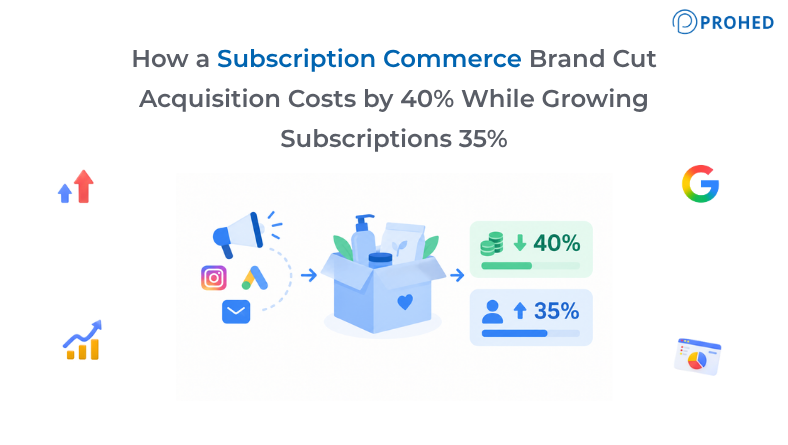
Most subscription brands get stuck choosing between two bad options, keep spending more on ads to hit growth targets, or slow down to protect margins. A subscription marketing strategy built around a single acquisition channel almost always forces that trade-off eventually, usually sooner than anyone expects. At PROHED, we worked with A Box of Stories, a subscription commerce platform, on exactly this problem, and the result was 35% more subscriptions alongside a 40% drop in acquisition cost, both happening at the same time, not traded off against each other. Here’s how that actually came together, and what of it applies to any subscription brand watching CAC climb.
The Problem: Rising CAC and Flat Organic Visibility
A Box of Stories came to us with a setup we see constantly. Paid acquisition was working, technically, but costs kept creeping up every quarter while organic traffic just sat there, flat. That combination is a warning sign for any subscription commerce business, since recurring revenue models live or die on LTV:CAC staying healthy over time, not on how good month-one conversion numbers happen to look.
A few things were compounding the problem at once:
- Acquisition leaned almost entirely on paid social, so every new subscriber cost roughly the same, or more, as the last one, with no organic channel picking up any of the slack
- Organic search visibility hadn’t grown alongside the brand’s actual content output, meaning real work was going in without compounding into real traffic
- There was no structured retention layer catching subscribers before they churned, so the brand was essentially replacing lost subscribers on repeat instead of actually growing
Why a Single-Channel Subscriber Acquisition Model Breaks Down
Subscription businesses are especially exposed to rising CAC because the whole model only works if a subscriber sticks around long enough to pay back what it cost to acquire them, and then some. If churn stays high while CAC keeps climbing, you’re basically running faster just to stay in the same place.
A single-channel approach makes this worse in a few specific ways:
- Auction costs only move one direction on a channel you’re fully dependent on, since competitors bidding for the same audience keep pushing CPMs up regardless of how strong your creative is
- There’s no organic floor under acquisition, so any slowdown in paid spend translates directly into fewer new subscribers, with nothing else there to catch the volume
- Trial-to-paid conversion often gets treated as a black box, rarely optimised, even though small gains here compound across every subscriber acquired afterward
Building a Multi-Funnel Approach Instead of One Channel
The core shift for A Box of Stories was moving away from one dominant acquisition channel toward a genuine multi-funnel approach, where SEO, performance marketing, and retention actually worked together instead of running as three separate, disconnected efforts.
Layer | What Changed | Why It Mattered |
SEO | Structured content and technical SEO built around real search demand | Created an acquisition channel with no marginal cost per subscriber |
Performance marketing | Diversified beyond the one dominant paid channel, with real creative testing built in | Reduced dependency on a single auction, slowing CAC growth |
Retention flows | Structured win-back and engagement sequences for existing subscribers | Protected the subscriber base paid acquisition had already earned |
None of these three worked in isolation, and that’s really the point. SEO traffic fed into the same trial funnel paid traffic did. Performance marketing got more efficient as brand familiarity from organic content grew in the background. And retention flows meant subscribers coming in through either channel actually stuck around long enough to be worth having acquired in the first place.
The Retention Layer That Made the Numbers Work
Cutting churn mattered just as much to the final result as acquisition did, honestly probably more, since a subscription business can’t out-market a leaky bucket no matter how good the ads get. A Box of Stories runs on repeat engagement by nature, subscribers deciding month after month whether to stay, which makes retention marketing a core part of the business model, not some nice-to-have bolted on afterward.
The retention work centred on a few specific things:
- Behaviour-triggered win-back sequences for subscribers showing early signs of pulling away, rather than waiting until after a cancellation to even notice
- Trial-to-paid conversion optimisation, since a weak handoff from free trial to paid subscription quietly wastes a real chunk of acquisition spend before it ever gets a shot at paying back
- Content and communication built around actual subscriber behaviour, not a generic monthly newsletter blasted out to everyone regardless of how engaged they actually are
Related Read: How to Reduce Customer Acquisition Cost for Ecommerce in India Without Killing Growth
The Results: Organic Growth, Lower CAC, More Subscriptions
Over the course of the engagement, this combined approach produced roughly 20% month-over-month organic traffic growth, a 35% lift in subscriptions, and a 40% drop in acquisition cost. None of these three numbers happened on their own.
Organic traffic growth meant SEO was actually contributing real, compounding volume to the trial funnel instead of paid spend carrying the entire load. That eased pressure on the paid channel, which freed up budget to get reallocated toward whatever creative and audiences were genuinely converting, rather than just maintaining raw volume. And the retention layer meant more of the subscribers coming in through both channels actually stuck around, which is ultimately what moved the acquisition cost number. CAC calculated against subscribers who stay is just a fundamentally better number than CAC calculated against subscribers who churn out by month two.
What This Means for Other Subscription Box Marketing Strategies
The specific tactics here won’t transfer identically to every subscription business out there, but the underlying structure does. A reasonable approach for any brand feeling similar pressure:
- Audit where acquisition is actually coming from: If one channel is responsible for the overwhelming majority of new subscribers, that’s the structural issue worth fixing first, not a targeting tweak inside that same channel.
- Treat SEO as a genuine acquisition channel, not a side project someone works on occasionally: For subscription commerce specifically, organic content ranking for real search demand becomes a channel with no marginal cost per subscriber, exactly the kind of lever that eases pressure on a paid channel whose CAC keeps rising.
- Build retention before scaling acquisition further: Pouring more budget into acquisition while churn stays high just means replacing lost subscribers faster, not actually growing the base.
- Watch trial-to-paid conversion as closely as top-of-funnel numbers: A brand can have genuinely strong acquisition metrics and still underperform badly if the trial-to-paid step is quietly leaking subscribers before they ever become paying customers.
How PROHED Approaches Subscription Commerce Growth
We build subscription marketing engagements around this same multi-funnel logic as a default, mostly because relying on one acquisition channel is almost always the root cause when a subscription brand’s CAC starts outrunning what the business can absorb. In practice that usually means combining SEO and performance marketing from day one instead of running them off separate budgets, and building retention flows into the plan before scaling acquisition further, not after churn has already become an obvious problem.
As a digital marketing agency in India for growth, our work with subscription and recurring revenue businesses has shown pretty consistently that the brands solving CAC problems fastest are the ones willing to invest in organic and retention at the same time, not one after the other.
Conclusion
A subscription business watching CAC climb rarely has an acquisition problem alone. More often it’s a dependency problem, on one channel, on acquisition with no retention underneath it, on trial conversion nobody’s actively managing. A Box of Stories cut acquisition costs by 40% and grew subscriptions 35%, not by spending differently on the same channel, but by getting SEO, performance marketing, and retention to actually work together instead of running independently. That structural shift, more than any single tactic on its own, is usually what makes the difference for subscription commerce brands stuck in this exact bind.
FAQs
1. How can a subscription business reduce its customer acquisition cost?
Diversifying beyond a single paid channel, particularly by building SEO into a genuine acquisition source, reduces how dependent you are on rising auction costs over time. Pairing that with stronger retention also lowers effective CAC, since a subscriber who sticks around longer makes the original acquisition cost look proportionally smaller.
2. What is a good LTV:CAC ratio for a subscription commerce brand?
A ratio of 3:1 or better is generally considered healthy, meaning a subscriber’s lifetime value runs at least three times what it cost to acquire them. Brands sitting below that are usually either paying too much to acquire subscribers in the first place, or losing them too fast through churn.
3. Why does organic traffic matter for subscription box marketing specifically?
Organic search traffic carries no marginal cost per subscriber once the content is built and ranking, which makes it genuinely different from paid acquisition as a growth lever. For subscription brands watching paid CAC rise every quarter, organic growth takes real pressure off the channel that keeps getting more expensive.
4. How much does reducing churn actually affect acquisition cost?
Quite a lot, since CAC is typically calculated against the full cost of acquiring someone, but a subscriber who churns quickly never generates enough revenue to justify that spend. Reducing churn effectively makes every acquisition dollar already spent work harder, without needing to touch the acquisition strategy at all.
5. What’s the difference between a multi-channel and a multi-funnel approach to subscriber acquisition?
Multi-channel usually just means running ads across more than one platform. A multi-funnel approach integrates SEO, performance marketing, and retention so each one actually reinforces the others. The distinction matters because channels running in isolation don’t compound the way an integrated system does.
6. How important is trial-to-paid conversion for subscription commerce growth?
It’s one of the more overlooked levers in subscription marketing, since a weak trial-to-paid step quietly wastes acquisition spend before a subscriber ever becomes profitable. Even a modest improvement here compounds across every subscriber acquired afterward, often more than finding an entirely new acquisition channel would.
7. Should subscription brands prioritise acquisition or retention first?
Retention should generally come first, or at least run alongside acquisition, since scaling acquisition on top of high churn just means replacing lost subscribers faster rather than actually growing the base. Fixing retention also makes every subsequent acquisition dollar more effective, which is why it tends to produce faster, more durable results overall.
8. How long does it take to see results from a combined SEO and performance marketing strategy for subscriptions?
Performance marketing improvements can show up within weeks, but SEO-driven organic growth typically takes a few months to really build momentum. Brands that commit to both together, instead of waiting for SEO to prove itself before investing properly, tend to see the acquisition cost benefits compound faster, roughly the 20% month-over-month organic traffic growth pattern that built steadily rather than all at once.
Not sure if your subscription brand has an acquisition problem or a channel-dependency problem? Get a growth audit from PROHED and we’ll map out exactly where your SEO, performance marketing, and retention are leaving CAC on the table.
Schedule a Free Strategy Call with PROHED Today