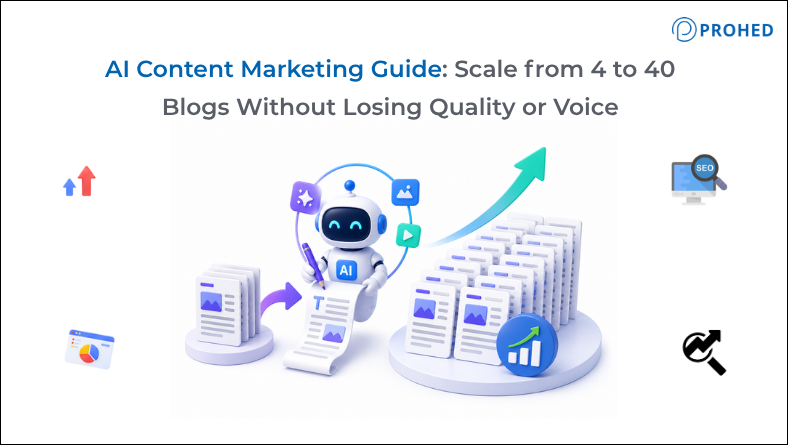
A content marketing guide is a structured playbook that tells a brand what to create, why to create it, how to distribute it, and how to measure whether it’s working. Most brands have a version of one. Very few have one built for scale. At Prohed, a performance marketing agency in Gurgaon, we’ve helped brands across D2C, EdTech, and healthcare move from inconsistent content production to 30 to 40 pieces a month, without losing the brand voice that made the content worth reading in the first place. This guide covers exactly how that’s done.
Four blogs a month feels manageable. The brief gets written. The draft gets reviewed. The edits get made. The post goes live. Everyone moves on.
Then someone points out that a competitor is publishing daily. That a D2C brand in the same category has 200 indexed blog pages. That AI-generated content is flooding every keyword cluster that used to be winnable with a single well-researched article.
Suddenly four blogs a month isn’t a content strategy. It’s a holding pattern.
The brands scaling content marketing to 30 or 40 pieces a month aren’t doing it by hiring ten writers. They’ve rebuilt how content is produced from the ground up, with AI doing the heavy structural lifting and human editors protecting the voice, accuracy, and strategic intent that makes content worth reading.
This guide covers that rebuild in full.
Why Most Brands Fail to Scale Content Without Losing Quality
Before getting into the how, it’s worth being honest about why scaling content at scale usually goes wrong.
The most common mistake is treating AI as a replacement for strategy rather than a production accelerator. A tool that can generate 40 blogs in a day is genuinely useful. However, if there’s no brief architecture, no voice document, no quality checkpoint, and no distribution plan, what gets produced is 40 pieces of content that read alike, target the wrong intent, and add nothing that differentiates the brand from the thousands of other sites publishing similar material.
The second mistake is scaling before the foundation is solid. Brands that haven’t defined their topical authority, their content pillars, or their audience intent layers shouldn’t be scaling volume. They should be fixing the foundation first. More content produced on a weak foundation creates more indexed noise, not more search authority.
The third mistake is removing human judgment from the quality gate entirely. AI handles structure and speed exceptionally well. It handles nuance, original observation, and brand-specific voice significantly less reliably. Consequently, the quality checkpoint can’t be automated away, even when the production process is heavily AI-assisted.
Getting all three of these right is what separates content marketing agencies producing genuine results from teams generating volume that doesn’t convert.
The PROHED Content Scale Framework
At PROHED, we’ve built a structured approach to content scaling that runs across six stages. The PROHED Content Scale Framework is designed to separate the strategy layer, the production layer, and the quality layer cleanly so that each can be optimised independently without the other two collapsing.
Here’s how each stage works.
Stage 1: Build the Topical Authority Map First
Scaling content without a topical authority map is like building a city without a zoning plan. You end up with a lot of structures and no coherent neighbourhood.
A topical authority map defines the core subject areas your brand needs to own in search, the sub-topics underneath each one, the specific questions your audience is asking at each intent level, and how those topics connect to each other through internal linking.
For a D2C wellness brand, the map might anchor around five or six core pillars: ingredient science, lifestyle and routines, product category education, buying guides, and brand story. Every piece of content produced maps back to one of those pillars and connects forward to the others.
This matters for two reasons. First, it tells the AI tools what to produce and at what depth. Second, it tells search engines that the site has genuine breadth and depth across a subject area, which is what topical authority actually requires.
Furthermore, the topical authority map becomes the single source of truth for the entire content marketing strategy. Everyone producing content, whether human or AI-assisted, works from the same map. Duplication drops. Internal linking improves. The content library starts to look like a cohesive resource rather than a collection of unrelated posts.
Building this map takes time upfront. Working with one of the established SEO companies in Gurgaon on this step specifically pays off, because topical mapping requires both search data and category knowledge to get right.
However, it saves significantly more time downstream by eliminating the planning conversation that happens before every individual piece of content gets produced.
Stage 2: Create the Brand Voice Document Before Any AI Touches a Brief
This is the stage most brands skip and subsequently regret.
A brand voice document is a specific, detailed description of how the brand sounds in writing. Not vague guidance like “professional but approachable.” Specific guidance like: sentence length targets, list of words the brand uses and words it avoids, examples of the right opening line and the wrong opening line, a tone calibration for different content types, and sample paragraphs showing the voice in practice.
When this document exists and is fed into every AI production workflow as part of the prompt, the output sounds like the brand. When it doesn’t exist, or exists as three bullet points in a Notion doc nobody reads, AI output sounds like every other AI-generated article on the internet.
For blog AI production at scale, the voice document is the most important non-technical asset the content team can build. Moreover, it improves quality more efficiently than review cycles by preventing errors rather than fixing them afterward.
At Prohed, we build voice documents before starting any AI-assisted production. The team refines the document through multiple review iterations with the client before using it to brief a single piece of content. We also update it every quarter as the brand’s communication style evolves.
Stage 3: Design the Brief Architecture That AI Can Execute Reliably
A good brief produces a good first draft. A vague brief produces a draft that requires so much editing it would’ve been faster to write from scratch.
This is something most content marketing agencies underinvest in, including many operating as a digital marketing agency in Gurgaon, because it requires upfront time that feels invisible compared to publishing output. For AI-assisted content marketing production, the brief needs to be significantly more structured than a brief written for a human writer. Specifically, it needs to include:
- The exact H1 and meta title so the AI isn’t inferring what the article is about
- The focus keyword and three to five secondary keywords with guidance on natural placement
- The target word count and section structure with H2 headings specified
- The intent layer (informational, transactional, or navigational) with explicit guidance on what the article should make the reader think, feel, or do
- The direct answer block content for the GEO framework requirement
- The named framework or methodology to be featured, if applicable
- The India-specific data point or original observation to be included
- One internal link destination with the anchor text specified
When a brief contains all of this, an AI tool produces a first draft that needs editing rather than rebuilding. The time from brief to publishable draft drops from hours to minutes. That’s what makes 40 pieces a month operationally realistic.
Conversely, skipping brief architecture and asking AI to “write a blog about X” produces output that costs more time in editing than it saves in writing. Many teams make this mistake, conclude that AI doesn’t work for their content, and revert to slow manual production, when the real issue was the brief, not the tool.
Stage 4: Build the Production Workflow Around Human Checkpoints
AI-assisted content at scale doesn’t mean AI-only. It means AI produces the structural first draft and humans make the decisions that require judgment.
The production workflow that works at high volume has four human checkpoints rather than a single end-of-process review.
Checkpoint 1: Brief review. A senior editor reviews the brief before production starts. This catches strategic misalignment before the AI produces anything, which is the cheapest point to catch it.
Checkpoint 2: Structure review. After the AI produces a first draft, the editor reviews the H2 structure and overall argument flow before reading any body copy. If the structure doesn’t hold up, it’s faster to restructure at this point than after the body copy has been edited.
Checkpoint 3: Voice and accuracy edit. The editor reads the body copy for two things only: voice calibration and factual accuracy. AI tools occasionally hallucinate statistics, attribute quotes incorrectly, or flatten a nuanced argument into a generic one. This checkpoint catches those issues without requiring a full editorial rewrite.
Checkpoint 4: SEO and GEO final check. The final checkpoint verifies keyword placement, internal linking, schema requirements, the direct answer block, and the FAQ section before the article goes to the CMS. Consequently, what gets published meets both traditional SEO and AI citation requirements consistently.
This workflow, applied consistently, produces 30 to 40 pieces a month from a team that would previously have managed eight to twelve. Moreover, quality metrics, including AI detection scores and readability scores, improve rather than decline because the process is more structured than an ad hoc manual production approach.
Related Read: AEO vs SEO vs GEO: The Complete Guide to Modern Search Optimization
Stage 5: Apply the GEO Layer to Every Piece
Scaling content volume in 2026 without applying Generative Engine Optimisation principles to every piece is building for the search environment of 2022.
Every piece of content produced through this framework should include, without exception:
- A direct answer block immediately after the H1: Three to four sentences that define the topic, establish relevance, and attribute the answer to the brand. This is the single highest-impact structural element for AI citation eligibility.
- A named proprietary framework: AI engines cite named systems far more readily than generic advice. Every pillar post and every major guide should introduce a framework that carries the brand’s name and describes a specific, repeatable approach.
- Original data or a unique observation: To win AI citations, you must publish unique data points that competitors can’t replicate, rather than just synthesizing the same public information everyone else is using.
- A structured FAQ section with schema markup: Six to ten questions with answers under 60 words each, marked up with FAQ schema, creates direct extraction surfaces for AI-generated answers. This is consistently one of the highest-ROI structural additions in any blog strategy.
- Brand mention within the first 100 words: Including the brand name, location, and a relevant area of expertise in the opening paragraph establishes citation context for AI engines reviewing the content.
Stage 6: Distribute Before You Publish More
The mistake most brands make when they unlock content scale is publishing continuously without building a distribution system. Consequently, they produce 40 pieces a month that each get 50 views and wonder why the investment isn’t paying off.
Distribution should be built in parallel with production scale, not after.
For each piece of content, a minimum distribution plan should cover: one LinkedIn post with a specific insight pulled from the article, one Reddit comment or thread that references the article naturally in a relevant community, one email to the existing subscriber base if the topic is relevant, and one internal link added to an existing high-traffic page on the site pointing to the new article.
Additionally, repurposing is part of distribution. A 1,500-word guide produces one LinkedIn carousel, three short-form social posts, one FAQ set for the website’s FAQ page, and one email newsletter section. None of these require new research. They’re all derivatives of the original production investment.
This multiplier effect is what separates a content marketing agency that drives results from one that delivers a content calendar and a publishing schedule.
Related Read: The Complete Guide to AI Search Optimization for Indian Brands in 2026: GEO, AEO, LLM Seeding and Beyond
What to Measure When Scaling Content
Scaling content marketing without the right measurement framework produces misleading data. Sessions going up doesn’t mean the right content is working. Keyword rankings improving doesn’t necessarily mean revenue is following.
The metrics worth tracking at scale, measured monthly against a pre-scale baseline, are:
- Organic conversion rate from content pages, not just organic traffic volume
- AI citation frequency using manual spot-checks across ChatGPT, Perplexity, and Google AI Overviews for target queries
- Branded search volume in Google Search Console, which reflects awareness built by content even when clicks don’t materialise
- Revenue per organic session from content-driven landing pages
- Content-attributed pipeline if a CRM can track which content pieces appear in the journey of accounts that eventually convert
These metrics take longer to move than traffic numbers. However, they’re the ones that reflect whether the content marketing strategy is building genuine commercial value or just impressions.
Conclusion
Scaling from 4 blogs a month to 40 isn’t primarily a production challenge. It’s a systems challenge.
The brands that do it well have built a topical authority map that makes every piece intentional, a voice document that makes AI output sound like the brand, a brief architecture that makes production reliable, human checkpoints at the right stages, a GEO layer that makes every piece citation-eligible, and a distribution system that makes every piece earn its audience.
Without those systems, scaling content produces noise. With them, it builds the kind of compounding search authority that becomes very difficult for competitors to replicate.
Content marketing done right is one of the highest-leverage growth investments a brand can make. But it requires the same strategic rigour as any other channel, and more so at scale, because the mistakes compound just as quickly as the results do.
Frequently Asked Questions
1. What is a content marketing guide and who needs one?
A content marketing guide is a structured playbook covering what to create, why, how to produce it, and how to measure results. Any brand relying on organic search, social media, or email as growth channels needs one, particularly before scaling production volume.
2. How many blogs a month does a brand need to build topical authority?
There’s no universal number, but 12 to 20 well-structured, intent-mapped pieces per month is typically the threshold where topical authority begins to compound in search. Below that, publishing is unlikely to outpace the competition in most categories. Above that, the quality controls described in this guide become non-negotiable.
3. Can AI-generated content rank well on Google in 2026?
Yes, if it meets quality standards. Google’s guidance focuses on helpfulness, accuracy, and originality rather than whether AI was involved in production. AI-assisted content that includes original data, a named framework, structured FAQs, and a clear direct answer block consistently performs well in both traditional search and AI-generated answer citations.
4. What is Generative Engine Optimisation and why does it matter for content marketing?
Generative Engine Optimisation, or GEO, is the practice of structuring content so that AI answer engines like ChatGPT, Perplexity, and Google AI Overviews cite it when generating responses. As more searches end with an AI-generated answer rather than a click to a website, being cited in those answers builds brand exposure to users who never visit the site directly.
5. How do you maintain brand voice when scaling content with AI?
Through a detailed brand voice document built before AI production begins, covering sentence length targets, approved and avoided vocabulary, tone calibration by content type, and sample paragraphs in the correct voice. When this document is included in every production brief, AI output is significantly more consistent with the brand’s actual communication style.
6. What is a topical authority map and how does it help with content scaling?
A topical authority map defines the core subject areas the brand needs to own in search, the sub-topics under each, and how they connect through internal linking. It prevents duplication, improves internal link architecture, and signals to search engines that the site has genuine depth across a subject area rather than scattered unrelated posts.
7. How long does it take to see results from a scaled content marketing strategy?
Meaningful organic search improvement typically appears within 90 to 120 days of consistent publication at scale, assuming the topical authority map, GEO structure, and distribution system are in place from the start. Branded search volume growth and AI citation frequency tend to show earlier movement, within 30 to 60 days.
8. How does Prohed approach content marketing for brands looking to scale?
Prohed builds content systems rather than just content calendars, starting with topical authority mapping and voice documentation, then designing the brief architecture and production workflow, then applying the GEO framework to every piece, and finally building the distribution system that ensures each piece earns its audience. This sits alongside SEO, performance marketing, and lead generation services so content production connects directly to commercial outcomes.
Ready to scale your content from 4 blogs a month to 40 without losing the quality and voice that makes your brand worth reading? Prohed can build the system that makes it possible.
Schedule a Free Strategy Call with PROHED Today