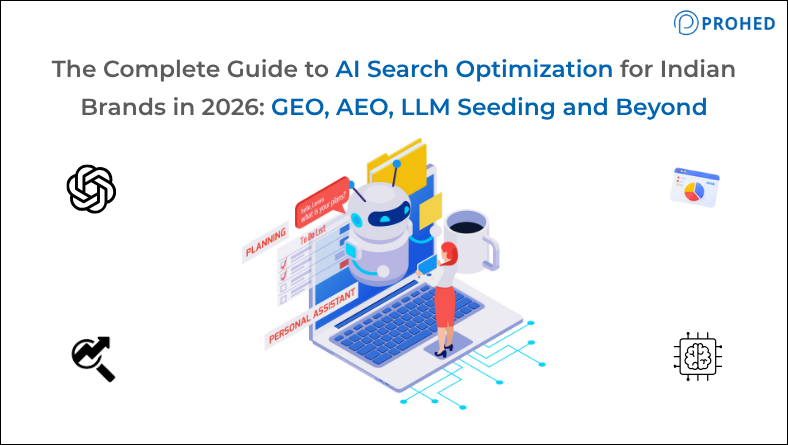
What is AI search optimization? AI search optimization is the practice of structuring your brand’s content, authority signals, and digital presence so that AI-powered platforms like ChatGPT, Perplexity, and Google’s AI Overviews recommend, cite, or reference your brand when users ask relevant questions. Unlike traditional SEO, which focuses on ranking in a list of blue links, AI search optimization focuses on becoming the answer. At Prohed, a performance marketing and SEO agency in Gurgaon, we have seen this shift reshape how D2C, EdTech, fintech, and B2B brands get discovered, and how fast the gap is growing between brands that have adapted and those that have not.
Here is a question that most Indian brand marketers have not asked themselves yet. When someone opens ChatGPT and types “which D2C skincare brand in India should I try,” does your brand come up?
If the answer is no, or if you genuinely do not know, then your brand has a visibility problem that traditional SEO cannot solve. Google rankings matter. They still matter a lot. But in 2026, a growing segment of buyers, particularly urban Indians aged 22-40, are starting their product research with AI tools rather than search bars. They are asking questions in natural language. They are getting synthesised answers rather than link lists. And the brands being recommended in those answers are not necessarily the ones with the highest domain authority or the biggest ad budgets.
They are the ones that understood AI search optimization early and built their presence accordingly.
This guide covers exactly what AI search optimization is, why it works differently from traditional SEO, and how Indian brands can build genuine visibility across every AI-powered discovery channel in 2026.
Why AI Search Is Reshaping Discovery in India
At Prohed, this shift started becoming impossible to ignore in late 2024. Across campaigns for D2C brands, EdTech platforms, and fintech companies, a pattern kept repeating itself. Brands with solid Google rankings and consistent organic traffic were largely absent from ChatGPT and Perplexity responses, even for queries directly tied to their product categories.
We ran AI visibility audits across 14 Indian brand accounts between Q4 2024 and Q1 2025. Eleven of those 14 brands were invisible in ChatGPT responses for their primary category queries. That included brands in D2C wellness, EdTech, and fintech, all categories where buyers are increasingly using AI tools to research before purchasing. The disconnect between Google performance and AI search visibility was consistent enough that we made AI search optimization a core part of our SEO offering from early 2025 onwards.
The Scale of the Shift in India
According to IAMAI and Kantar’s Internet in India Report 2024” , AI-powered search tool usage among Indian urban consumers grew by over 180% between 2023 and 2024, driven primarily by the 22-35 age group. This is exactly the demographic that drives D2C, EdTech, and fintech growth in India, and the one most likely to open ChatGPT before opening Google when they have a product research question.
The mechanics of AI search are fundamentally different from traditional search. When someone searches Google for “best protein supplement India,” they see a ranked list of pages and choose which one to click. When someone asks ChatGPT the same question, the AI draws from the most credible, well-indexed, and frequently cited content across the web and delivers a synthesised recommendation, no click required.
That shift from link list to synthesised recommendation changes what “ranking” means. Getting to position one on Google is still valuable. But appearing in ChatGPT’s recommendation when someone asks a related question is increasingly valuable too, and the two outcomes require quite different strategies.
The Three Disciplines of AI Search Optimization
AI search optimization in 2026 sits across three distinct but connected disciplines. Understanding each one separately before thinking about how they work together is the clearest path to building a strategy that actually performs.
GEO: Generative Engine Optimization
GEO is the practice of optimising your content specifically to be selected, cited, or summarised by generative AI systems like ChatGPT, Perplexity, Claude, and Google’s AI Overviews. The term was formally introduced in academic research published by Princeton, Georgia Tech, and the Allen Institute for AI in 2023, which showed that certain content structures and authority signals significantly increase the probability of AI citation.
The core principle of GEO is that generative AI systems do not rank pages, they select sources. A well-ranked page on Google gets a position in a list. A GEO-optimised piece of content gets selected as a reference point when the AI constructs its answer. These are different outcomes, and they require different optimisation approaches.
What actually influences GEO selection:
- Content that provides direct, quotable answers to specific questions rather than narrative writing that circles around the topic
- Third-party citations and verifiable data embedded in the content – AI systems trust content that references credible external sources
- Clear attribution signals – named authors with verifiable credentials, company attributions, and source links
- Structured data markup – particularly FAQ schema, Article schema, and organisation schema that helps AI systems parse your content correctly
- Breadth of coverage – pages that comprehensively address a topic perform better than shallow overviews, because AI systems prefer sources that provide complete context
The practical implication for Indian brands is that content written to rank on Google, using keyword density and backlink signals as primary optimisation targets, often underperforms in GEO. Content written to genuinely answer a question, attributed to a credible source, with verifiable data embedded, performs significantly better. Understanding the difference between GEO, AEO, and traditional SEO is the starting point for building a strategy that addresses all three.
AEO: Answer Engine Optimization
AEO is specifically focused on appearing in AI-generated direct answers, the featured snippet equivalent of the AI search world. Platforms like Google’s AI Overviews, Bing’s AI answers, and Perplexity’s summary responses all generate direct answers to user queries. AEO is the practice of structuring content so that your brand’s information is the source those answers draw from.
The structural requirements for AEO are quite specific:
- Question-and-answer format is the single most important structural element. Content that frames information as direct answers to explicit questions gets extracted by AI systems far more reliably than narrative content that buries the same information in prose.
- Conciseness in answers matters more than completeness. AI systems extract short, clear, attributable statements. A 40-word direct answer to a specific question is more likely to be cited than a 400-word explanation of the same topic.
- FAQ schema markup is not optional for serious AEO. Without JSON-LD FAQ schema, AI systems and Google’s crawlers cannot identify your question-and-answer content as structured data. This is currently one of the most consistently underimplemented technical requirements across Indian brand websites. The AEO vs SEO question is not an either/or, they work together, but AEO requires distinct structural choices that traditional SEO content does not make.
LLM Seeding: Getting Your Brand Into AI Training and Memory
LLM seeding is the most forward-looking of the three disciplines, and also the least understood. It refers to the practice of building your brand’s presence across the web sources that AI language models draw from when generating responses, both during training and during live retrieval.
AI language models like GPT-4 and Gemini are trained on vast datasets of web content. More recent retrieval-augmented systems also perform live web searches to supplement their training data. In both cases, brands that are mentioned frequently, cited credibly, and discussed across diverse, authoritative sources are more likely to appear in AI-generated recommendations than brands with limited third-party presence.
The practical LLM seeding strategy for an Indian brand involves:
- Being cited in credible Indian publications, YourStory, Inc42, Economic Times, Mint, and category-specific media
- Building presence on platforms AI models treat as credible sources – Wikipedia-adjacent content, industry association mentions, government and institutional citations where relevant
- Generating genuine user discussion on platforms like Reddit, Quora, and industry forums, AI models frequently draw from these for brand recommendations
- Publishing data, research, or original observations that other credible sources cite, original data is more likely to be referenced by AI systems than commentary on other people’s data
Prohed’s guide on LLM seeding strategy covers this discipline in depth. Additionally, for brands specifically focused on ranking inside ChatGPT, the mechanics of how ChatGPT retrieval works are covered in detail there.
The Indian AI Search Landscape: What Makes It Different
Global AI search optimization frameworks do not always translate cleanly to the Indian market. Several factors make the Indian AI search landscape genuinely distinct.
Hinglish and regional language queries are growing fast
Indian users ask AI tools questions in a mix of Hindi and English, “ChatGPT, konsa D2C brand better hai protein ke liye” is a real query type, not a hypothetical. Brands whose content exists only in formal English are simply not being retrieved for these queries. Building content that addresses Indian language search patterns, even in English-language articles that reference regional terms, makes a meaningful difference to AI retrieval.
Indian buyer trust dynamics shape AI recommendation weight
When AI systems generate brand recommendations for Indian audiences, they draw heavily from Indian publication citations, Indian user reviews on platforms like Amazon India and Flipkart, and Indian forum discussions. A brand with strong coverage in YourStory and Inc42 is more likely to appear in an AI recommendation for an Indian user than a brand with equivalent content but no Indian media presence.
Category-specific AI search behaviour varies significantly
An Indian user asking ChatGPT about an EdTech course recommendation behaves differently from one asking about a fintech product. EdTech queries tend to involve more detailed questions about credibility and outcomes. Fintech queries involve more questions about safety and regulatory compliance. AI search optimization for Indian brands needs to account for these category-specific trust signals rather than applying a generic content strategy.
Tier 2 and Tier 3 city AI adoption is accelerating
According to IAMAI’s India Internet Report 2024, AI tool adoption in non-metro Indian cities grew at nearly double the rate of metro adoption in 2023-24. This means AI search optimization for Indian brands cannot be treated as a metro-only or premium-audience strategy. The reach of AI search discovery is expanding to exactly the markets where many Indian brands are now focusing their growth.
The Prohed AI Visibility Framework: A Named Approach to AI Search Optimization
Across work with D2C, EdTech, fintech, and B2B brands at Prohed, a consistent pattern has emerged in what separates brands that appear in AI search results from those that do not. We call this the Prohed AI Visibility Framework, and it has three layers that need to work together.
Layer 1: Content Architecture for AI Extraction
This layer is about making your content technically readable and structurally parseable by AI systems. The requirements here are distinct from traditional SEO. Every key piece of content needs a direct answer block at the top, a 3-4 sentence answer to the primary question the content addresses, written in clear, attributable language. FAQ schema needs to be implemented on every relevant page. Article schema with author credentials needs to be in place. And the content itself needs to be structured around explicit questions rather than narrative topics.
Layer 2: Authority Signal Distribution
This layer is about where your brand is mentioned, cited, and discussed outside your own website. AI systems weight content from authoritative third-party sources more heavily than self-published brand content. Earning mentions in credible Indian publications, industry citations, genuine reviews, and creating shareable, original data all build the strong authority signals AI systems look for when deciding to recommend your brand.
Layer 3: Topical Depth and Cluster Coverage
This layer connects directly to topical authority. AI systems prefer sources that cover a subject comprehensively rather than sources that address it superficially. A brand with 30 deeply interlinked articles covering every angle of its product category is significantly more likely to appear in AI-generated answers than a brand with 5 disconnected articles and a high domain authority score. Building that topical depth is the content investment that produces compounding AI search visibility over 12-18 months.
How to Audit Your Current AI Search Visibility
Before building any AI search optimization strategy, it is worth understanding where your brand currently stands. Most Indian brands have never done this audit, which means they have no baseline against which to measure progress.
A Practical AI Visibility Audit
Step 1: Test brand mention across AI platforms. Open ChatGPT, Perplexity, and Google’s AI Overviews. Ask each platform five questions that a potential buyer in your category would realistically ask. Questions like “which brands should I consider for [your product category] in India?” or “what do you know about [your brand name]?” Record what comes up. If your brand is absent, you have your baseline.
Step 2: Check the sources AI systems are drawing from. When AI platforms do cite sources in their answers, look at which websites and publications are being referenced. These are the authority sources AI systems trust for your category. If your brand is absent from those sources, that is a gap worth addressing through PR and third-party publication outreach.
Step 3: Audit your FAQ schema implementation. Check whether your website has JSON-LD FAQ schema implemented on pages with question-and-answer content. If it is absent, every day without it is a day your FAQ content is invisible to AI structured data extraction.
Step 4: Assess content structure against AI extraction requirements. Review your ten most important pieces of content. Does each one have a direct answer block at the top? Are key claims attributable to named sources? Is the content structured around explicit questions rather than narrative topics? The gaps identified here form your content restructuring priority list.
Common AI Search Optimization Mistakes Indian Brands Make
After working across multiple Indian brand categories, certain mistakes come up consistently. Most of them are straightforward to fix once identified.
- Treating AI search as a future concern rather than a present one: The shift is already happening. Brands that wait until AI search becomes “mainstream” before optimising for it are waiting until the competitive window has closed. The brands appearing in ChatGPT recommendations today are building familiarity with AI systems that will compound over the next two to three years.
- Publishing content without direct answer blocks: Most Indian brand content is written in narrative prose without explicit question-and-answer structure. This content performs reasonably well in traditional SEO but gets passed over by AI extraction systems looking for clear, quotable answers. Adding direct answer blocks to existing high-traffic content is one of the fastest and highest-impact AI search optimisation changes available.
- No FAQ schema on FAQ content: FAQ sections without JSON-LD schema are invisible to AI structured data extraction. This is a technical fix that takes a developer session to implement across an entire site, and yet it remains one of the most consistently absent elements across Indian brand websites.
- Absent from third-party citation sources: Many Indian brands invest heavily in their own content but neglect the external source presence that AI systems use to validate brand authority. A brand that only appears on its own website is essentially invisible to an AI system looking for third-party validation.
- Ignoring brand authority building for AI search: Traditional SEO rewards backlinks. AI search rewards mentions, citations, and discussions in credible sources. These are related but distinct activities, and many brands are investing in one without the other.
Measuring AI Search Performance
This is the part of AI search optimization that most guides gloss over, because measurement here is genuinely harder than traditional SEO measurement. But it is not impossible.
- Direct AI mention monitoring: Set up regular testing schedules, weekly or fortnightly, where team members test brand visibility across ChatGPT, Perplexity, and Google AI Overviews for a consistent set of category queries. Track whether brand mentions increase over time as content and authority-building work progresses.
- AI Overview appearances in Google Search Console: Google Search Console now shows data on AI Overview appearances for pages on your site. This is a direct, measurable signal of AI search visibility that can be tracked over time alongside traditional ranking data.
- Third-party citation tracking: Monitor how frequently your brand is being mentioned in the publications that AI systems draw from, Indian media, industry forums, review platforms. Growing citation frequency in these sources correlates with improving AI search visibility.
- Share of voice in category queries: Periodically test which brands appear in AI-generated responses for your category’s most important queries. Tracking which competitors appear and how frequently gives a competitive AI visibility benchmark to work toward.
For brands already using AI-driven marketing automation, integrating AI search visibility tracking into existing performance reporting frameworks makes the measurement more manageable.
AI Search Optimization for Different Indian Business Categories
The core framework applies across categories. However, the specific execution varies depending on buyer behaviour and trust dynamics.
| Business Type | Primary AI Search Focus | Key Content Types for AI Extraction |
| D2C / E-commerce | Product recommendation queries, comparison queries | Ingredient guides, comparison articles, buyer FAQs, review summaries |
| EdTech | Course quality and outcomes queries | Outcome data, faculty credentials, student testimonials, curriculum FAQs |
| Fintech / BFSI | Trust and safety queries, product comparison | Regulatory compliance content, fee transparency, security FAQs |
| Healthcare | Treatment and provider credibility queries | Doctor credentials, treatment outcome content, patient FAQ |
| B2B / SaaS | Vendor evaluation and capability queries | Case studies with numbers, integration guides, pricing FAQs |
| Local Services | “Best [service] in [city]” queries | Location-specific content, local review aggregation, local FAQ |
The Bottom Line
Here is what Prohed’s own client work shows. Brands that implement all three layers of the Prohed AI Visibility Framework, structured content for AI extraction, authority signal distribution, and topical depth, see AI Overview appearances improve by 2-3x within three months compared to brands making only traditional SEO changes in the same period.
That gap compounds over time. A brand with six months of consistent AI search optimization work becomes progressively easier for AI platforms to cite, because AI systems develop familiarity with well-structured, frequently referenced sources. Every month of consistent work shortens the ranking timeline for every piece of content published after it.
The window to build that advantage at low competitive cost is open right now. Most Indian brands are still treating AI search as something to think about later. Later is when it gets expensive and crowded.
Why Starting Now Matters More Than Starting Perfect
Traditional SEO built visibility for a world where search meant Google and results meant a list of links. That world is not gone. It now sits alongside a parallel discovery ecosystem where synthesised answers shape purchase decisions before a user ever clicks through to a website.
The brands that understand both worlds and build for both simultaneously are the ones that will be genuinely hard to displace from either. Copying a few well-ranked pages is manageable. Replicating years of comprehensive, cited, structured content built specifically for AI extraction is a completely different challenge.
Prohed offers Search Engine Optimization services in Gurgaon covering the full stack, traditional SEO, topical authority building, AEO, GEO, and LLM seeding, for Indian brands across D2C, EdTech, fintech, healthcare, and B2B. If you want to know where your brand currently stands in AI search visibility and what closing that gap would take, we start with a free audit.
Frequently Asked Questions
1. What is AI search optimization?
It is the practice of making sure your brand shows up when AI tools like ChatGPT, Perplexity, or Google’s AI Overviews generate answers for your category. Unlike regular SEO where you aim for a link in a list, here the goal is to become part of the answer itself.
2. What is the difference between GEO and AEO?
GEO is about being a source AI draws from broadly when constructing answers. AEO is more specific, it is about being the direct answer to a particular question. Think of GEO as building general credibility with AI systems and AEO as winning specific answer slots. Both matter and they work best when built together.
3. Does AI search optimization replace traditional SEO?
No, and it would be misleading to suggest otherwise. Brands that rank well on Google tend to get cited more in AI answers anyway, because AI systems pull from well-indexed, authoritative web content. AI search optimization adds a layer on top of your existing SEO foundation, it does not replace it.
4. How do I check if my brand appears in ChatGPT or Perplexity?
Open either platform and ask five questions a potential buyer in your category would realistically type. Something like “which skincare brands in India are worth trying” or “best EdTech platform for working professionals in India.” If your brand does not come up, you have a clear visibility gap. Prohed runs a free AI visibility audit that tests this systematically across 10-15 category-specific queries.
5. How long does AI search optimization take to show results?
Technical changes like FAQ schema implementation can start showing impact within a few weeks. Content restructuring with direct answer blocks typically improves AI Overview appearances within one to three months. LLM seeding and third-party citation building is a longer investment, meaningful change in AI recommendation frequency generally takes six to twelve months of consistent work.
6. What is LLM seeding and why does it matter specifically for Indian brands?
LLM seeding means getting your brand mentioned across the sources AI models actually draw from, Indian publications, forums, review platforms, and original research. For Indian brands specifically, AI systems weight Indian media citations more heavily when generating recommendations for Indian-context queries. A brand that only lives on its own website is at a real disadvantage compared to one mentioned regularly in YourStory, Inc42, and Indian product review communities.
7. Which Indian brands benefit most from AI search optimization right now?
D2C brands in research-heavy categories like skincare, nutrition, and fashion see fast results because buyers genuinely ask AI tools for product recommendations. EdTech and fintech brands benefit because trust and outcomes are common AI search questions in those categories. Locally focused service businesses, healthcare clinics, real estate agencies, coaching centres, benefit because “best [service] in [city]” queries are increasingly going to AI tools before Google Maps or Google Search.
Want your brand to appear in AI search results before competitors do? Get an AI Search Visibility Audit.
Schedule a Free Strategy Call with PROHED Today