AI search refers to search experiences where generative AI synthesizes an answer rather than showing a ranked list of links. New data shows google.com has become AI Mode’s second most-cited domain, and the primary driver is Google Business Profile cards, not organic results. At PROHED, a performance marketing agency in Gurgaon, this confirms what we’ve been building into client strategy for months: your Google Business Profile is now a direct input into how Google AI search describes your business to potential customers.
Here’s what that data actually means in plain terms.
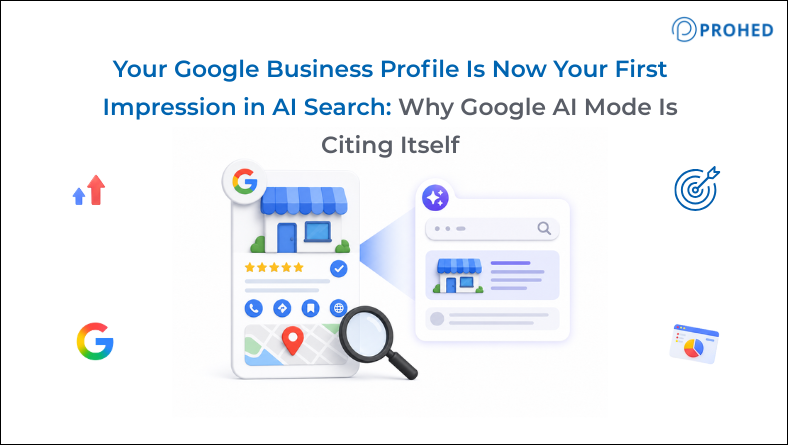
When someone opens Google AI Mode and searches for a restaurant, a healthcare provider, a home services company, or a hotel, the AI generates a response. And in a growing share of those responses, the citation doesn’t point to the business’s own website. It points to a Google-hosted Business Profile card containing that business’s hours, photos, reviews, and contact details.
Google is citing itself. But the information inside those citations comes from data you control.
That’s the shift that matters for every brand thinking about AI for SEO in 2026. Your website still matters. However, your Google Business Profile has become a parallel first impression, one that now appears inside AI-generated answers whether you’ve optimized it or not.
The question is whether the impression it creates is working for your business or against it.
What the Data Actually Shows
According to Profound’s research covering April to June 2026, citation share for google.com in Google AI Mode rose by 8.4 times over that period. The growth was concentrated in two specific Google-hosted surfaces.
The first is Google Business Profile cards, which appear most frequently in local-intent searches. The second is Product Knowledge Panels, which surface in product comparison, compatibility, and specification queries.
Profound’s analysis identified five sectors where the Business Profile citation increase was most pronounced:
- Hospitality and travel
- Home services
- Restaurants and dining
- Real estate
- Healthcare
These aren’t niche categories. Together they represent a significant portion of local business search volume. And across all five, google AI mode is pulling directly from Business Profile data rather than linking to brand websites for a meaningful share of queries.
This pattern connects to something SE Ranking data identified earlier in 2026: Google properties accounted for approximately 17% of 1.3 million citations in AI Mode, rising to around 20% when YouTube was included. The Profound data suggests that share has grown further, driven specifically by the Business Profile and Product Knowledge Panel surfaces.
The implication is direct. For local and product queries, google search AI is increasingly describing businesses through their own Google-hosted data rather than through their website content. That makes the quality and completeness of that Google-hosted data more commercially significant than it’s ever been.
What It Actually Means When Google AI Mode Cites Itself
This is the part that deserves more attention than the headline suggests.
When google AI mode citing itself shows up in citation data, it doesn’t mean Google is pulling from its own editorial content. It means the AI is referencing Google-hosted structured data, specifically your Google Business Profile card, to construct its response.
The distinction matters. The citation lands on Google’s infrastructure. But the information inside that citation, your hours, services, photos, category, reviews, and attributes, comes from data your business controls.
Consequently, google new AI behaviour hasn’t made the Business Profile irrelevant. It’s made it more consequential. A user searching for a healthcare provider, a home services company, or a restaurant in google AI search may receive a fully synthesized response sourced entirely from the Business Profile, without ever clicking through to the website.
That response is your first impression. And right now, for most businesses, it’s being shaped by a profile that was set up years ago and hasn’t been meaningfully updated since.
Furthermore, this pattern is concentrated in specific sectors: hospitality and travel, home services, restaurants and dining, real estate, and healthcare. If a business operates in any of these categories, google search AI is more likely to construct its description from Business Profile data than from any other source.
The practical implication is straightforward. The brands investing in Business Profile completeness are having their AI-generated impression shaped deliberately. The ones that aren’t are leaving it to whatever data happens to be in the profile, complete or not, current or not, compelling or not.
The PROHED GBP AI Citation Optimization Framework
At PROHED, we’ve built a structured approach to Google Business Profile optimization for AI search visibility. The PROHED GBP AI Citation Framework covers six areas that directly influence how Business Profile data appears in AI-generated responses.
1. Business Category and Service Completeness
The primary category selection is the single most influential signal in how google AI classifies a business for query matching. The category tells the algorithm which queries a business is eligible to appear in. Secondary categories add nuance.
Beyond categories, the services section is where most profiles are weakest. Listing individual services with descriptive names and short descriptions gives the AI structured, extractable data about what the business actually does. A legal firm that lists “Family Law,” “Divorce Mediation,” and “Child Custody” as discrete services is far more likely to appear in specific, intent-matched AI search responses than one that lists only “Legal Services.”
2. Photos: Volume, Recency, and Coverage
Google AI mode citing itself through Business Profiles means the visual data in those profiles is now part of the AI-generated impression. Profiles with a high volume of recent, high-quality photos across multiple categories, including interior, exterior, team, product, and service photos, provide richer visual context for AI-generated cards.
Additionally, photo recency matters. Profiles that haven’t added new photos in over six months appear stale to the algorithm. A consistent cadence of new photo additions, even once a month, signals an actively maintained profile.
3. Review Volume, Recency, and Response Rate
Reviews are one of the most heavily weighted inputs in local AI for SEO visibility. The AI draws on review sentiment and volume when describing a business’s reputation in a generated response.
Three specific review signals matter most. First, overall volume: more reviews provide a stronger signal. Second, recency: recent reviews carry more weight than older ones, so a business with 200 reviews earned over five years and nothing recent is signaling a stale profile. Third, response rate: responding to reviews, both positive and negative, signals active management and correlates with stronger AI visibility for local queries.
4. Q&A Section Optimization
The Q&A section of a Google Business Profile is significantly underused by most businesses. However, it’s one of the most directly extractable content surfaces for google search AI responses.
Adding well-structured questions and detailed answers covering common customer queries, such as parking, payment methods, wait times, service process, or product availability, gives AI Mode structured, accurate content to pull from when constructing a response. The questions should mirror what potential customers would actually type in a search.
5. Business Description With Keyword Specificity
The business description field allows 750 characters. Most profiles use a fraction of that space with generic copy.
A description that specifically names service types, locations served, specializations, and relevant industry terms gives the google algorithm more structured signals to work with when matching the profile to specific queries. It also gives google AI more accurate source material when generating a description of the business in a synthesized response.
6. Attribute Completeness
Attributes cover accessibility features, payment methods, service options, health and safety practices, and category-specific characteristics. They’re often overlooked during initial profile setup and rarely updated afterward.
For AI search specifically, attributes provide the kind of specific factual detail that distinguishes one business from another in a generated response. A restaurant with “outdoor seating,” “accepts reservations,” and “family-friendly” attributes produces a more useful AI-generated description than one that provides no attribute information at all.
Related Read: Google Search Ranking Volatility Alert: How to Respond When Rankings Shift Without a Confirmed Update
Will AI Replace SEO? What This Data Actually Answers
The question of will Ai replace SEO comes up every time a development like this one surfaces. The Business Profile data above actually answers it.
No. But it changes what SEO encompasses.
Google search engine optimization used to mean website-centric work: on-page content, technical infrastructure, backlinks. Those things still matter. However, google seo marketing in 2026 also includes the structured data inside Google’s own properties: Business Profile completeness, review signals, Q&A content, and service listings.
The brands that treat these as part of their SEO surface area will appear in AI-generated responses more accurately and more frequently than those that don’t. The ones that treat Business Profile as a set-and-forget utility will have their AI-generated impression shaped by whatever data happens to be in the profile, regardless of whether it’s current, complete, or commercially compelling.
Among marketing agencies in India and top digital marketing companies in India, the ones building this kind of holistic approach to AI visibility are already ahead of the majority who are still optimizing only for traditional organic rankings. The gap between those two approaches will grow considerably over the next 12 to 24 months as google AI mode expands its reach.
At PROHED, GBP optimization sits alongside our broader SEO, Performance Marketing, B2C Lead Generation, Social Media Marketing, and E-commerce Marketing work because local visibility and AI search visibility are now the same conversation for most service and product businesses.
Conclusion
Google AI Mode citing Google’s own Business Profile cards as its second most referenced domain is not a Google SEO loophole. It’s a structural feature of how google AI search generates local and product responses.
The data you populate in your Google Business Profile is the data that appears in those citations. Which means the business with the most complete, current, and well-structured profile is the one most likely to be described accurately, compellingly, and frequently in AI search responses.
The optimization work isn’t complex. Categories, services, photos, reviews, Q&A content, descriptions, and attributes are all within your direct control. Furthermore, unlike many google algorithm factors that require external validation to influence, Business Profile data is owned and updated by you. That makes it one of the most accessible and highest-leverage AI for seo investments available in 2026.
Frequently Asked Questions
1. What is Google AI Mode and how does it affect local businesses?
Google AI Mode gives searchers a direct, written summary instead of a standard list of links. For local businesses, this means potential customers looking for a nearby restaurant, clinic, or service provider will often see an AI answer pulled directly from a Google Business Profile, rather than clicking through to visit the actual website.
2. Why is Google.com the second most-cited domain in AI Mode?
Google’s AI frequently gets its details from its own built-in features, such as Google Business Profiles and product panels. When someone searches for a local business, the AI uses that structured internal data to write its answer, which is why it cites google.com as the source instead of the business’s own web domain.
3. Which industries are most affected by AI Mode citing Google Business Profiles?
The five industries impacted the most are hospitality and travel, home services, restaurants, real estate, and healthcare. If you operate in one of these fields, Google AI is far more likely to describe your business using your Google Profile data rather than reading the content published on your website.
4. How can I optimize my Google Business Profile for AI search visibility?
You can boost your AI visibility by keeping your profile complete, accurate, and regularly updated. Pick the most accurate primary and secondary categories, describe every individual service you offer, and post fresh, high-quality photos. It also helps to collect and reply to reviews, fill out common questions in the Q&A section, and complete all extra attribute fields like payment types and amenities.
5. Does a Google Business Profile citation in AI Mode lead to website traffic?
No. A citation in AI Mode means the Business Profile card was referenced as a source for the AI-generated response. The user sees the information from the profile, but does not necessarily click through to the website. However, visibility in the AI-generated response builds brand exposure, and can drive branded searches and direct traffic even though the click doesn’t happen in the moment.
6. Will AI replace SEO for local businesses?
No. But it does change what SEO means. On-site SEO for a brand’s website is still important. But given Google’s current propensity to reference a brand’s structured data in its own ecosystem, the completeness of a Business Profile and the review signals it conveys now functions as a second SEO surface. Brands that bake Business Profile optimization into their broader SEO strategy will outperform those that don’t for AI search visibility.
7. How often should a Google Business Profile be updated?
At minimum, monthly. Review and update photos, check that services and hours are current, respond to recent reviews, and add new Q&A content when new customer questions arise. The Google algorithm treats profile recency as a quality signal, and AI Mode draws more reliably from profiles that appear actively maintained.
8. How does PROHED approach Google Business Profile optimization for AI search?
PROHED applies the GBP AI Citation Framework across client profiles, covering category selection, service completeness, photo strategy, review management, Q&A optimization, and attribute completeness. This work is integrated with broader SEO and performance marketing strategy so that organic AI visibility and paid search performance work toward the same commercial outcomes.
Are you optimizing your Google Business Profile for AI search responses? PROHED can audit your profile and build an AI citation strategy to ensure search engines describe your business accurately and compellingly everywhere AI Mode generates answers.
Schedule a Free Strategy Call with PROHED Today