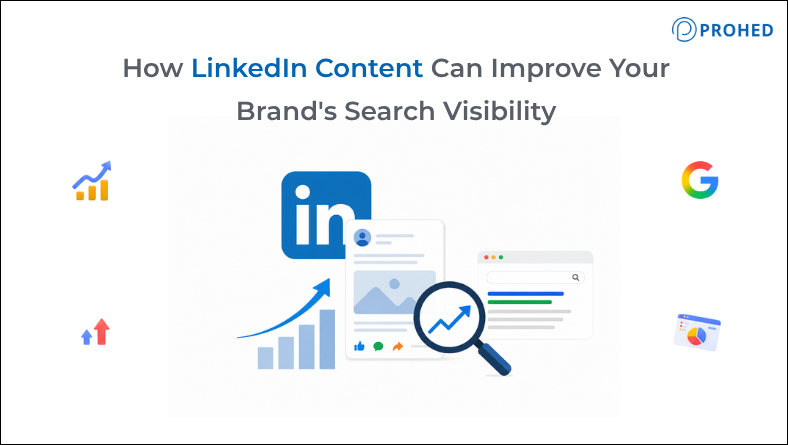
LinkedIn content is everything you publish, from a short text or video post to an entire newsletter or PDF carousel. While many marketers still view LinkedIn as primarily a B2B networking and lead-gen platform, it’s also a powerful SEO tool. Google indexes LinkedIn posts, articles and company pages to feature on top of search results and in AI-powered answers. At PROHED, we tailor LinkedIn strategies that encourage robust engagement and boost your visibility in Google searches, because the two are most effective when combined.
Here’s something most brands miss entirely.
They spend months building a LinkedIn presence. Regular posts. Company page updates. Thought leadership articles from the founding team. And then they measure the results entirely through LinkedIn’s native analytics: impressions, reactions, followers.
They never check whether any of that content is ranking on Google.
A significant amount of it is. LinkedIn profiles rank for branded searches. LinkedIn articles rank for industry keywords. Company pages appear in knowledge panels. And as Google’s platform properties update (July 2026) has confirmed, social content now competes directly in search results alongside website pages.
Treating LinkedIn content as a search visibility tool, not just a networking tool, is one of the most underused advantages available in content and marketing strategy right now.
Why LinkedIn Content Ranks on Google
LinkedIn has one of the strongest domain authorities of any website on the internet. Consequently, content published on LinkedIn inherits a portion of that authority and frequently ranks in Google search results for competitive keywords.
Three specific types of LinkedIn content are indexed and rankable:
Content Type | Google Search Behavior |
LinkedIn Articles | Rank for long-tail industry keywords, appear in web results |
LinkedIn Company Pages | Rank for branded searches, appear in knowledge panels |
Individual Profile Pages | Rank for name + role searches, appear in top results |
LinkedIn Posts (text) | Appear in Google Discover, occasionally in web results |
LinkedIn Videos | Indexed and rankable in Google Video search |
LinkedIn Newsletters | Indexed as standalone pages, rank for topic keywords |
This isn’t accidental. Google actively crawls and indexes LinkedIn pages because the platform produces original, structured, professional content at a massive scale. Furthermore, as Google’s AI Overviews increasingly pull from third-party sources to construct answers, LinkedIn articles and newsletter editions are becoming citation candidates for professional and B2B queries.
The PROHED LinkedIn Content SEO Framework
At PROHED, we structure LinkedIn marketing content around four inputs that simultaneously improve on-platform performance and Google search visibility.
1. Keyword-Intentional Article Topics
LinkedIn’s native article editor produces standalone, indexable pages. Unlike standard posts, articles have dedicated URLs, meta descriptions, and heading structures that Google can crawl and evaluate like any webpage.
The most impactful use of LinkedIn articles for search visibility is targeting long-tail keywords that a brand’s website doesn’t yet rank for. If the company blog targets “B2B lead generation strategy,” a LinkedIn article can target “B2B lead generation for SaaS companies in India” and rank independently.
What makes a LinkedIn article rank on Google:
- A keyword-intentional headline that mirrors actual search queries
- A clear H2 structure with specific, searchable subheadings
- Minimum 600 to 800 words of original, specific content
- An internal link back to the brand’s website for authority transfer
- A direct answer in the first paragraph that matches search intent
2. Consistent Newsletter Publishing
LinkedIn Newsletters are significantly underused as a search visibility tool. Each newsletter edition is published as a standalone indexed page with its own URL. Consequently, a brand publishing a weekly newsletter generates 52 additional indexed pages per year, all carrying LinkedIn’s domain authority.
For marketing strategies targeting professional audiences, this means a newsletter that covers a consistent topic over several months can build significant topical authority in Google’s eyes, eventually ranking for cluster keywords around that topic.
Newsletter topics that typically earn Google visibility:
- Category-specific industry trends (“state of B2B marketing in India 2026”)
- How-to content with specific, actionable steps
- Data-backed observations from actual work or campaigns
- Opinions on recent platform or algorithm changes
3. Profile and Company Page Optimization for Branded Search
This is where most brands lose ground without realizing it.
When a potential client searches a brand name on Google, the results typically show the website, and then several LinkedIn entries: the company page, founder profiles, and sometimes individual posts. The information Google displays from those LinkedIn pages matters to the brand impression being formed.
Company page optimization checklist:
Element | What to Optimize |
Company name and tagline | Include primary keyword or service descriptor |
About section | Write 250+ words using natural keyword language |
Specialities | List specific services, not generic category terms |
Location | Include city name for local search relevance |
Featured section | Link to top-performing website pages |
Regular posts | Consistent activity signals an active, credible brand |
Individual founder and team profiles matter equally. A CEO profile that ranks on page one for “performance marketing CEO Gurgaon” is brand real estate that no paid campaign can replicate.
4. Strategic Hashtag and Topic Selection
LinkedIn’s internal search and Google’s crawling of LinkedIn both respond to topical consistency. A brand that publishes exclusively about one subject area, say, B2B lead generation or D2C growth marketing, accumulates topical authority faster than one posting across many unrelated themes.
Selecting three to five core topic areas and maintaining content discipline around them is a marketing strategy decision as much as a LinkedIn one. Topic consistency tells both LinkedIn’s algorithm and Google’s crawlers what the brand genuinely specialises in, which improves relevance signals for category-level searches.
Additionally, hashtags on LinkedIn are searchable surfaces. Including two to four specific hashtags per post, particularly those with established follower counts on LinkedIn, adds discovery potential beyond the brand’s existing audience.
LinkedIn Content and AI Search Visibility
This is the angle most marketing and strategies content on this topic misses entirely.
Google’s AI Overviews and Perplexity both pull from LinkedIn pages when constructing answers to professional and B2B queries. A LinkedIn article that provides a direct, structured answer to a specific professional question is a genuine AI citation candidate.
The same principles that make website content citable by AI apply to LinkedIn:
- A direct answer in the first paragraph
- Specific data points or original observations rather than generic advice
- A named framework or methodology that can be attributed to the brand
- A structured format that makes individual sections extractable
For brands asking whether will AI replace SEO, the answer is that it changes what content earns visibility. LinkedIn content built with these structural elements earns AI citations that build brand awareness with professional audiences even when they never visit the website directly.
What LinkedIn Content Does That Website Content Can’t
This comparison helps clarify why LinkedIn content should sit alongside website content in a visibility strategy, not compete with it.
Factor | Website Content | LinkedIn Content |
Domain authority | Brand-built, variable | LinkedIn’s massive authority, inherited |
Audience reach | Search traffic only | Platform + search traffic |
Trust signal for B2B buyers | Professional but expected | Peer-to-peer credibility |
Indexed immediately | No, depends on crawl frequency | Usually within 24 to 48 hours |
AI citation potential | High with GEO optimisation | High, especially for professional queries |
Branded search contribution | Primary | Secondary and supplementary |
The insight here is that both content surfaces serve the same brand. A buyer researching a company finds the website AND the LinkedIn page. Both create impression. Both can rank. Optimizing both is therefore a compounding advantage.
Let PROHED Build Your LinkedIn Content Strategy
At PROHED, LinkedIn marketing service sits within a broader search visibility and performance marketing system. We build article topic maps based on keyword gaps, optimize company pages and founder profiles for branded search, structure LinkedIn newsletters for Google indexation, and connect LinkedIn content performance to broader SEO and lead generation reporting.
This connects directly to our SEO, Social Media Marketing, B2B Lead Generation, and Performance Marketing services. Among top digital marketing agencies in Gurugram, the teams building connected LinkedIn and SEO strategies are consistently outperforming those treating the two as separate workstreams.
As a social media marketing company in Gurgaon and performance marketing agency in India, PROHED builds LinkedIn content strategies that generate professional credibility, search rankings, and AI citation eligibility at the same time.
Conclusion
LinkedIn content is no longer just a professional networking asset. In 2026, it actively contributes to Google search visibility, AI citation eligibility, and branded search presence in ways most brands haven’t yet built a strategy around.
LinkedIn articles rank for industry keywords. Company pages rank in branded searches. Newsletters generate indexed pages that build topical authority. And AI Overviews are beginning to cite LinkedIn content for professional queries.
The brands building linkedin marketing strategy with search intent in mind are earning dual visibility: on the platform and in Google simultaneously. That compounding advantage is available right now and is still underused by most competitors.
Frequently Asked Questions
1. Does LinkedIn content rank on Google?
Yes. LinkedIn has huge domain authority and content published on the platform routinely appears in Google search results. LinkedIn articles, LinkedIn newsletter articles, LinkedIn company pages and individual LinkedIn profiles are all Google indexable and rankable. Articles in particular, often rank for longtail professional and industry keywords.
2. How does LinkedIn content improve search visibility?
LinkedIn content can help with search visibility in three ways: by adding the page to Google’s index and ranking for professional and industry related keywords, by adding the page to the search result for brand name queries, and by creating AI Overviews that recommend the page to answer professional queries. Each of these help to increase brand awareness in Google and do not require a change to any existing website content.
3. What LinkedIn content type ranks best on Google?
LinkedIn Articles and LinkedIn Newsletters rank best because they are indexable and consistently rank, as they produce individual page URLs with a heading hierarchy that can be targeted and ranked. Company pages rank highly for branded queries. Individual pages rank well for name and role searches, which is great for founders and senior leaders.
4. How should I optimize LinkedIn articles for Google search?
Use a headline that mirrors an actual search query. Structure the article with clear H2 subheadings. Write a minimum of 600 to 800 words with specific, original content. Include a direct answer in the first paragraph. Add an internal link to the brand’s website. These elements improve Google ranking potential significantly.
5. How often should a brand publish LinkedIn content for search visibility?
Consistency matters more than frequency. Publishing two to three high-quality articles or newsletter editions per month, focused on three to five core topic areas, builds topical authority more effectively than posting daily across unrelated subjects.
6. Can LinkedIn content be cited in Google AI Overviews?
Yes. Google AI Overviews pick up LinkedIn pages when they’re the best source for a professional or B2B query. LinkedIn pieces that have a direct answer to the question in the first paragraph, include specific data points on a theme, and anchor the message around a named framework are more likely to get cited than generic posts.
7. How does LinkedIn content relate to a brand’s overall SEO strategy?
LinkedIn content complements website SEO by targeting keywords the website hasn’t ranked for yet, building topical authority through consistent newsletter publishing, and contributing to branded search results when potential clients search the brand name. Both surfaces serve the same buyer and should be optimised together.
Is your LinkedIn content working as a search visibility asset, or just a networking tool? PROHED can build a LinkedIn content strategy that ranks on Google, earns AI citations, and generates qualified leads simultaneously.
Schedule a Free Strategy Call with PROHED Today