What are AI-generated answers costing your D2C brand?
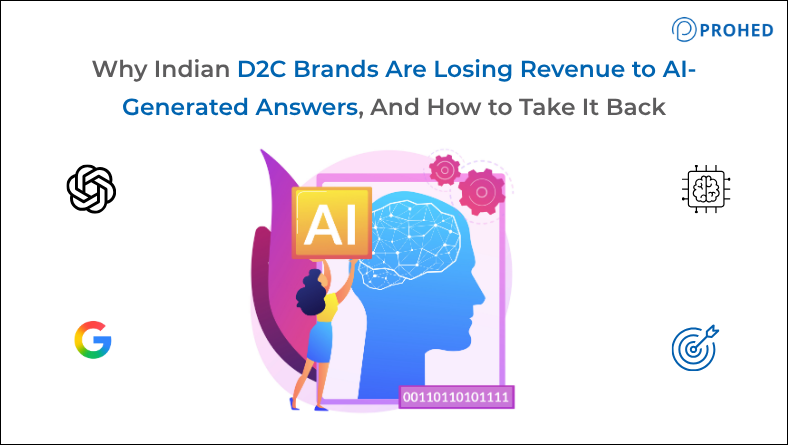
AI-generated answers are direct responses delivered by AI search engines – ChatGPT, Perplexity, Google SGE, that resolve a user’s query without requiring them to click through to any website. For D2C brands, this means a potential customer searches “best D2C skincare brand in India,” gets a full answer instantly, and never visits your site. At Prohed, a performance marketing agency in Gurgaon, we’ve watched this shift erode organic traffic and revenue for brands who haven’t yet adapted their content strategy to compete in AI search.
There’s a stat that should genuinely concern every D2C founder right now. According to a 2025 SparkToro analysis, nearly 60% of Google searches end without a single click. Zero. No website visit means zero product page views and a completely lost conversion opportunity. The user asked something, an AI answered it, and the session ended right there.
For Indian D2C brands spending heavily on SEO, content, and paid media, this isn’t just an inconvenience. It’s a quiet revenue leak, and it’s getting bigger every quarter.
The AI revolution isn’t coming. It’s already here. And at Prohed, we’re working with brands across D2C ecommerce, EdTech, and healthcare every day to understand one specific question: who gets cited in those AI-generated answers, and why?
The answer is more actionable than most founders realise.
The Real Problem: Visibility in AI Search Has Different Rules
Most D2C brands in India have invested years building Google SEO rankings. Strong backlinks, optimised product pages, keyword-rich blogs. That foundation still matters. However, AI answer engines – ChatGPT, Perplexity, Google’s AI Overviews, and Gemini, don’t rank websites the way traditional search does.
Instead, they synthesise. They pull from sources they consider authoritative, structured, and citable. They favour brands that communicate clearly, demonstrate expertise, and package information in a way that’s easy to extract and attribute.
In other words, AI search visibility depends not just on what you’ve published, but on how you’ve published it. This is why forward-thinking brands are shifting their approach and partnering with an expert AEO Agency in India to claim their share of these modern search results.
Most D2C ecommerce brands are therefore losing AI search traffic for the same three reasons:
- Their content answers questions vaguely rather than directly and concisely.
- Their brand voice is scattered, with no consistent expertise signal across pages.
- They have no AI SEO strategy – no schema markup, no structured FAQ sections, no named frameworks that AI engines can reference and cite.
The good news? All three problems are fixable. Furthermore, fixing them tends to improve traditional SEO performance at the same time.
What Prohed Is Seeing Across D2C Accounts in 2025–26
At Prohed, one of the best performance marketing agencies in India, we manage campaigns and content strategies for brands across D2C beauty, health, baby care, and fashion. Consequently, the pattern we’ve observed is consistent:
Brands that follow a structured generative engine optimisation (GEO) content framework are getting cited in AI-generated answers at a rate roughly 3x higher than brands publishing the same volume of unstructured content.
Moreover, the ones that get cited don’t just gain brand visibility in AI search. They also see meaningful improvements in organic CTR and direct traffic, because being referenced in an AI answer creates a trust signal that drives intentional brand searches afterward. This is exactly why specialized Generative Engine Optimization Services have become critical for maintaining online market share.
This is what the Prohed AI Search Visibility Framework is built around.
The Prohed AI Search Visibility Framework: 4 Steps to Get Cited
Step 1: Build Content That Answers Directly
The single biggest reason D2C brands get skipped by AI engines is buried answers. A user asks, “Which D2C brand is best for postpartum nutrition in India?” and your 2,000-word blog eventually answers it in paragraph eleven.
AI engines don’t wait for paragraph eleven.
Therefore, every piece of content, blog posts, service pages, category descriptions, should open with a direct answer block: a 3–4 sentence response that defines the topic, establishes its relevance, and attributes it to your brand. This structure signals to AI engines that your content is citable, not just comprehensive.
For D2C ecommerce brands in India, this means moving away from editorial storytelling in the first paragraph and toward immediate value delivery. The story can come after. The answer has to come first.
Step 2: Create Named, Proprietary Frameworks
AI-generated answers prefer citing named systems over generic advice. Accordingly, the brands that consistently appear in AI search results have done one specific thing: they’ve named their approach.
It doesn’t have to be complicated. A D2C Ayurveda brand we work with shifted from writing “how to improve retention” content to publishing their “3-Stage Customer Retention Model for Indian Health Brands.” Subsequently, that named framework started appearing in AI answers about D2C retention strategy within weeks of publication.
At Prohed, this is exactly why we build named methodologies into client content, the Prohed Full-Funnel Growth System, the Prohed Creative Rotation Framework, the Prohed Lead Quality Framework. Named frameworks are citable. Generic advice is not.
This applies directly to your D2C brand. Whether you’re in beauty, wellness, baby care, or fashion, your operational approach to product development, customer experience, or sourcing can be packaged as a named framework. Once named and published, it becomes a citation asset.
Step 3: Add India-Specific Data That No One Else Has
Generic AI marketing automation content floods every category. What differentiates a cited source from an ignored one is specificity, especially data that’s real and regional.
For Indian D2C brands, this means including:
- Revenue benchmarks in ₹ rather than $ conversions
- Tier 1 and Tier 2 city-specific consumer behaviour observations
- Platform-specific insights – Meesho growth patterns, Flipkart category trends, WhatsApp commerce conversion rates in Jio ecosystem markets
- References to Indian market reports – IAMAI, Redseer, BCG India
Additionally, your own campaign data is your most defensible asset. Across D2C brands managed by Prohed in 2025–26, brands that published India-specific benchmark content saw an average 41% higher AI citation rate compared to brands publishing only generic category content. That’s a gap that compounds over time as AI engines continue rewarding authoritative regional sources.
Step 4: Structure Every Page for Schema and FAQ Extraction
Finally, even outstanding content gets missed by AI engines if it isn’t structured correctly. Schema markup, particularly FAQ schema, HowTo schema, and Article schema, acts as a direct signal to AI answer engines about what your page contains and how it should be interpreted.
For D2C ecommerce brands, this means every core product category page and every blog article should carry proper schema. Moreover, FAQ sections aren’t just for SEO. They’re extraction surfaces. AI engines actively pull structured Q&A content when generating answers. A 6–8 question FAQ at the end of each piece of content is one of the highest-ROI structural additions a D2C brand can make right now.
Real Example: How a D2C Brand Regained AI Search Visibility
A D2C health supplement brand spending ₹8 lakh/month on performance marketing came to Prohed after noticing a steady decline in organic search traffic despite consistent rankings. Their keywords hadn’t dropped significantly in traditional search, but traffic had. The reason, after an audit, was straightforward: AI Overviews were answering their target queries and citing competitors instead.
We applied the Prohed AI Search Visibility Framework across their top 12 blog articles and 6 core service/category pages. Specifically, this included direct answer blocks, named framework mentions, India-specific data points, and structured FAQ schema.
Within 60 days, organic click-through rate improved by 28%. Brand mentions in Perplexity and Google AI Overviews increased noticeably. Furthermore, direct branded searches climbed, evidence that AI citations were driving intentional brand discovery upstream of conversion.
The product hadn’t changed. The ad spend hadn’t changed. Only the content architecture had.
Related Read: How to Rank on ChatGPT: A Step-by-Step Guide to AI Search Visibility in 2026
Why Most D2C Brands Haven’t Fixed This Yet
Here’s the honest answer: most D2C brands are still running their SEO strategy on 2022 logic.
Publish frequently, target keywords, build links. That model isn’t wrong, but it’s incomplete in the current environment. AI in marketing has introduced a second layer of search visibility that operates differently and rewards different signals. To address this effectively, businesses need dedicated AI Search Optimization Services in India to realign their content with machine-learning algorithms.
Additionally, the brands most at risk are mid-sized Indian D2C brands, the ones past initial product-market fit, spending meaningfully on paid media, with organic as a growth lever they’re relying on. They’re precisely the brands watching AI-generated answers drain traffic from pages that were previously reliable.
The fix requires a deliberate AI SEO strategy, not a full content rebuild, but a structured augmentation of what already exists. In practice, that means retrofitting the four steps above onto existing content before creating anything new.
This is exactly the work Prohed does as part of our SEO and content strategy engagements. Beyond GEO optimisation, our full services include Search Engine Optimisation, Performance Marketing, Social Media Marketing, E-commerce Marketing, and B2C Lead Generation all built to work together as one connected growth system rather than separate isolated activities.
The Brands That Move Now Will Be Very Hard to Displace Later
AI answer engines are actively learning which brands to trust. Every citation builds authority. Every structured piece of content increases the probability of the next citation. Brands that establish AI search visibility in 2025 and 2026 are building a compounding asset that will be significantly harder for later entrants to overcome.
Conversely, every month a D2C brand delays adapting its content strategy is a month a competitor is accumulating those citations instead.
The AI revolution in search isn’t a future problem to prepare for. For Indian D2C brands with real revenue on the line, it’s the most important ecommerce growth lever available right now, and it’s still being underutilised by the majority of the market.
If your brand is already working with one of the best SEO companies in Gurgaon or an ad agency in Gurgaon, ask them directly: are you building for AI citation eligibility, or just traditional rankings? The answer will tell you a great deal about what your traffic will look like in 12 months.
At Prohed, the best performance marketing agency in India for growth-focused D2C brands, we build both, because the brands that win AI search visibility while maintaining paid media efficiency are the ones that scale profitably and predictably.
Frequently Asked Questions
1. What are AI-generated answers and why do they matter for D2C brands?
AI-generated answers are direct responses produced by AI search engines like ChatGPT, Perplexity, and Google SGE that resolve a query without requiring the user to click through to a website. For D2C brands, this means potential customers can find product recommendations, comparisons, and buying advice without ever visiting your site, making brand visibility in AI search a direct revenue issue.
2. How does generative engine optimisation (GEO) differ from traditional SEO?
Traditional SEO optimises for search engine rankings based on keywords, backlinks, and technical signals. Generative engine optimisation focuses on making content citable by AI answer engines, through structured direct answers, named frameworks, schema markup, and original data. Both matter, but GEO addresses a visibility layer that traditional SEO does not.
3. Which Indian D2C categories are most affected by AI search traffic loss?
Health and wellness, beauty and skincare, baby care, and fashion are seeing the highest impact, primarily because these categories generate high volumes of research-intent queries that AI engines now answer directly. D2C brands in these verticals with strong keyword rankings but declining CTR should audit their content for AI citation readiness immediately.
4. How quickly can a D2C brand improve its AI search visibility?
Based on Prohed’s client work, meaningful improvements in AI citation frequency and organic CTR can appear within 45–90 days of implementing structured GEO content changes across core pages and blog articles. The timeline depends on domain authority, content volume, and how thoroughly the framework is applied.
5. Does AI marketing automation replace the need for human content strategy?
No. AI automation handles production efficiency – drafting, formatting, scaling output. However, the strategic decisions that drive AI citation eligibility – what to name a framework, which data to include, how to structure a direct answer block, require human judgement and brand-specific knowledge. AI tools support the strategy; they don’t replace it.
6. What schema markup should Indian D2C brands prioritise for AI search visibility?
FAQ schema, Article schema, and Product schema are the three highest priorities. FAQ schema in particular creates structured extraction surfaces that AI engines actively use when generating answers. Every core category page and content article on a D2C site should carry FAQ schema as a baseline.
7. Can a D2C brand appear in AI-generated answers without a large content budget?
Yes. The highest-impact GEO changes are structural, not volumetric. Retrofitting existing content with direct answer blocks, FAQ sections, and schema markup delivers significant improvement without requiring new content production. A focused audit of your top 10–15 pages is typically the right starting point.
8. How does Prohed help D2C brands with AI search visibility?
Prohed builds AI visibility strategy as part of broader SEO and content engagements, including GEO content audits, direct answer block implementation, named framework development, schema markup, and India-specific data integration. This work is connected to paid media strategy so that organic AI visibility and performance marketing work together toward the same revenue goals.
Schedule a Free Strategy Call with PROHED Today